TL;DR:
- Personalized facial analysis considers unique anatomy and dynamics for natural-looking enhancements.
- Facial aging involves multiple layers; effective treatment addresses both support structures and surface skin.
- Movement and anatomy assessment are crucial for safe, subtle, and authentic aesthetic results.
Most people assume that subtle, beautiful enhancements come from following the latest trends or chasing a mathematically perfect face. The reality is more nuanced. Personalized facial analysis is essential because each person’s anatomy and facial dynamics are entirely unique. What works beautifully on one face may look forced on another. Understanding your own facial structure, how your muscles move, where volume sits, and how your proportions relate, is the real foundation for enhancements that look natural, rested, and genuinely like you.
Table of Contents
- Why facial structure matters for natural-looking results
- The anatomy of facial aging: What really changes as we age?
- Facial proportions and the myth of the golden ratio
- Nuances and risks: Asymmetry, muscle variants, and safe enhancement
- Our perspective: What most guides get wrong about facial balance
- Subtle, natural results: Start your personalized facial assessment
- Frequently asked questions
Key Takeaways
| Point | Details |
|---|---|
| Personal analysis matters | Understanding your own unique structure is the best way to get natural-looking enhancement results. |
| Aging is multilayered | Changes in fat, bone, and muscles all play a role—successful treatments address them together. |
| Proportions are flexible | Beauty isn’t dictated by the golden ratio; symmetry and balance matter most. |
| Safety requires expertise | Pre-treatment assessments and individualized planning minimize risks and maximize subtlety. |
Why facial structure matters for natural-looking results
Your face is not a flat canvas. It is a layered, dynamic system of bone, muscle, fat, and skin, each layer influencing how treatments behave and how results appear. When a provider understands your specific anatomy, they can place treatments with precision, supporting what is already there rather than overwriting it.
Key facial muscles relevant to aesthetic outcomes include the frontalis (forehead), corrugator and procerus (between the brows), orbicularis oculi (around the eyes), zygomaticus (cheek and smile), and masseter (jaw). Each of these muscles shapes how your face moves and how it rests. Treating one without understanding its relationship to the others can shift results in ways that feel unnatural.
Fat pads are equally important. The face contains multiple distinct fat compartments, both deep and superficial. These compartments support the overlying skin and give the face its three-dimensional shape. When fat pads deflate or shift with age, the change is visible at the surface. Understanding this layered relationship is what allows for facial anatomy in aesthetics to guide subtle, targeted work rather than broad, imprecise corrections.
Here is what that means practically:
- Muscle strength and depth vary from person to person, affecting how injectables settle and last
- Fat pad position influences where volume looks natural versus where it looks added
- Skin thickness and elasticity determine how surface treatments perform
- Bone structure creates the underlying framework everything else rests on
“The goal is never to redesign the face. It is to support what is already there, quietly and precisely.”
Pro Tip: Before any treatment, ask your provider to walk you through which specific anatomical structures they are addressing and why. A confident, knowledgeable answer is a strong sign of a measured, personalized approach.
The anatomy of facial aging: What really changes as we age?
Aging is not one single process. It is four processes happening simultaneously across bone, fat, muscle, and skin, each on its own timeline. Understanding which layer is changing most for you is what makes enhancement feel supportive rather than corrective.

Aging changes include fat pad atrophy, bone resorption, and weakening of the SMAS (the fibromuscular layer beneath the skin), with midface volume loss, descent, and sagging being the most visible outcomes for adults in the 25 to 55 range.
| Layer | What changes | Visible effect |
|---|---|---|
| Bone | Gradual resorption, especially around the eye socket and jaw | Hollowing, less defined angles |
| Fat pads | Atrophy and downward migration | Sunken cheeks, deepening folds |
| Muscle (SMAS) | Weakening and laxity | Sagging, jowl formation |
| Skin | Loss of collagen and elasticity | Fine lines, crepiness, dullness |
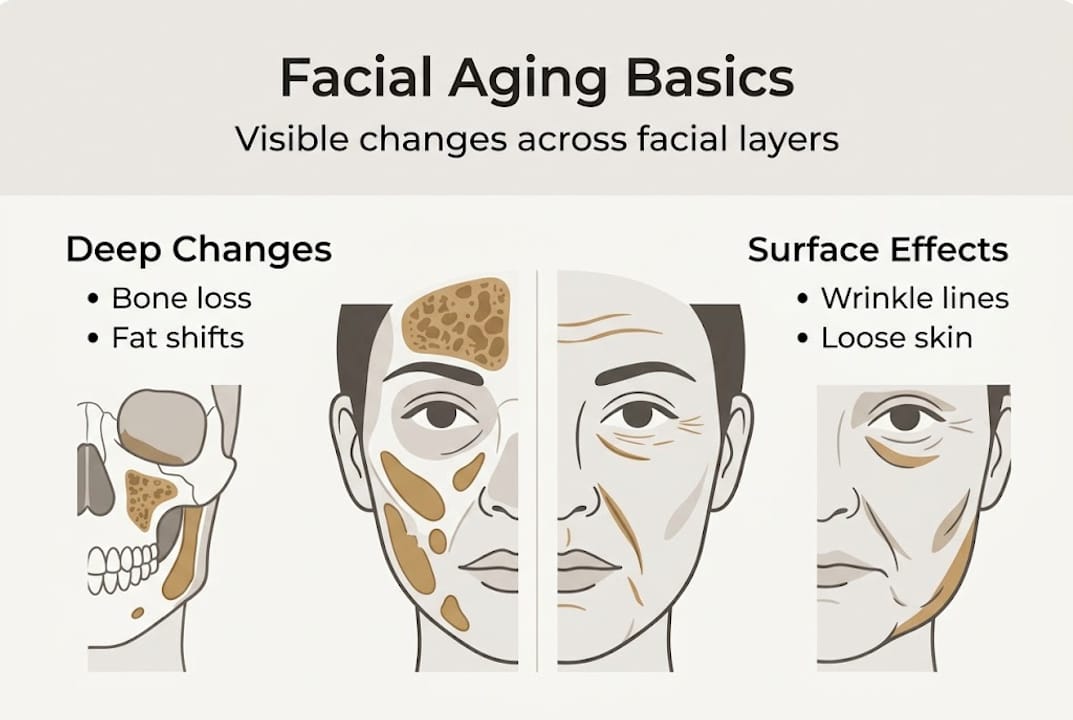
For most people in their late twenties through mid-fifties, midface changes drive the majority of visible aging. The cheeks flatten, the under-eye area hollows, and the nasolabial folds deepen, not because the skin is failing, but because the support structure beneath it has shifted.
This is why facial support for lasting results requires a multi-layered strategy. Treating only the surface while ignoring volume loss underneath produces results that look patched rather than restored. The most believable outcomes address both the deep support and the surface quality together.
The face contains over 40 individual muscles, and understanding how they interact is central to how injectables in aesthetics are planned and placed.
Key signs that midface aging is the primary driver for you:
- Cheeks appear flatter or less defined than they once did
- Shadows appear under the eyes even when well-rested
- Nasolabial folds have deepened noticeably
- The face looks tired rather than lined
Facial proportions and the myth of the golden ratio
The golden ratio has been applied to facial aesthetics for decades, suggesting that a face length to width ratio of approximately 1.6 to 1, equal vertical thirds, and eye spacing of one eye-width apart represents ideal beauty. It is a useful reference point. It is not a treatment plan.
Ideal face dimensions such as the 1.6:1 length-to-width ratio and equal vertical thirds are best understood as general guidelines, not strict rules. Applying them rigidly to real faces produces results that can look constructed rather than natural.
The more compelling research points elsewhere. Symmetry and averageness are stronger predictors of perceived attractiveness than mathematical ratios. Averageness here does not mean plain. It means that faces perceived as attractive tend to reflect a balanced, harmonious arrangement of features that feels familiar and approachable rather than extreme.
| Approach | Basis | Limitation |
|---|---|---|
| Golden ratio | Mathematical proportion | Rigid, ignores individual variation |
| Natural symmetry | Balance between sides | Does not account for dynamic movement |
| Expert assessment | Anatomy, movement, structure | Most personalized, most accurate |
What this means for your enhancement goals:
- Chasing a specific ratio can lead to overcorrection in areas that did not need treatment
- Your face’s natural asymmetry is part of what makes it recognizable and real
- Enhancement examples that honor individual structure consistently look more natural than those designed around measurements
“The most attractive faces are not the most mathematically perfect ones. They are the ones that look most like themselves.”
Personalized analysis, grounded in how your specific face moves and ages, will always produce more believable results than any formula.
Nuances and risks: Asymmetry, muscle variants, and safe enhancement
Even experienced providers encounter surprises in facial anatomy. Muscle and skin variants are more common than most people realize, and they can shift results in ways that are difficult to predict without thorough pre-treatment assessment.
One well-documented example: a bifid zygomaticus major muscle, a natural split variation, occurs in approximately 35% of people. This variant, along with thin periorbital skin and other structural differences, increases the risk of asymmetry and unpredictable outcomes if not identified before treatment. Pre-procedure scanning, including ultrasound or EMG assessment, is becoming an increasingly valued tool in careful practice.
Dynamic assessment combined with layer-specific injection technique significantly reduces the risk of unnatural results. Watching how a face moves, smiling, speaking, raising the brows, reveals relationships between structures that a still photograph simply cannot capture.
Pro Tip: Ask your provider whether they assess your face in motion before planning treatment. If the answer is no, that is worth exploring further. Static assessment alone misses important information.
How a careful provider ensures personalized, safe outcomes:
- Full facial assessment at rest and in motion before any treatment is planned
- Identification of structural variants, including muscle splits and skin thickness differences
- Layer-specific treatment planning that addresses deep support before surface refinement
- Conservative initial dosing with a planned follow-up to assess results
- Clear communication about what was treated, why, and what to expect over time
Choosing a provider who follows these steps is the most important decision you can make. Choosing injectables naturally starts with finding someone who treats the whole face, not just the concern you walked in with. And injectables in facial rejuvenation work best when they are part of a considered, layered plan.
Our perspective: What most guides get wrong about facial balance
Most articles on facial aesthetics reduce beauty to a set of measurements. They present the golden ratio as a destination and symmetry as the goal. This framing is understandable. It is also incomplete.
What gets left out is movement. Your face is not a sculpture. It is a living, expressive system, and how it moves is as important as how it rests. Research on dynamic facial assessment confirms what experienced practitioners have long observed: watching how a face moves reveals far more than any static measurement.
The most natural-looking results we see come from providers who assess the face in motion, plan treatment across multiple layers, and resist the urge to treat everything at once. Restraint is a skill. Pacing is a strategy.
Our advice: before any enhancement, ask about skin rejuvenation insights and how dynamic assessment factors into your plan. If a provider cannot explain their layered approach, keep looking.
Subtle, natural results: Start your personalized facial assessment
Understanding your facial structure is the first step toward enhancements that feel right, not just look different. At The Aesthetics Lounge and Spa Raleigh, every consultation begins with a thorough, anatomy-first assessment that considers how your face moves, where support has shifted, and what your goals actually are.
We offer a range of non-surgical options, including neuromodulators, dermal fillers, and clinical skincare, all planned with the same measured, conservative approach. Our goal is always safer, natural aesthetic results that support your structure without overwriting it. Explore our full range of aesthetic treatments in Raleigh or learn more about our facial rejuvenation process. When you are ready, we are here.
Frequently asked questions
How do I know which facial area needs enhancement?
A professional facial assessment considers muscle activity, fat distribution, and symmetry to build a personalized plan. Dynamic assessment and understanding fat and muscle layers together guide the most accurate treatment choices.
Are the golden ratio or perfect symmetry really necessary for beauty?
No. Symmetry and averageness are better predictors of perceived attractiveness than exact mathematical ratios, making personalized analysis far more valuable than chasing a formula.
Do facial muscles or bones matter more for natural-looking enhancements?
Both matter equally. Muscles and bones interact to shape the face and its expressiveness, so a complete assessment considers both the structural framework and the dynamic movement it supports.
What’s the safest approach for subtle non-surgical facial enhancements?
An individualized plan based on full facial analysis and dynamic assessment is the most reliable path. Layer-specific injection combined with dynamic assessment is the current standard for safe, natural, and subtle outcomes.