
Most people believe wrinkles are the enemy of youthful appearance. But the truth is, facial support matters far more than surface lines when it comes to natural, long-term enhancement. Modern non-surgical options prioritize restoring and maintaining the underlying structures that keep your face lifted, shaped, and recognizably you. This guide clarifies what facial support truly means, how aging affects it, and which medically guided treatments can help you maintain a rested, supported look without ever appearing overdone.
Table of Contents
- What is facial support and why does it matter?
- How does the face lose support with age?
- Non-surgical treatments: Restoring and enhancing facial support
- Comparing top non-surgical options for facial support
- Safety, longevity, and the importance of medically guided care
- Discover your natural look with advanced facial support
- Frequently asked questions
Key Takeaways
| Point | Details |
|---|---|
| Facial support basics | True facial renewal means restoring structure, not just smoothing lines. |
| Non-surgical options | Fillers, threads, and collagen boosters effectively support your face without surgery. |
| Medically guided care | Choosing the right treatment and provider means safer, longer-lasting, and more natural results. |
| Personalized approach | Your ideal plan combines anatomy, treatment type, and expert assessment. |
What is facial support and why does it matter?
Facial support is the combination of bone, fat, ligaments, and skin that maintains your face’s shape and lift. It’s not about erasing lines. It’s about preserving the architecture that keeps your features in place. When support is strong, your face looks rested and naturally contoured. When it weakens, you see flattening, hollowing, and sagging, even if your skin is smooth.
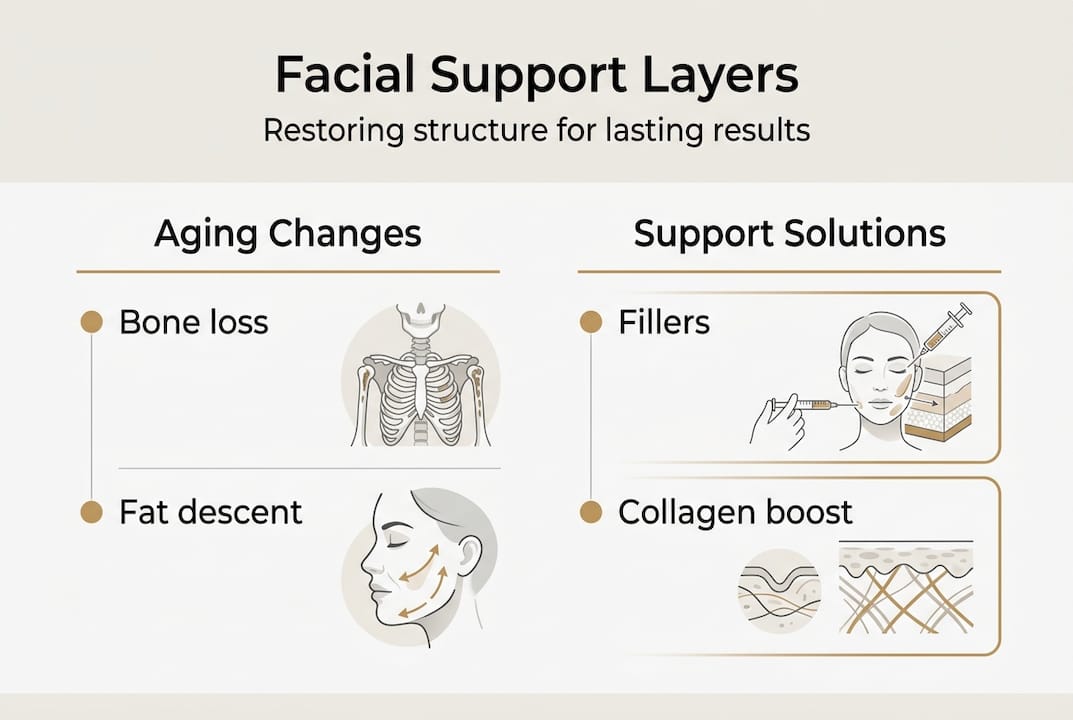
Aging doesn’t just create wrinkles. It changes the support structures beneath your skin. Bone resorbs. Fat pads shift downward. Ligaments stretch. These changes cause the visible signs we associate with aging: hollow under-eyes, flattened cheeks, a less defined jawline. Addressing these foundational shifts, rather than chasing surface fixes, is what creates believable, lasting results.
Many people focus on smoothing lines with neurotoxins or resurfacing treatments. Those have their place. But without restoring the underlying support, you risk a flat, two-dimensional appearance. True rejuvenation respects facial structure basics and works with your anatomy, not against it.
Common misconceptions about facial support:
- Thinking volume alone equals support (it doesn’t—placement and technique matter more)
- Believing all fillers do the same thing (some add volume, others stimulate collagen)
- Assuming tighter skin solves sagging (without support, tightness looks pulled, not lifted)
- Expecting instant, permanent results (real support builds gradually and requires maintenance)
“Support isn’t about looking different. It’s about looking like yourself, just more rested and quietly renewed.”
When you understand facial support, you make better decisions. You choose treatments that enhance your natural contours instead of distorting them. You work with providers who plan for longevity, not quick fixes.
How does the face lose support with age?
Aging disrupts facial support in predictable ways. Bone loss in the midface causes cheeks to flatten. Fat pads descend, creating hollows under the eyes and jowls along the jawline. Ligaments that once held everything in place stretch and weaken. Collagen production slows, reducing skin’s ability to bounce back.

These changes accelerate after age 30. Most people lose visible midface volume from their 30s onward, with the rate increasing in the 40s and 50s. The result is a face that looks tired, even when you’re well-rested.
Key signs of lost facial support:
- Flattened cheeks that once had natural fullness
- Hollow or shadowed under-eye areas
- Nasolabial folds that deepen as cheeks descend
- Jowls forming along the jawline
- Loss of definition in the chin and neck
Research shows that midface volume restoration can add significant projection and fullness when done correctly. One study found that biostimulatory fillers provided an additional 4.88 mL of volume and 1.62 mm of projection at nine months, demonstrating that strategic support can create measurable, lasting change.
Collagen loss compounds these structural shifts. After 30, your body produces less collagen each year. This affects skin elasticity, making it harder for your face to maintain its shape. Collagen’s role in aging extends beyond skin texture to the deeper support structures that keep your face lifted.
Understanding these changes helps you recognize that effective treatment must address multiple layers. Surface treatments alone won’t restore the lift and contour that come from proper support.
Non-surgical treatments: Restoring and enhancing facial support
Modern non-surgical treatments offer effective ways to restore facial support without surgery. Each approach works differently, targeting specific aspects of the support system. Choosing the right combination depends on your anatomy, goals, and how your face has changed over time.
Pro Tip: Choosing a strategy that supports, not distorts, your natural uniqueness yields better results over time. Work with providers who understand facial anatomy and prioritize restraint.
| Treatment | Mechanism | Duration | Best For |
|---|---|---|---|
| Hyaluronic Acid Fillers | Immediate volume restoration | 12-18 months | Cheeks, under-eyes, jawline definition |
| Biostimulators (PLLA, CaHA) | Gradual collagen production | 18-24 months | Overall facial volume, skin quality |
| PDO Threads | Mechanical lift and collagen stimulation | 12-18 months | Midface lift, jawline tightening |
| Ultherapy | Ultrasound-induced collagen tightening | 12-18 months | Skin laxity, brow lift, neck tightening |
Hyaluronic acid fillers provide immediate support by replacing lost volume. They work best when placed strategically to restore natural contours, not simply to fill lines. Proper technique respects your facial proportions and creates lift that looks effortless.
Biostimulators like PLLA and CaHA take a different approach. Instead of adding volume directly, they stimulate your body to produce new collagen over several months. The results are gradual, natural, and long-lasting. These treatments excel at restoring overall facial fullness and improving skin quality.
PDO threads offer mechanical lift while also triggering collagen production. They’re particularly effective for midface sagging and jawline definition. The threads dissolve over time, but the collagen they stimulate remains, providing ongoing support.
Ultherapy uses focused ultrasound to heat deep tissue layers, stimulating collagen production without breaking the skin. It’s ideal for addressing skin laxity and creating subtle lift in the brow, neck, and jawline. In North Raleigh, Ultherapy PRIME offers advanced collagen stimulation for long-term tightening.
Each treatment has its place. The key is understanding which approach, or combination of approaches, addresses your specific support needs. Examples of non-surgical facial support show how these treatments create natural, believable results when applied with precision and restraint.
Comparing top non-surgical options for facial support
Choosing the right treatment requires understanding how different options compare in practical terms. Each modality offers distinct advantages depending on your goals, timeline, and tolerance for downtime.
| Feature | HA Fillers | Biostimulators | PDO Threads | Ultherapy |
|---|---|---|---|---|
| Results Timeline | Immediate | 2-3 months | 1-2 weeks | 3-6 months |
| Downtime | Minimal (1-2 days) | Minimal (1-3 days) | Moderate (3-7 days) | Minimal (1-2 days) |
| Primary Benefit | Volume restoration | Collagen building | Mechanical lift | Skin tightening |
| Ideal Candidate | Defined volume loss | Overall facial thinning | Mild to moderate sagging | Skin laxity without volume loss |
| Maintenance | Annual touch-ups | Every 18-24 months | Annual treatments | Every 12-18 months |
Fillers restore volume and support for 12-18 months, while threads provide mechanical lift for 1-2 years. Ultherapy stimulates collagen for long-term tightening, though none of these options substitute for surgery in cases of advanced laxity.
When evaluating treatments, consider these questions:
- What specific changes bother you most—volume loss, sagging, or skin laxity?
- Do you prefer immediate results or gradual improvement?
- How much downtime can you accommodate?
- Are you addressing early signs of aging or more advanced changes?
- What’s your budget for initial treatment and ongoing maintenance?
Understanding differences between filler types helps you make informed choices. Not all fillers are created equal. Some are designed for deep structural support, others for fine lines. Placement matters as much as product selection.
The best outcomes come from combining treatments strategically. For example, biostimulators might rebuild overall volume while targeted filler restores specific contours. Threads could provide lift while Ultherapy tightens skin. Facial enhancement approaches that layer treatments thoughtfully create the most natural, comprehensive results.
Safety, longevity, and the importance of medically guided care
Who performs your treatment matters as much as which treatment you choose. Medically guided care ensures safe technique, personalized planning, and ongoing support that protects your investment and your appearance.
Benefits of medical guidance:
- Comprehensive facial analysis that identifies true support needs
- Treatment plans that prioritize structure over surface fixes
- Safe injection technique that respects vascular anatomy
- Realistic expectations about results and maintenance
- Access to medical-grade products and advanced technologies
- Ongoing monitoring to adjust treatments as your face changes
Research confirms that focusing on structure rather than just smoothing lines leads to better long-term outcomes. Studies show patient satisfaction rates of 94% at 18 months when treatments prioritize structural support for sustainable aging prevention.
Medically led practices approach facial support differently than trend-driven providers. They assess your entire face, not just the area you think needs work. They consider how treatments will age with you. They plan for longevity, not just immediate gratification.
Pro Tip: Don’t chase trends—work with providers skilled in anatomy and long-term aging prevention. The best results come from patience, precision, and a commitment to looking like yourself.
The benefits of medically led spas extend beyond safety. Medical oversight means access to advanced treatments, higher-quality products, and providers who understand the science behind aesthetic enhancement. It means working with someone who can adjust your plan as your needs evolve.
Longevity in aesthetic care isn’t about permanent results. It’s about sustainable enhancement that respects your natural aging process. Facial rejuvenation tips emphasize the importance of consistent, conservative care over dramatic interventions.
Discover your natural look with advanced facial support
You now understand that facial support is the foundation of natural, lasting enhancement. The right treatments, applied with precision and restraint, can restore the lift and contour that time has changed, all while keeping you recognizably yourself.
At The Aesthetics Lounge & Spa in North Raleigh, we specialize in medically guided aesthetic treatments that prioritize facial support over quick fixes. Our approach is calm, anatomical, and intentionally conservative. We plan first, educate always, and treat with precision so you still look like yourself, just more supported.
Every consultation begins with a comprehensive facial analysis. We assess your bone structure, soft tissue distribution, and skin quality to create a treatment strategy that respects your unique anatomy. Whether you’re exploring choosing natural treatments for the first time or refining an existing plan, we guide you toward decisions that feel clear, not pressured.
Our top non-surgical options include advanced dermal fillers, biostimulators, PDO threads, and Ultherapy PRIME, all delivered with medical expertise and thoughtful pacing. We don’t chase trends. We build treatment plans designed for longevity, supporting your face as it ages naturally.
Frequently asked questions
What is the difference between facial support and simply adding volume?
Facial support means restoring the underlying structure for lift and shape, while adding volume can fill lines but may not improve sagging or natural contours. Support addresses multiple tissue layers, creating three-dimensional enhancement rather than surface-level filling.
How long do facial support treatments like fillers and threads really last?
Most fillers last 12-18 months, while threads and collagen-stimulating options give support for 1-2 years with gradual, natural fading. Longevity depends on product choice, placement technique, and your individual metabolism.
Which treatments are safest for natural facial support in my 30s or 40s?
Medically supervised dermal fillers, PDO threads, and ultrasound-based collagen boosters offer safe, natural support when tailored to your individual anatomy. In North Raleigh, Ultherapy PRIME and PDO threads provide effective options for early to moderate aging concerns.
Is non-surgical facial support better than surgery for lifting results?
Non-surgical treatments can restore and maintain youthful contours in mild to moderate laxity, but surgery may be better for advanced sagging. The right choice depends on the degree of change, your goals, and your tolerance for downtime and recovery.