
Strong facial features tell the story of a life well lived, yet time can quietly soften those contours and leave you wishing for subtle support. In North Raleigh, many adults want understated enhancements that help them look refreshed without obvious signs of treatment. With injectables offering minimally invasive treatments proven to restore volume and promote your natural structure, this guide explains how expert care can rejuvenate your look while keeping your results natural and personalized.
Table of Contents
- Injectables Defined for Facial Rejuvenation
- Types of Injectables and Their Distinctions
- How Injectables Restore Youthful Features
- Risks, Safety, and Choosing Medical Expertise
- Comparing Injectables to Surgical Approaches
Key Takeaways
| Point | Details |
|---|---|
| Injectables Offer Minimal Invasiveness | They restore facial volume and enhance contours without the need for surgery, allowing for quick recovery and immediate return to normal activities. |
| Types and Mechanisms Matter | There are immediate volume fillers and stimulatory injectables, each suited to different patient goals, balancing quick results with long-term enhancements. |
| Expertise is Key for Safety and Results | Choosing a trained medical professional ensures natural-looking outcomes and reduces risks associated with improper placement of injectables. |
| Understanding Your Goals is Crucial | Clients should clearly convey their desired results to their providers to receive tailored treatment plans that best meet their aesthetic needs. |
Injectables Defined for Facial Rejuvenation
Injectables are minimally invasive treatments designed to restore facial volume, smooth wrinkles, and enhance contours without surgery. They work by either physically filling hollow areas or stimulating your skin to regenerate its own support structure.
As you age, your face naturally loses volume beneath the skin surface. Collagen breaks down, bone density decreases, and skin loses elasticity. This creates the hollowed cheeks, deepened folds, and sagging appearance many people notice in their 40s and 50s.
Injectables counteract this process by restoring what time has taken away.
How Injectables Work
There are two main categories, each with a different mechanism:
- Volume Fillers physically replace lost tissue and restore facial contours
- Stimulators trigger your body to produce new collagen and structural support
Both approaches address the same problem—volume loss—but take different paths to get there.
Common Injectable Types
Injectable fillers use materials like hyaluronic acid, collagen-stimulating compounds, and other biocompatible substances. Here’s what sets them apart:
- Hyaluronic Acid Fillers — hold moisture, feel natural, reversible if needed
- Collagen Stimulators — encourage your body’s own rebuilding over time
- Synthetic Options — designed for longer-lasting structural support
Each has different longevity, feel, and integration with your tissue.
Why Injectables Appeal to North Raleigh Adults
You’re looking for results that read as rested, not overdone. Injectables offer quick recovery—no downtime like surgery requires. You can return to normal activities immediately.
They’re also reversible and adjustable. If something doesn’t feel right, your provider can modify or dissolve certain fillers. This flexibility matters when you’re seeking subtle enhancement, not dramatic transformation.
The best injectables are those you don’t notice—results that make people say you look well-rested, not that you’ve had work done.
The Medical Approach Matters
Not all injectables produce natural results. Placement, amount, and product choice determine whether you look refreshed or filled. This is why understanding how to choose injectables naturally requires working with someone trained in facial anatomy, not just technique.
At The Aesthetics Lounge, the focus is on conservative, anatomical placement. You plan before treating, educate always, and proceed with precision so you maintain your identity while looking supported.
Pro tip: When consulting about injectables, ask your provider to explain exactly where they’ll place product and why—this shows they’re thinking about your unique face, not applying a template.
Types of Injectables and Their Distinctions
Not all injectables work the same way. Some restore volume immediately, while others work quietly behind the scenes to rebuild your skin’s structural support. Understanding the difference helps you know what to expect from treatment.
Injectable fillers vary in their composition, longevity, and mechanism—either immediate volume replacement or gradual collagen stimulation. This variation is intentional. Your provider selects based on your specific goals and facial anatomy.
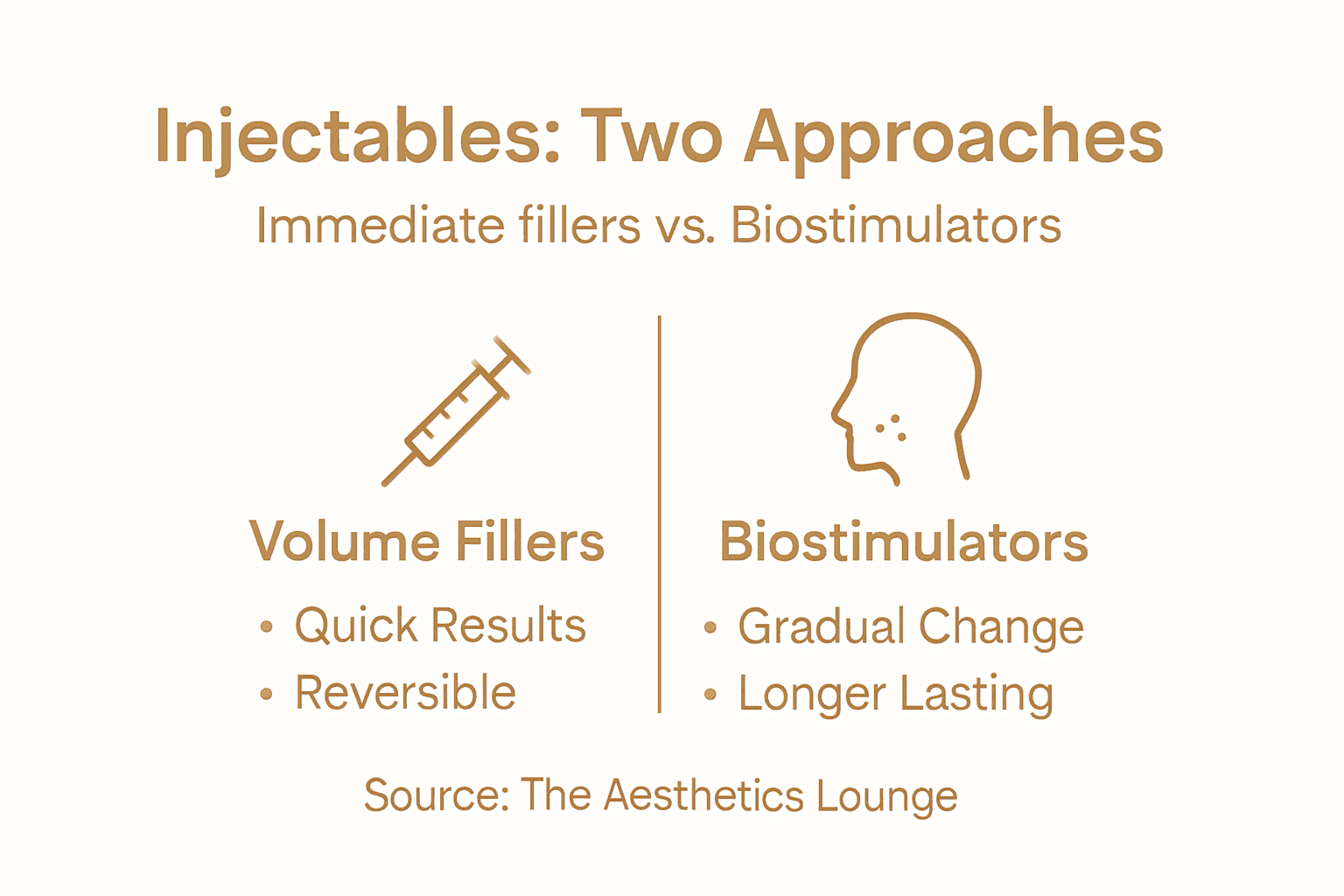
Immediate Volume Fillers
These restore lost volume right away. You see results within days, and the effect is noticeable but natural when placed correctly.
Hyaluronic Acid (HA) is the most common choice in this category:
- Holds moisture like a sponge beneath skin
- Feels soft and natural
- Fully reversible if you change your mind
- Lasts 6-12 months depending on placement
- Works well for lips, cheeks, and under-eye hollowing
HA is popular among North Raleigh clients seeking subtle enhancement because it doesn’t feel foreign in the face. Your own body eventually metabolizes it, so there’s no permanent commitment.
To better understand how injectables differ, see this side-by-side comparison:
| Feature | Immediate Volume Fillers | Biostimulatory Injectables |
|---|---|---|
| Onset of Results | Within 1-7 days | Develops over weeks to months |
| Typical Longevity | 6-12 months | 12-24 months or more |
| Reversibility | Often reversible | Not easily reversible |
| Primary Benefit | Rapid volume replacement | Gradual collagen stimulation |
| Ideal Use | Events or quick refresh | Subtle, long-term restoration |
Biostimulatory Injectables
These take a different approach. Rather than filling space, they encourage your body to regenerate its own collagen and elastin over weeks and months.
Common biostimulators include:
- Poly-L-Lactic Acid (PLLA) — stimulates gradual collagen production over months
- Polycaprolactone (PCL) — triggers long-lasting structural rebuilding
- Calcium Hydroxylapatite (CaHA) — hybrid approach: immediate support plus collagen stimulation
These work slower than HA but produce sustained results that can last 12-24 months or longer.
Biostimulators shine when your goal is looking progressively more rested over time, not transformed overnight.
Why This Distinction Matters
Your choice depends on your timeline and goals. If you want immediate softness before an event, HA fillers deliver. If you prefer gradual improvement that builds naturally over time, biostimulators align better with a conservative approach.
At The Aesthetics Lounge, treatment planning considers your unique needs—not just what’s trending. Your provider discusses longevity expectations, feel, reversibility, and whether you want instant results or patient enhancement.
Mixing both types is also an option. Some clients use HA for immediate contouring combined with biostimulators for long-term structural support. This layered approach creates depth and natural-looking fullness.
Pro tip: Ask your provider which injectable type they recommend and why—their answer reveals whether they’re thinking about your face individually or applying a standard protocol.
How Injectables Restore Youthful Features
Your face ages in layers. Bone density decreases, fat compartments shrink, skin thins, and collagen breaks down. Injectables address these changes by replacing what’s been lost and stimulating your body to rebuild on its own.
The result isn’t a filled appearance—it’s restoration of the natural proportions and support your face had before these changes accumulated.

The Volume Loss Problem
You probably notice hollowed cheeks before you notice wrinkles. This happens because volume loss occurs beneath the skin surface through fat pad descent, dermal thinning, and bone resorption. Without that underlying support, skin sags, folds deepen, and age becomes visible.
Injectables solve this from the inside out, not by stretching skin tighter but by restoring the structural foundation underneath.
Two Restoration Pathways
Injectables work through two distinct mechanisms:
- Immediate Volume Replacement — hyaluronic acid and similar fillers physically restore lost tissue right away
- Biostimulation — poly-L-lactic acid and calcium hydroxylapatite trigger your fibroblasts to produce new collagen and elastin over time
Both strategies restore youthful proportions. The difference is timing: one works now, the other builds strength over months.
Where Restoration Happens
Injectables work in specific zones where aging manifests:
- Cheekbones — restore lift and fullness that descends with age
- Jawline — rebuild definition lost to soft tissue sagging
- Temples — fill hollowing that creates a tired appearance
- Under Eyes — address the shadowed look from volume loss
- Lips — restore shape and subtle fullness that naturally thins
- Smile Lines — soften creases by supporting tissue beneath wrinkles
Strategic placement in these zones creates the appearance of youthfulness without looking enhanced.
When injectables restore facial structure rather than add volume, results read as rested—like you’ve had good sleep and proper nutrition, not like you’ve had work done.
Natural Rejuvenation vs. Overfilling
The difference between natural results and overdone outcomes comes down to provider judgment. Restoring your face means understanding your original facial proportions and working within them, not changing them.
This is why examples of aesthetic treatments designed for natural results emphasize conservative placement and thoughtful timing. Your provider should explain exactly what they’re restoring and why—not how much they can add.
At The Aesthetics Lounge, restoration means supporting what you have, not replacing it with something new.
Pro tip: When meeting with your provider, ask them to point out which specific facial structures have lost volume—a good clinician can articulate exactly what they’re restoring and why, revealing whether they’re thinking about your face’s geometry or just filling hollows.
Risks, Safety, and Choosing Medical Expertise
Injectables are safe when administered by trained medical professionals who understand facial anatomy, injection technique, and patient assessment. But like any procedure, they carry real risks—especially when placed in untrained hands.
Understanding these risks and knowing what separates safe practice from dangerous shortcuts helps you make an informed decision about where to seek treatment.
Real Risks Worth Understanding
Adverse events from injectables range from mild to severe. Common minor complications include bruising, swelling, and temporary discomfort that resolve within days.
More serious but rare complications include:
- Granulomas — inflammatory nodules that form months after injection
- Vascular occlusion — when filler blocks blood flow, risking tissue death
- Vision loss or blindness — extremely rare but possible from arterial injection near the eye
- Infection — from non-sterile technique or contaminated products
The good news: these serious events are preventable through proper technique, anatomical knowledge, and patient selection.
Why Provider Expertise Matters
Complication rates drop dramatically with experienced, medically trained injectors. Someone who understands facial blood vessel anatomy won’t inject where vessels run. Someone trained in precise placement won’t use excessive volume.
Expertise includes:
- Deep knowledge of facial anatomy and vascular patterns
- Ability to assess which patients are good candidates
- Skill in proper injection depth, angle, and technique
- Recognition of early signs of complications
- Sterile protocol and proper product handling
These aren’t optional skills—they’re the difference between natural results and preventable harm.
The cheapest injectable experience often carries the highest risk. Price should never be your primary decision factor when choosing where to place injectables in your face.
Choosing a Medical Provider
Medical expertise in aesthetics means working with licensed medical professionals—physicians, nurse practitioners, or physician assistants under medical supervision—not cosmetologists or untrained aestheticians.
A reputable provider will:
- Conduct thorough consultation and medical history review
- Discuss realistic expectations and risks transparently
- Use only FDA-approved products with traceable sources
- Maintain sterile injection protocols
- Have clear plans for managing complications
- Provide realistic before-and-after examples
- Never pressure you into treatment
At The Aesthetics Lounge, the focus is on informed consent and conservative planning. You discuss risks openly, understand exactly what’s being done and why, and feel confident in your provider’s credentials and approach.
Red Flags to Avoid
Be cautious of providers who:
- Guarantee results or promise you’ll look a certain way
- Rush consultation or skip medical history questions
- Use non-FDA-approved products or refuse to name what they’re injecting
- Lack verifiable credentials or won’t discuss their training
- Pressure you into larger treatments or multiple areas
- Price injectables significantly below market rate
These shortcuts aren’t worth the risk to your face and vision.
Pro tip: Before your first appointment, ask your provider directly: “What is your training in facial anatomy, and what is your protocol if a complication occurs?” A confident, knowledgeable provider can answer clearly without defensiveness.
Comparing Injectables to Surgical Approaches
Injectables and surgery aren’t competitors—they’re different solutions for different needs. Understanding where each excels helps you choose what actually matches your goals and lifestyle.
Most people in their 40s and 50s start with injectables. A minority eventually explore surgery. Knowing the distinction prevents disappointment and wasted money.
Why Injectables Appeal First
Minimally invasive facial rejuvenation with injectables offers immediate appeal: no surgery, no general anesthesia, no recovery time, no scars. You walk in, get treated, and return to normal activities the same day.
Injectables are also reversible and adjustable. If results aren’t what you hoped, your provider can modify or dissolve fillers. This flexibility matters when you’re testing what works for your face.
Here’s a summary of how injectables compare to surgical alternatives:
| Consideration | Injectables | Surgical Procedures |
|---|---|---|
| Recovery Time | Usually none | 1-3 weeks typical |
| Customization | Highly adjustable | Fixed after surgery |
| Addressed Issues | Volume loss, mild sagging | Significant laxity, structural descent |
| Duration of Effect | 6-24 months | 7-10 years or longer |
| Scarring | None | Small, hidden scars |
| Flexibility | Easily modified | Permanent until revised |
What Injectables Can and Cannot Do
Injectables excel at:
- Restoring lost volume in cheeks, temples, and under eyes
- Softening wrinkles and creases through support
- Defining lips and jawline
- Creating subtle fullness and lift
- Maintaining natural facial movement and expression
Injectables cannot:
- Address significant skin laxity or sagging
- Tighten loose neck skin
- Remove excess skin
- Provide the dramatic lift of a surgical facelift
- Reshape bone structure
If your primary concern is loose, drooping skin rather than volume loss, injectables alone won’t deliver what you need.
When Surgery Becomes Necessary
Surgery remains the gold standard for significant structural changes. Facelifts, necklift procedures, and brow lifts address skin and tissue that have genuinely lost elasticity and descended.
Surgery is indicated when:
- Skin sags significantly despite volume restoration
- Jowls form along the jawline
- Neck skin becomes loose and crepey
- You want permanent, long-lasting results
- Injectables alone haven’t addressed your concerns
Surgical results last 7-10 years or longer. Injectables typically last 6-18 months depending on type.
The best approach isn’t always the most dramatic one—it’s the one that solves your actual problem without overtreatment.
A Realistic Timeline
Many people follow this progression: start with injectables in their 40s, maintain with regular treatments, then explore surgery in their 50s or 60s if they want more dramatic results.
This staged approach lets you understand your face, test what works, and make surgery decisions from experience rather than assumption. It also allows you to enjoy injectable results for years before considering a more invasive commitment.
At The Aesthetics Lounge, the philosophy is conservative planning regardless of approach. Whether you’re starting injectables or exploring surgery eventually, the focus remains on supporting your face’s structure, respecting your identity, and avoiding overdone outcomes.
Your provider should discuss both options openly during consultation. If someone pushes surgery when injectables would serve you better—or vice versa—that’s a red flag about their priorities versus yours.
Pro tip: If considering surgery someday, start with injectables now. Learning how volume changes your face prepares you for surgical planning and helps surgeons understand your aesthetic goals more clearly.
Discover Natural Facial Rejuvenation with Expert Injectables in North Raleigh
Aging brings volume loss beneath the skin and subtle changes that can make you look tired or worn down. If you want to restore that youthful, well-rested appearance without looking overdone or unnatural, injectables offer a precisely tailored solution. At The Aesthetics Lounge and Spa Raleigh, we understand how crucial it is to approach facial rejuvenation with a calm, anatomical, and intentionally conservative plan that respects your unique facial structure and natural movement.

Explore our Skin Care Archives to learn more about treatments designed for lasting skin health and harmony. Begin your journey now by visiting our main website. Our medically led team listens carefully to your goals and crafts injectable strategies that focus on restoring volume, enhancing contours, and supporting your natural beauty with smart, reversible options. Contact us today to schedule a consultation and take the first step toward looking like yourself, only more refreshed and supported.
Frequently Asked Questions
What are injectables in facial rejuvenation?
Injectables are minimally invasive treatments that restore facial volume, smooth wrinkles, and enhance contours without the need for surgery. They can physically fill hollow areas or stimulate your skin to regenerate its own support structure.
How do different types of injectables work?
Injectables can be divided into two main categories: volume fillers, which provide immediate restoration of lost tissue, and stimulators, which trigger your body to produce new collagen and elastin over time.
What is the difference between hyaluronic acid fillers and biostimulatory injectables?
Hyaluronic acid fillers provide immediate volume and are reversible, lasting 6-12 months. Biostimulatory injectables, like poly-L-lactic acid, encourage gradual collagen production, with results developing over weeks to months and lasting 12-24 months or longer.
Are injectables safe, and what risks are associated with them?
Injectables are generally safe when administered by trained medical professionals. However, potential risks include bruising, swelling, granulomas, vascular occlusion, vision loss, and infection. It’s important to choose a knowledgeable provider to minimize these risks.