
Choosing non-surgical facial enhancements can feel overwhelming when you want changes that look subtle and natural, not artificial or overdone. Understanding how the skin, muscles, fat, and bones interact sets the foundation for medical treatments that preserve your unique look while supporting long-term skin health. By focusing on the interconnected layers of facial anatomy, you can work with a provider who respects your individuality and helps you age confidently in North Raleigh.
Table of Contents
- Defining Facial Anatomy In Aesthetic Care
- Key Facial Structures And Their Roles
- Facial Movement, Expression, And Symmetry
- Anatomy’s Impact On Aging And Enhancements
- Risks Of Ignoring Anatomy In Treatments
- Building Individualized, Natural-Looking Outcomes
Key Takeaways
| Point | Details |
|---|---|
| Understanding Facial Anatomy is Crucial | Aesthetic professionals must thoroughly understand the complex layers of facial anatomy to create natural-looking enhancements. |
| Precision in Treatments Matters | Even minor adjustments can dramatically alter aesthetic outcomes; approaches must respect the delicate balance of facial features. |
| Holistic Assessment is Essential | Comprehensive evaluation of individual facial structures leads to personalized treatment plans that maintain a patient’s unique identity. |
| Continuous Learning Reduces Risks | Staying updated on anatomical knowledge and techniques minimizes complications and optimizes patient safety in aesthetic procedures. |
Defining Facial Anatomy in Aesthetic Care
Facial anatomy represents the intricate structural framework that defines human aesthetic perception and medical intervention. Complex facial structure analysis reveals multiple interconnected layers that practitioners must understand to achieve natural-looking enhancements.
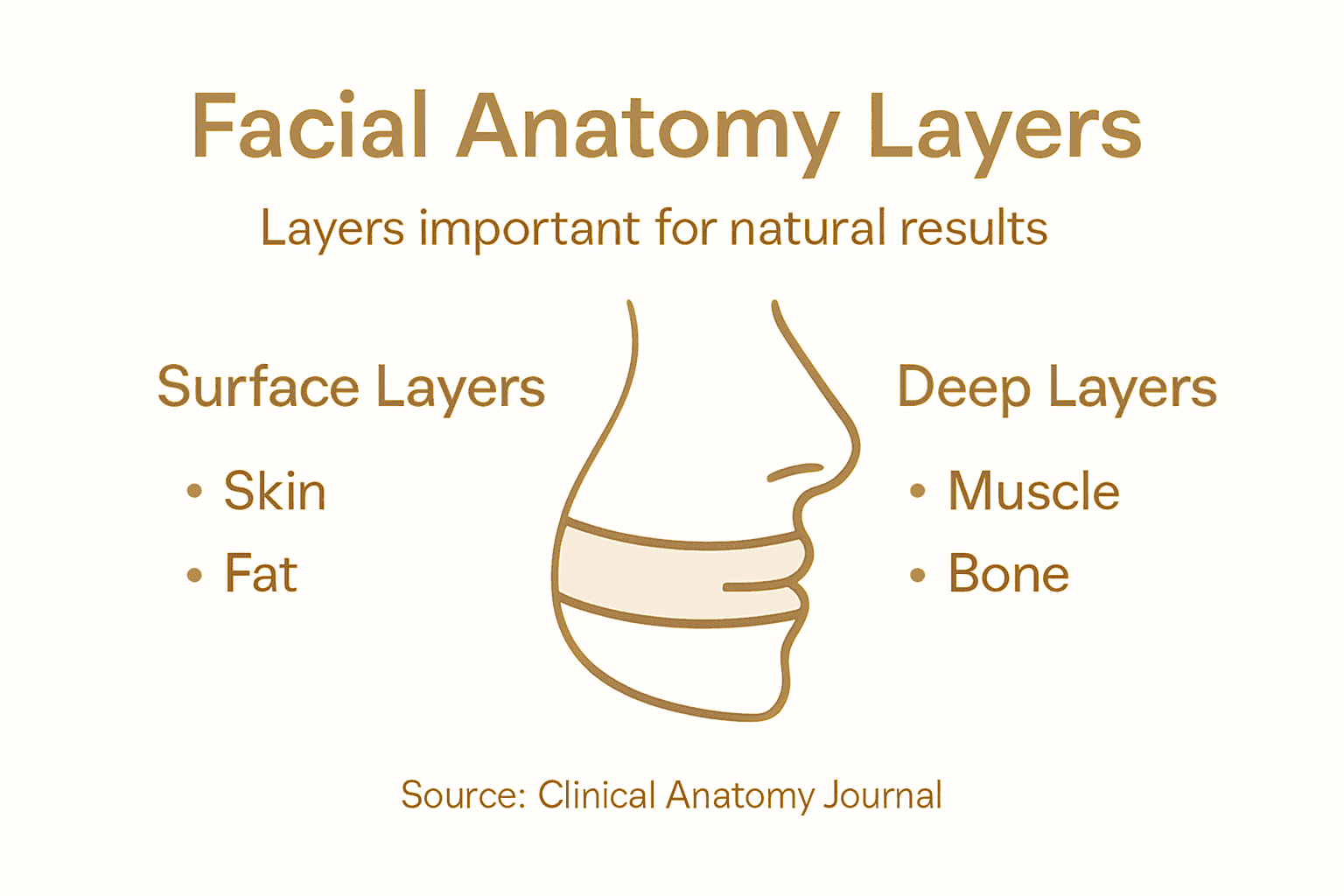
The human face comprises several critical anatomical components that work together to create individual expression and movement:
- Skin Layer: The outermost protective barrier with unique thickness and elasticity
- Muscle Layer: Responsible for facial expressions and dynamic movement
- Fat Compartments: Provide volume, contour, and age-related changes
- Bone Structure: Fundamental framework providing foundational support
Understanding these layers allows aesthetic professionals to map precise intervention strategies that respect natural facial architecture. By recognizing how each anatomical component interacts, practitioners can design treatments that enhance rather than dramatically alter an individual’s inherent characteristics.
Medical providers approach facial anatomy with surgical precision, understanding that even millimeter-level adjustments can dramatically impact aesthetic outcomes. The goal is never transformation but subtle, believable refinement that maintains the patient’s unique identity.
Pro tip: Always evaluate facial anatomy holistically, considering how individual structural elements work together to create harmonious, natural-looking results.
Key Facial Structures and Their Roles
Aesthetic professionals must thoroughly understand the intricate layers of facial anatomy to develop precise, natural-looking interventions. Anatomical layers critical to aesthetic procedures provide a comprehensive roadmap for safe and effective treatments.
The key facial structures can be categorized into several fundamental components:
- Skin Layer: The external barrier with unique characteristics
- Thickness varies across facial regions
- Determines texture and elasticity
- Primary indicator of aging and health
- Muscle Layer: Responsible for dynamic facial expressions
- Mimetic muscles control movement
- Influences facial animation and emotional communication
- Fat Compartments: Essential for volume and contour
- Distribute facial fullness
- Change with age and metabolic factors
- Bony Framework: Provides structural support
- Defines fundamental facial shape
- Influences overall facial proportions
Each anatomical structure plays a unique role in facial aesthetics. The interaction between these layers determines how an individual’s face moves, ages, and responds to medical interventions. Understanding these interconnected components allows practitioners to design treatments that enhance natural features without dramatic alterations.
Precision in understanding facial anatomy is not just technical knowledge—it’s the art of preserving individual beauty.
Medical providers approach facial structure analysis with surgical precision, recognizing that even minute adjustments can significantly impact aesthetic outcomes. The sophisticated interplay between skin, muscles, fat, and bone requires a nuanced, holistic approach that respects each patient’s unique anatomical landscape.
Pro tip: Develop a comprehensive visual mapping of individual facial structures before any aesthetic intervention to ensure targeted, safe, and naturally harmonious results.
Facial Movement, Expression, and Symmetry
Facial expressions represent a complex symphony of muscular interactions that communicate our most intimate emotional experiences. Dynamic facial muscle interactions reveal the intricate mechanisms underlying human emotional communication and aesthetic perception.
The primary components of facial expression involve several key muscle groups:
- Mimetic Muscles: Responsible for emotional communication
- Control subtle and dramatic facial movements
- Located across different facial regions
- Determine emotional authenticity
- Symmetry Indicators: Balance and proportion markers
- Reflect neurological and muscular health
- Influence perceived attractiveness
- Critical for natural aesthetic outcomes
Professional aesthetic interventions must respect the delicate balance of these muscular systems. Even minor adjustments can dramatically alter facial dynamics, potentially compromising natural expression and emotional communication.
Precision in facial treatments means preserving the subtle language of human emotion.
The interconnected nature of facial muscles means that treatments must be approached with surgical precision and deep understanding. Practitioners who recognize the nuanced relationships between muscle groups can create interventions that enhance rather than restrict natural facial movement.
Pro tip: Map individual facial muscle patterns before any aesthetic intervention to ensure treatments maintain natural expression and emotional authenticity.
Anatomy’s Impact on Aging and Enhancements
Facial aging is a complex biological process that transforms every anatomical layer, creating unique challenges for aesthetic interventions. Comprehensive facial aging mechanisms reveal the intricate transformations occurring beneath our skin’s surface.
The primary anatomical changes associated with aging include:
- Bone Resorption: Structural foundation modifications
- Decreased bone density
- Reduced facial volume
- Altered facial contour and proportions
- Muscle Atrophy: Diminishing muscular support
- Reduced muscle mass
- Decreased muscle tone
- Changes in facial expression dynamics
- Fat Redistribution: Volume and support transformation
- Shifting fat compartments
- Loss of youthful facial fullness
- Uneven fat distribution
- Skin Modifications: Textural and elasticity changes
- Reduced collagen production
- Decreased skin elasticity
- Increased visible signs of aging
Aesthetic professionals must approach these changes with nuanced understanding, recognizing that each anatomical layer contributes to the overall aging process. Strategic interventions can subtly address these transformations while maintaining natural facial characteristics.
The following table summarizes how key facial anatomical layers respond to aging and aesthetic interventions:
| Layer | Aging Effects | Intervention Focus |
|---|---|---|
| Skin | Reduced elasticity, wrinkles | Restore texture, boost collagen |
| Muscle | Atrophy, weaker tone | Enhance movement, support tone |
| Fat Compartments | Volume loss, redistribution | Restore contours, balance fullness |
| Bone Structure | Resorption, loss of support | Reinforce framework, improve proportions |
Successful aesthetic treatments do not fight aging—they collaborate with the body’s natural progression.
Precision in treatment requires a holistic view of facial anatomy, understanding how each layer interacts and changes over time. The goal is not to reverse aging but to support the body’s natural evolution with refined, thoughtful interventions.
Pro tip: Map individual anatomical changes through comprehensive baseline assessments to develop personalized, age-responsive treatment strategies.
Risks of Ignoring Anatomy in Treatments
Aesthetic interventions demand extraordinary precision, with potential consequences far beyond cosmetic outcomes. Critical anatomical knowledge prevents complications that could compromise patient safety and long-term results.
The most significant risks of inadequate anatomical understanding include:
- Vascular Complications
- Potential for accidental blood vessel injection
- Risk of tissue necrosis
- Potential for permanent blood flow disruption
- Nerve Damage
- Potential facial muscle paralysis
- Sensory nerve disruption
- Long-term muscular dysfunction
- Structural Misalignment
- Unintended facial asymmetry
- Compromised natural facial movement
- Reduced treatment predictability
- Infection Risks
- Improper injection technique
- Higher chance of complications
- Increased recovery time
Aesthetic practitioners must recognize that facial anatomy is not a static blueprint but a complex, dynamic system. Each intervention requires meticulous understanding of individual variations, potential risk zones, and precise technique.
Here’s a quick reference guide to common risk areas that require heightened anatomical awareness during facial aesthetic treatments:
| Risk Area | Potential Complication | Prevention Strategy |
|---|---|---|
| Vascular Zones | Vessel injury, necrosis | Precise mapping, slow injection |
| Nerve Pathways | Paralysis, loss of sensation | Avoid high-risk areas, gentle technique |
| Structural Regions | Facial asymmetry, misalignment | Customized assessment, post-treatment review |
| Infectious Sites | Prolonged healing, infection | Sterile protocols, proper aftercare |
Ignorance in anatomy transforms aesthetic treatments from precision interventions into potential medical hazards.
Comprehensive anatomical knowledge transcends technical skill—it represents a fundamental commitment to patient safety and optimal outcomes. Professional aesthetic providers must continuously update their understanding of facial structures and emerging treatment methodologies.
Pro tip: Invest in continuous anatomical training and utilize 3D imaging technologies to develop a comprehensive understanding of individual facial variations.
Building Individualized, Natural-Looking Outcomes
Achieving personalized aesthetic results requires a sophisticated approach that respects each individual’s unique facial architecture. Comprehensive assessment of anatomical variations enables practitioners to design treatments that enhance natural beauty without compromising individual character.
Key strategies for creating individualized outcomes include:
- Detailed Facial Assessment
- Comprehensive facial structure mapping
- Evaluation of asymmetries and unique characteristics
- Analysis of dynamic facial movement patterns
- Personalized Treatment Planning
- Customized intervention strategies
- Respect for individual facial dynamics
- Targeted approach to specific aesthetic concerns
- Preserving Individual Identity
- Subtle, refined enhancements
- Maintaining natural facial expressions
- Avoiding overdone or generic results
- Adaptive Treatment Techniques
- Micro-adjustments based on individual anatomy
- Responsive approach to facial structure
- Minimally invasive interventions
Successful aesthetic treatments are less about dramatic transformation and more about refined, thoughtful enhancement. Each intervention must be approached as a unique artistic endeavor, carefully calibrated to the individual’s inherent facial characteristics.
True aesthetic mastery lies in enhancement that whispers, not shouts.
Professional providers recognize that natural-looking outcomes demand more than technical skill—they require a deep understanding of facial anatomy, individual variation, and the subtle art of aesthetic refinement.
Pro tip: Develop a comprehensive consultation process that captures not just physical measurements, but the patient’s unique aesthetic vision and emotional expectations.
Embrace Your Unique Facial Anatomy with Expert Care
Understanding the complexity of facial anatomy and its impact on natural-looking results is key to achieving refined aesthetic enhancements. If you are seeking treatments that respect your individual bone structure, muscle movement, and skin health without compromising your identity, The Aesthetics Lounge and Spa in North Raleigh provides precisely that expertise. Our medically led approach prioritizes careful assessment and precision so you can enjoy subtle yet impactful improvements that last.
Discover how our calm, anatomical, and intentionally conservative treatment plans are designed to support your natural beauty. Explore our Skin Care Archives – The Aesthetics Lounge and Spa Raleigh | Medical Spa in Raleigh, NC to learn more about maintaining healthy skin that complements your facial enhancements. Ready to begin your journey toward balanced, natural results that honor your unique facial anatomy? Visit The Aesthetics Lounge and Spa today and schedule a consultation to experience personalized aesthetic care developed with your distinct facial structure in mind.
Frequently Asked Questions
What are the key components of facial anatomy relevant to aesthetics?
The key components include the skin layer, muscle layer, fat compartments, and bone structure, each playing a critical role in facial aesthetics and movement.
How does understanding facial anatomy impact aesthetic treatments?
Understanding facial anatomy allows practitioners to perform precise interventions that enhance natural features, ensuring safe and effective results while avoiding complications.
What changes occur in facial anatomy with aging?
Facial aging involves bone resorption, muscle atrophy, fat redistribution, and skin modifications, all contributing to altering facial contours and dynamics.
Why is anatomical knowledge crucial for avoiding risks in aesthetic procedures?
Anatomical knowledge helps practitioners avoid risks such as vascular complications, nerve damage, and structural misalignment, ensuring patient safety and optimal treatment outcomes.