
You want to look refreshed, not redone. That’s the most common thing we hear from clients considering injectables for the first time. The fear of looking overdone, puffy, or frozen is real, and it’s exactly why preparation matters as much as the treatment itself. What most people don’t realize is that how you prepare in the days before your appointment directly shapes your results, your recovery, and how long those results actually last. This guide walks you through everything you need to know so you can walk into your appointment with clarity and confidence.
Table of Contents
- Understanding injectables and why preparation matters
- What you need before your injectable appointment
- Step-by-step: Preparing for your injectables appointment
- Choosing the right provider: Why expertise and assessment matter
- Safety, side effects, and special situations
- Get expert guidance and achieve natural results in Raleigh, NC
- Frequently asked questions
Key Takeaways
| Point | Details |
|---|---|
| Start preparation early | Begin avoiding certain medications and adjusting habits at least a week before your appointment. |
| Choose qualified providers | Selecting a board-certified, experienced injector ensures safer, more natural results. |
| Follow step-by-step guidance | A daily plan before your session reduces bruising, swelling, and complications. |
| Know safety basics | Understand common side effects and when to contact your provider for best outcomes. |
| Natural results are possible | With the right preparation and expertise, injectables can refresh your look without looking overdone. |
Understanding injectables and why preparation matters
Injectables fall into two main categories: neurotoxins and dermal fillers. Neurotoxins like Botox, Dysport, and Xeomin work by temporarily relaxing the muscles responsible for expression lines. Dermal fillers, including hyaluronic acid (HA) fillers and calcium hydroxylapatite (CaHA), restore volume, define contours, and smooth deeper folds. Both categories are precise tools, and their outcomes depend heavily on how they’re used and how your body is prepared to receive them.
The role of injectables in modern aesthetics has grown significantly. Nearly 10 million Botox injections were performed in the U.S. in 2024 alone, with clinics reporting low complication rates when proper training and protocols are followed. That’s a reassuring number, but it also means the quality of your experience depends on the details.
Here’s what you need to know about how long results typically last:
- Botox and neurotoxins: Effects last 3 to 4 months on average
- HA fillers (lips, under eyes): Typically 6 to 12 months
- HA fillers (cheeks, jawline): Can last 12 to 24 months
- CaHA fillers: Generally 12 to 18 months
Proper preparation doesn’t just reduce your risk of bruising. It supports more even product distribution, reduces inflammation that can distort early results, and helps extend the longevity of what your injector places. Think of it like priming a wall before painting. The surface condition determines how well the finish holds.
“Conservative dosing and a staged approach are the foundation of natural-looking injectable results. The goal is always to enhance what’s already there, not replace it.”
Pro Tip: If you’re new to injectables for facial rejuvenation, start with a single area and assess results before adding more. Less is genuinely more when you’re building a long-term aesthetic plan.
What you need before your injectable appointment
Preparation starts well before you walk through the door. The most overlooked part of the process is what you put into your body and what you stop taking in the days leading up to treatment.
Certain substances increase bleeding and bruising risk by thinning the blood or dilating vessels. Avoiding blood thinners, NSAIDs, aspirin, alcohol, and caffeine for 3 to 7 days before your appointment significantly reduces swelling and bruising. This is one of the most impactful things you can do on your own before arriving.
“Minimizing bruising isn’t just cosmetic. Less trauma to the tissue means better product placement and a cleaner healing process.”
Here’s a quick reference table for what to bring and what to disclose:
| Category | What to do |
|---|---|
| Identification | Bring a valid photo ID |
| Medical history | List current medications and supplements |
| Allergy records | Note any known reactions to lidocaine or fillers |
| Health disclosures | Inform provider of pregnancy, neuromuscular conditions, or thin skin |
| Transportation | Arrange a ride if you’re anxious about post-treatment driving |
Beyond logistics, there are health conditions that require full disclosure before any injectable treatment:
- Pregnancy or breastfeeding: Most providers will not treat during this period
- Neuromuscular disorders (like myasthenia gravis or ALS): Neurotoxins can worsen symptoms
- Active skin infections or cold sores: Treatment should be postponed
- Blood clotting disorders or anticoagulant therapy: Requires medical clearance
When you choose injectables naturally, the process should feel collaborative, not rushed. A good provider will ask about all of this before touching a needle.

Pro Tip: Start your preparation a full week in advance. It gives you enough time to stop supplements, adjust your schedule, and arrive calm rather than scrambling the morning of your injectable treatments appointment.
Step-by-step: Preparing for your injectables appointment
Here’s a practical day-by-day plan that takes the guesswork out of preparation. Each step has a reason behind it, and following the full sequence makes a measurable difference in your outcome.
Preparation enhances longevity by reducing complications like product migration or vascular occlusion. The steps below are designed around that goal.
- 7 days out: Stop fish oil, vitamin E, flaxseed, and herbal supplements like ginkgo and garlic. These all thin the blood.
- 5 days out: Discontinue aspirin and NSAIDs (ibuprofen, naproxen) unless prescribed for a medical condition. Consult your doctor before stopping any prescribed medication.
- 3 days out: Avoid alcohol completely. Even moderate drinking increases bruising risk significantly.
- 2 days out: Skip intense exercise and saunas. Elevated heart rate and heat increase blood flow to the face.
- 1 day out: Avoid facials, waxing, laser treatments, and dental work. These create inflammation that can interfere with injectable placement.
- Morning of: Skip caffeine, arrive with a clean face (no heavy makeup), eat a light meal, and stay hydrated.
Here’s a side-by-side comparison to keep it simple:
| Timeline | What to do | What to avoid |
|---|---|---|
| 7 days before | Stop supplements | Fish oil, vitamin E, herbal thinners |
| 5 days before | Review prescriptions with doctor | Aspirin, ibuprofen, naproxen |
| 3 days before | Hydrate well | Alcohol |
| 2 days before | Rest and reduce stress | Intense cardio, saunas, hot yoga |
| 1 day before | Confirm appointment details | Facials, waxing, dental procedures |
| Day of | Eat, hydrate, arrive clean | Caffeine, heavy makeup, rushing |
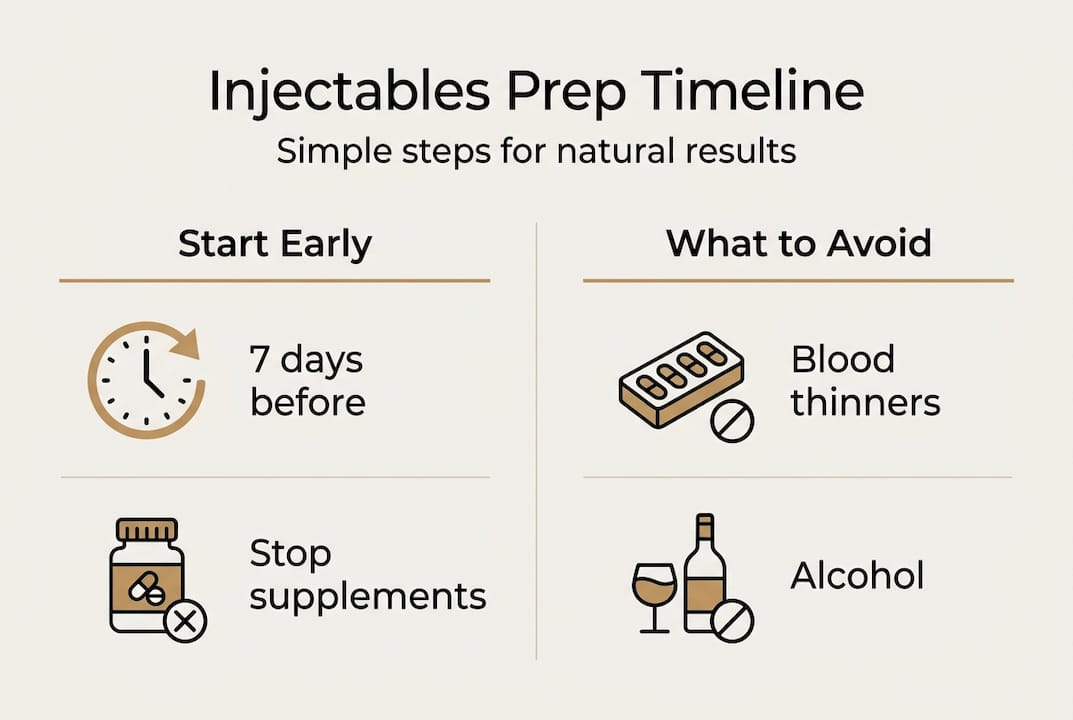
For planning your aesthetic consultation, this kind of structured approach makes the conversation with your injector far more productive.
Pro Tip: Write down your top three concerns and questions before your appointment. Your injector can only address what you share. A prepared client gets a more tailored treatment plan every time.
Choosing the right provider: Why expertise and assessment matter
Your preparation only goes so far if the person holding the syringe isn’t qualified to use it well. Provider selection is arguably the most important decision in this entire process.
Here’s what to look for when evaluating a provider:
- Board certification or advanced medical licensure (MD, NP, PA, RN with aesthetic training)
- Documented training in facial anatomy and injection technique
- A portfolio of before-and-after photos showing subtle, natural results
- Willingness to do a full facial assessment before recommending any treatment
- Access to reversal agents like hyaluronidase for HA fillers in case of complications
- A conservative, staged approach rather than pushing maximum product in one session
Board-certified providers who prioritize facial assessment and anatomy knowledge consistently deliver safer, more natural outcomes. The anatomy of the face is complex. Vessels, nerves, and muscle layers vary between individuals, and an injector who understands those differences can work with your structure rather than against it.
“The best injectors are the ones who tell you what you don’t need as clearly as what you do. That kind of restraint is a skill, not a limitation.”
Understanding the role of medical providers in aesthetic care goes beyond credentials. It’s about clinical judgment. A medically trained injector can recognize early warning signs, respond to complications, and adjust technique in real time. That’s not something a weekend certification course can replicate.
For a deeper look at what separates clinical-grade care from cosmetic-only settings, medical aesthetics explained is worth reading before your first appointment. You can also explore Botox training techniques to understand what rigorous injector education actually involves.
Safety, side effects, and special situations
Even with excellent preparation and a skilled provider, your body will respond to injectables in its own way. Knowing what’s normal versus what needs attention keeps you safe and informed.
Common, expected side effects (usually resolve within 3 to 7 days):
- Mild redness or warmth at injection sites
- Swelling, especially around the lips and under-eye area
- Light bruising that fades within a week
- Tenderness to the touch for 24 to 48 hours
Less common but serious warning signs (contact your provider immediately):
- Sudden or severe pain at the injection site
- Skin blanching or a white/gray discoloration
- Vision changes or double vision
- Persistent swelling beyond 72 hours
- Asymmetry that worsens rather than improves
Vascular occlusion is a rare but serious complication where filler blocks a blood vessel. It requires immediate treatment with hyaluronidase, which is why choosing a provider who stocks and knows how to use it is non-negotiable.
“If something feels wrong after an injectable treatment, don’t wait. Call your provider the same day. Early intervention makes all the difference in outcomes.”
Certain groups should avoid injectables entirely or proceed only with specialist guidance:
- Pregnant or breastfeeding individuals
- People with neuromuscular disorders like myasthenia gravis
- Those with active skin infections, open wounds, or cold sores in the treatment area
- Individuals on anticoagulant therapy without medical clearance
If you’re exploring non-surgical alternatives because injectables aren’t right for you right now, there are effective options that carry fewer contraindications.
Get expert guidance and achieve natural results in Raleigh, NC
Preparation gives you the foundation. The right provider gives you the outcome. At The Aesthetics Lounge and Spa Raleigh, every injectable appointment starts with a thorough facial assessment and a conversation, not a product menu. We believe in building a treatment plan that respects your anatomy, your timeline, and your goals.

Our injectable treatments Raleigh are guided by medical expertise and a commitment to results that look like you on your best day. Whether you’re considering neurotoxins for the first time or refining an existing filler plan, we approach every session with precision and intention. Explore our approach to medical-led aesthetics and learn more about the facial rejuvenation process we use to support long-term skin health. When you’re ready, we’re here on Six Forks Road.
Frequently asked questions
How long before my appointment should I start preparing?
Start at least seven days before your appointment. Stopping blood thinners and alcohol 3 to 7 days in advance gives your body enough time to reduce bruising risk before treatment.
Can I have injectables if I’m pregnant or breastfeeding?
No. Most providers recommend avoiding injectables entirely during pregnancy and breastfeeding. Safety in pregnancy has not been established for neurotoxins or fillers.
What medications should I avoid before injectables?
Avoid aspirin, ibuprofen, naproxen, and other NSAIDs for 3 to 7 days before treatment. Blood thinners, alcohol, and caffeine should also be paused during that window.
How soon will I see results and how long do they last?
Neurotoxin results typically appear within 3 to 7 days and last 3 to 4 months. HA fillers can last 6 to 24 months depending on the product and placement area.
What should I do if I notice side effects after my injection?
Contact your provider the same day if you experience unusual pain, skin discoloration, or vision changes. Vascular occlusion requires immediate treatment and should never be left to resolve on its own.
Recommended
- How to Choose Injectables Naturally for Refined Results
- 6 Examples of Aesthetic Treatments for Natural Results
- Role of Injectables in Aesthetics: Natural, Lasting Results
- Role of Injectables in Facial Rejuvenation: Natural Results
- Tipos de agujas en micropigmentación: claves para resultados seguros y naturales