TL;DR:
- Safe skin treatments are provided by board-certified practitioners with personalized assessments and evidence-based protocols.
- Top evidence-based non-surgical options include RF microneedling, IPL, fractional lasers, and photobiomodulation.
- Medical oversight and individualized planning are essential for safety and optimal results in aesthetic procedures.
Non-surgical skin treatments have grown dramatically in popularity, with non-invasive procedures rising year over year as adults seek healthier, more natural-looking skin without surgery. But with that growth comes real confusion. Not every treatment marketed as “non-invasive” is automatically safe, and not every provider offering these services is equally qualified. If you’re in Raleigh and exploring options, you deserve a clear, honest picture of what safe skin care actually looks like. This guide walks you through the clinical criteria that matter, the treatments backed by real evidence, and why medical oversight isn’t optional. It’s the foundation everything else is built on.
Table of Contents
- What makes a skin treatment safe?
- Top evidence-based non-surgical skin treatments
- Why medical guidance is essential for safety
- Combination therapies: How multimodal strategies enhance both safety and results
- A fresh perspective on safety: Beyond devices, it’s about personalized planning
- Next steps: Finding your safest skin treatment in Raleigh
- Frequently asked questions
Key Takeaways
| Point | Details |
|---|---|
| Medical guidance is crucial | Board-certified oversight is the foundation for safe, natural-looking results. |
| Not all treatments are equal | Choose evidence-backed procedures tailored to your unique skin needs. |
| Multimodal strategies work better | Layered approaches enhance both safety and the quality of your skin results. |
| Ask questions | Your safety improves when you seek providers who personalize and clearly explain every treatment step. |
What makes a skin treatment safe?
The word “safe” gets used loosely in aesthetic marketing. A treatment being non-surgical doesn’t automatically make it safe, and a device being FDA-cleared doesn’t mean it’s right for your skin. True safety is built on a specific set of conditions, and understanding them helps you ask better questions before you commit to anything.
At its core, safe aesthetic care means the treatment is delivered by a board-certified practitioner who has assessed your skin type, reviewed your health history, and selected a protocol grounded in clinical evidence. It also means you have access to proper aftercare guidance and follow-up support. The American Academy of Dermatology recognizes that medical oversight is essential for patient safety, particularly as innovative technologies like RF, lasers, and exosomes become more widely available.
Here are the core pillars of a safe treatment experience:
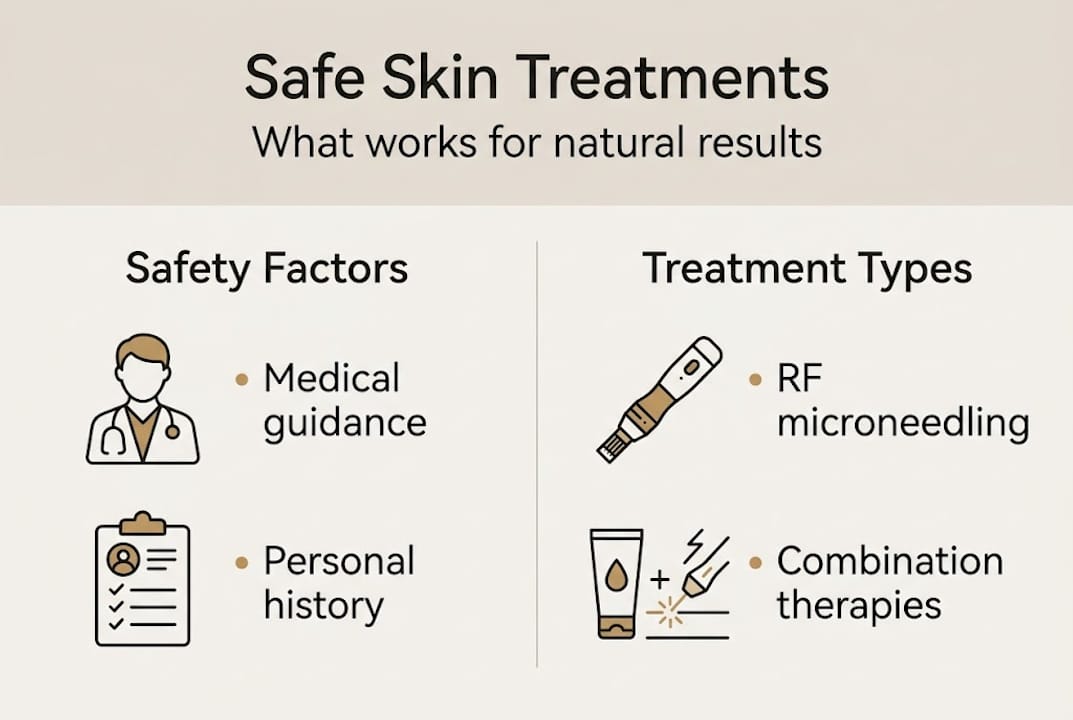
- Medical assessment first: Your skin type, tone, and any contraindications are evaluated before any device is used.
- Evidence-based protocols: Treatments follow dosing and technique guidelines supported by clinical data.
- Sun protection and avoidance of triggers: Pre and post-treatment care is clearly communicated and followed.
- Qualified practitioners: The person operating the device has formal training, not just a certification course.
- Realistic expectations: You’re told what the treatment can and cannot do for your specific concerns.
Good medical spa care doesn’t rush this process. The consultation is where safety is either established or compromised.
Pro Tip: If a provider offers a treatment without first asking about your skin history, medications, or sun exposure habits, that’s a signal to pause. Customization isn’t a luxury. It’s a safety requirement.
Top evidence-based non-surgical skin treatments
With a clear safety framework in place, it’s worth examining which treatments are actually supported by clinical evidence for adults aged 25 to 55. The options below are among the most studied and widely used in medically guided settings.
-
RF microneedling: Radiofrequency energy delivered through fine needles stimulates collagen remodeling at a deeper level than surface treatments. It’s effective for skin firmness, texture, and mild scarring. RF microneedling has a strong safety profile across most skin types, with collagen remodeling and low adverse effects consistently documented in clinical reviews.
-
Intense pulsed light (IPL): IPL targets pigmentation, redness, and sun damage using broad-spectrum light. It’s highly effective, but patient selection matters. IPL improves pigment and redness up to 50% in appropriate candidates, and it works best for Fitzpatrick skin types I through III.
-
Fractional lasers: Both ablative and non-ablative options exist. Non-ablative fractional lasers offer moderate results with less downtime, while ablative versions deliver more significant improvement for wrinkles and photodamage but require more recovery time.
-
Photobiomodulation (PBM): This light-based therapy uses specific wavelengths to support cellular repair. It carries minimal risk and reduces wrinkle volume by over 30% in randomized controlled trials, making it a strong option for those seeking gentle, consistent improvement.
| Treatment | Downtime | Best candidates | Key benefit |
|---|---|---|---|
| RF microneedling | 1 to 2 days | Most skin types | Firmness, texture |
| IPL | Minimal | Fitzpatrick I to III | Pigment, redness |
| Fractional laser | 2 to 7 days | Photodamage, wrinkles | Resurfacing |
| Photobiomodulation | None | Sensitive skin, all types | Cellular repair |
Exploring non-surgical treatments with a qualified provider helps you match the right option to your skin goals. For concerns around laxity and firmness, skin tightening options offer targeted support without surgical intervention.
Why medical guidance is essential for safety
Knowing which treatments exist is only part of the picture. How they’re applied, and by whom, is what determines whether your experience is safe or not. This is where medical oversight becomes non-negotiable.

Board-certified physicians and dermatologists bring something that device training alone cannot replicate: clinical judgment. They recognize contraindications, adjust protocols based on your skin’s real-time response, and understand when not to treat. That last point matters more than most people realize.
Common safety failures in aesthetic settings include:
- Using devices on skin types outside the recommended Fitzpatrick range
- Skipping pre-treatment screening for medications that increase photosensitivity
- Applying high-energy settings without assessing skin tolerance
- Lacking a clear protocol for adverse reactions
“As minimal downtime options advance the field, the AAD continues to emphasize that medical oversight remains the standard for ensuring patient safety with RF, lasers, and emerging technologies.”
The benefits of medically led spas go beyond credential displays on a wall. They show up in how your consultation is conducted, how your treatment is paced, and how your provider responds if something unexpected happens. Understanding why trust medically led spas matters helps you make more confident decisions about where to seek care.
Pro Tip: Before booking any energy-based treatment, ask two direct questions: Who is medically responsible for my care today? And what is your protocol if I have an adverse reaction? The answers will tell you a great deal about the practice’s safety culture.
Combination therapies: How multimodal strategies enhance both safety and results
Safety isn’t only about what a single treatment does in isolation. It’s also about how treatments interact when used together. Multimodal strategies, meaning layered combinations of devices and injectables, are increasingly the standard in medically guided aesthetic care.
The reasoning is sound. Different treatments work at different depths and on different tissue targets. RF microneedling addresses dermal collagen. Biostimulators like Sculptra work at a deeper structural level. IPL addresses surface pigmentation. When these are properly sequenced, multimodal approaches are synergistic for layered rejuvenation, producing results that are more natural-looking and longer-lasting than any single treatment alone.
Here’s what makes combination therapy work safely:
- Medical sequencing: Treatments are planned in a specific order to avoid overlapping inflammatory responses.
- Appropriate spacing: Recovery time between sessions is factored into the plan, not rushed.
- Unified oversight: One medical provider coordinates the full strategy rather than multiple unconnected practitioners.
- Adjusted dosing: Energy settings and injection volumes are calibrated to account for prior treatments.
| Combination | Target concern | Clinical advantage |
|---|---|---|
| RF microneedling + Sculptra | Volume loss, laxity | Deeper structural support |
| IPL + biostimulators | Pigment, tone, texture | Surface and mid-layer correction |
| Fractional laser + PBM | Resurfacing, healing | Faster recovery, reduced inflammation |
Exploring types of skin rejuvenation helps clarify which combinations align with your specific concerns. Reviewing treatment examples from medically guided practices gives you a realistic sense of what outcomes look like when strategies are thoughtfully built.
A fresh perspective on safety: Beyond devices, it’s about personalized planning
Here’s something most aesthetic marketing won’t tell you: the device itself is rarely the variable that determines your outcome. Two people can receive the same treatment on the same machine and have completely different results, because their skin, their history, and their provider’s judgment are all different.
The conversation in aesthetic care tends to center on technology. New devices, upgraded platforms, and branded treatment names dominate the conversation. But the evidence consistently points to something quieter and less marketable: individualized planning and an ongoing medical relationship are what actually keep you safe and deliver results that hold.
Your skin changes. What was appropriate at 35 may not be the right approach at 45. A provider who knows your history, tracks your progress, and adjusts your plan over time is offering something no single device can replicate. As one of the most thoughtful facial enhancement examples demonstrate, the most believable results come from strategy, not intensity.
Real safety in aesthetics is medical customization. No one-size-fits-all protocol, no matter how advanced the device, can substitute for a provider who genuinely knows your skin.
Next steps: Finding your safest skin treatment in Raleigh
If this guide has clarified anything, it’s that safe aesthetic care starts well before the treatment room. It starts with the right questions, the right provider, and a plan built around your skin, not a menu of services.
At The Aesthetics Lounge and Spa Raleigh, every consultation is medically guided and unhurried. We review your skin history, discuss your goals honestly, and recommend only what makes clinical sense for you. Explore our full range of aesthetic treatments in Raleigh or learn more about why trust medically led spas before your first visit. For practical guidance on maintaining your results, our facial rejuvenation tips are a helpful starting point. You deserve care that’s refined, measured, and genuinely yours.
Frequently asked questions
Which skin treatments are safest for sensitive or darker skin types?
RF microneedling and photobiomodulation are generally safer across a wider range of skin types, while IPL is best suited for lighter Fitzpatrick skin types I through III and requires careful patient selection.
How do I know if my provider is following safety protocols?
Ask whether a board-certified physician oversees your treatment, confirm that a medical screening is completed before any procedure, and verify that aftercare and emergency response protocols are clearly in place. Medical oversight is the standard, not a bonus.
What does ‘minimal downtime’ really mean?
For most modern non-surgical treatments, minimal downtime options typically mean redness or mild swelling lasting a few hours to two days, with most people resuming normal activities quickly.
Are combination treatments safe, or do they increase risk?
When medically guided and properly sequenced, multimodal approaches can actually reduce overall risk by using lower individual treatment intensities while still achieving more complete, natural-looking results.
Recommended
- Medically Guided Skincare Steps for Lasting Natural Results
- Step-by-step skin rejuvenation for lasting, natural results
- 7 Key Medically Led Spa Benefits for Natural-Looking Results
- Medical grade skincare explained: natural rejuvenation
- Natural Skincare Explained: Benefits for Sensitive Skin – Moose’s Tallow