
TL;DR:
- Medical grade skincare involves higher concentrations, purity, and advanced delivery systems for effective results.
- Clinical evidence shows significant, natural improvements in wrinkles, hydration, and elasticity within 12 weeks.
- Professional oversight is essential to ensure safe use, prevent irritation, and customize treatments for optimal outcomes.
You’ve probably stood in a skincare aisle comparing ingredient labels and wondered whether the $30 retinol serum is really any different from the one your dermatologist recommends. It’s a fair question. Many products share similar active ingredient names, which makes the distinction feel like marketing. But medical grade skincare is defined by measurable standards: higher active concentrations, superior ingredient purity, advanced delivery systems, and professional oversight backed by clinical research. Understanding those differences matters, especially when your goal is subtle, lasting rejuvenation rather than a dramatic change that doesn’t look like you.
Table of Contents
- What is medical grade skincare?
- Key ingredients for natural skin rejuvenation
- What does the clinical evidence show?
- Risks, limitations, and who should avoid certain products
- Our take: The real difference goes beyond ingredients
- Discover your pathway to natural, medically guided rejuvenation
- Frequently asked questions
Key Takeaways
| Point | Details |
|---|---|
| Higher ingredient standards | Medical grade skincare uses purer, more potent actives than typical drugstore products. |
| Backed by science | Clinical trials demonstrate clear benefits for wrinkles, hydration, and elasticity within weeks. |
| Professional guidance required | Safe and effective results depend on oversight from licensed skincare experts. |
| Not for everyone | Some ingredients carry risks for sensitive skin or certain life stages, so customized advice is vital. |
| Natural results prioritized | When used correctly, medical grade skincare can help you achieve subtle, age-defying improvements without looking ‘worked on.’ |
What is medical grade skincare?
Medical grade skincare is not simply a premium label. It represents a category of products formulated to stricter standards than what you find at a drugstore or beauty retailer. The distinction starts at the ingredient level and extends through how the product is accessed and supervised.
At its core, medical grade skincare features higher concentrations of active ingredients, superior purity levels often reaching 99% or USP-grade quality, and delivery systems engineered to carry actives deeper into the skin rather than sitting on the surface. These are not cosmetic differences. They affect whether an ingredient actually reaches the layer of skin where change happens.
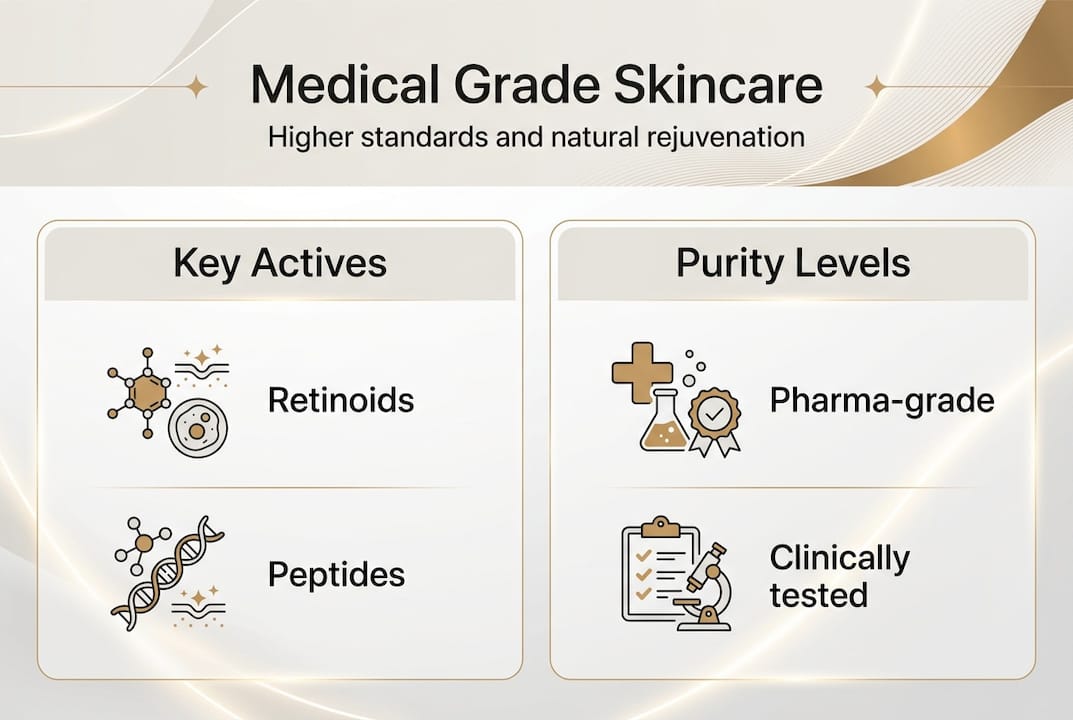
Over-the-counter products are regulated as cosmetics by the FDA, meaning they must be safe but are not required to prove efficacy. Medical grade products, by contrast, are typically dispensed only through licensed professionals, which creates a layer of oversight that OTC products simply don’t have. A provider can assess your skin, match the right formulation to your specific concerns, and adjust the regimen as your skin responds.
Here’s a clear comparison:
| Feature | Medical grade | OTC |
|---|---|---|
| Active concentration | High, clinically dosed | Lower, often minimal |
| Ingredient purity | Up to 99%, USP-grade | Variable |
| Delivery system | Advanced, penetrates deeper | Surface-level |
| Access | Licensed professionals only | Open retail |
| Clinical backing | Required for efficacy claims | Not required |
| Oversight | Supervised and customized | Self-directed |
Key distinctions that matter for your skin:
- Concentration: Medical grade retinoids, vitamin C, and peptides are dosed to produce measurable change, not just maintain appearance.
- Purity: Fewer fillers and stabilizers mean less risk of irritation from inactive ingredients.
- Delivery: Encapsulation and liposomal technology help actives reach the dermis, where collagen and elastin live.
- Oversight: A licensed provider monitors your skin’s response and adjusts the plan, which is critical for safety and results.
As explained in medical-led skincare, the goal is never transformation for its own sake. It’s supporting your skin’s natural biology with precision and care.
“Medical grade skincare products have higher concentrations of actives, superior purity, advanced delivery systems, require professional oversight, and are supported by clinical research.”
Key ingredients for natural skin rejuvenation
Now that you understand how medical grade skincare differs from OTC products, let’s drill down into the specific ingredients powering its results.
Not all actives are created equal, and the ones with the strongest clinical track record are also the most frequently supervised for good reason. These are the ingredients that appear consistently in medically guided regimens for natural anti-aging:
- Retinoids (tretinoin and retinol): The most studied anti-aging actives available. Dermatologists recommend retinoids at a 96.8% consensus rate for improving wrinkles, skin texture, and elasticity. Tretinoin, the prescription-strength form, works faster and more reliably than OTC retinol.
- Vitamin C: A potent antioxidant that targets uneven pigmentation, sun damage, and collagen degradation. It works best in stable, well-formulated serums at concentrations above 10%.
- Niacinamide: A form of vitamin B3 that strengthens the skin barrier, calms redness, and reduces hyperpigmentation without the irritation risk of stronger actives. It pairs well with most other ingredients.
- Broad-spectrum sunscreen: Non-negotiable. Without daily sun protection, every active ingredient you apply is working against a tide of ongoing UV damage. Sunscreen also prevents post-inflammatory hyperpigmentation when you’re using stronger actives.
The clinical evidence for retinoids is particularly striking. Studies show 32% wrinkle reduction and a 72% increase in hydration after 12 weeks of consistent use. That kind of improvement is measurable and visible, yet still reads as natural rather than altered.
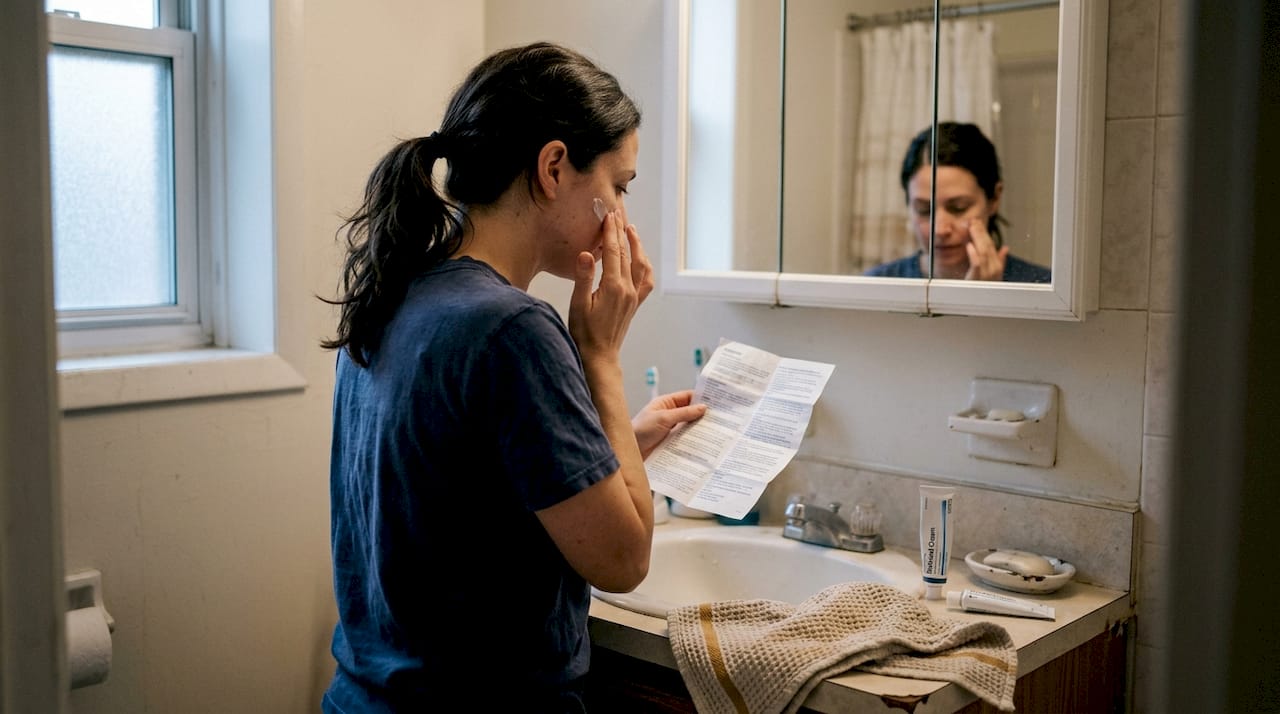
You can explore how these ingredients work within a full routine in our guide to skincare steps for natural results, or browse advanced skincare ingredients available through our clinic. For those interested in supporting skin health from the inside out, a wellness bundle for skin health can complement a topical regimen.
Pro Tip: Start with the lowest effective strength of any new active and increase gradually under professional supervision. Jumping to high concentrations too quickly is the most common reason people abandon retinoids before seeing results.
What does the clinical evidence show?
Understanding the science behind these ingredients can help set realistic expectations for what medical grade skincare can deliver.
Clinical research consistently supports the efficacy of medical grade actives, particularly retinoids, when used correctly and consistently. The data is not anecdotal. Network meta-analyses of anti-aging skincare show 20 to 30% wrinkle reduction and significant improvements in elasticity and hydration within 4 to 12 weeks of use.
Here’s what the data looks like across key outcomes:
| Outcome | Improvement | Timeframe | Ingredient |
|---|---|---|---|
| Wrinkle depth | Up to 32% reduction | 12 weeks | Tretinoin/retinoids |
| Skin hydration | Up to 72% increase | 12 weeks | Retinoids + niacinamide |
| Elasticity | Significant improvement | 8-12 weeks | Retinoids |
| Pigmentation | Moderate to marked reduction | 8-16 weeks | Vitamin C, niacinamide |
What to expect week by week:
- Weeks 1 to 2: Initial adjustment. Some dryness or mild flaking is normal as skin cell turnover accelerates. Hydration and barrier support are priorities here.
- Weeks 3 to 4: Skin begins to feel smoother. Texture improvements become noticeable. Redness from adjustment typically settles.
- Weeks 5 to 8: Tone becomes more even. Fine lines soften. Hydration levels stabilize.
- Weeks 9 to 12: The most significant visible changes emerge. Wrinkle depth decreases, elasticity improves, and the overall complexion looks more rested and supported.
“Up to 32% reduction in wrinkle depth and a 72% increase in hydration have been documented after 12 weeks of consistent medical grade retinoid use.”
The results patients see in real-world settings mirror this data closely. Improvements are gradual, believable, and proportional. You look like yourself, just more quietly renewed. Browse medical-grade products in Raleigh or read more about the benefits of medically led skincare to understand how these outcomes translate into a real treatment plan.
Risks, limitations, and who should avoid certain products
While results are impressive, not everyone is a candidate for high-powered actives, and prudence leads to better outcomes.
The same properties that make medical grade skincare effective also raise the stakes for misuse. Higher concentrations mean a higher margin for irritation, especially during the first weeks of use. Peeling, redness, and a burning sensation are the most common side effects, and they are largely avoidable with proper guidance.
Retinoids and strong actives carry a higher irritation risk and are not appropriate for everyone. Specific groups who should avoid unsupervised use include:
- Women who are pregnant or breastfeeding
- Patients who have recently undergone energy-based facial procedures such as laser resurfacing
- Those with active rosacea or highly reactive, sensitive skin
- Individuals with darker skin tones who are at increased risk for post-inflammatory hyperpigmentation (PIH)
- Anyone currently using multiple actives without professional coordination
Post-inflammatory hyperpigmentation deserves particular attention. For medium to deeper skin tones, aggressive actives can trigger darkening in areas of irritation, which is the opposite of the intended result. This is not a reason to avoid medical grade skincare entirely. It is a reason to work with someone who understands your skin’s specific biology.
Pro Tip: Always apply broad-spectrum SPF 30 or higher every morning when using any medical grade active. Sunscreen is not optional in these regimens. It prevents sensitivity reactions and significantly reduces PIH risk.
For more on how professional expertise keeps results safe and natural, read our article on medical expertise for natural cosmetic results. You can also explore a medically guided skin health workflow that accounts for these variables from the start.
Our take: The real difference goes beyond ingredients
Here is something worth sitting with: the gap between medical grade and OTC skincare is not always about concentration alone. OTC and medical grade products can sometimes overlap in ingredient strength. What they rarely overlap in is the quality of guidance surrounding their use.
We see this regularly. A client arrives having used a high-strength OTC retinol for months with minimal results and significant irritation. The product wasn’t wrong. The regimen was. No one had assessed their barrier health, sequenced the actives correctly, or adjusted the approach as their skin responded.
Medical grade skincare earns its value not just from what’s in the bottle, but from the clinical thinking applied around it. OTC products are entirely appropriate for maintenance and general skin health. But when goals become more specific, whether that’s persistent pigmentation, textural changes, or visible volume loss, a supervised protocol makes a measurable difference.
The most effective regimens we build combine both. Prescription-strength actives where they’re warranted, thoughtful OTC support where appropriate, and a plan that respects your skin’s pace rather than pushing it to its limit. True skin wellness isn’t about using the strongest thing available. It’s about using the right thing, at the right time, for your skin specifically. Learn more about the benefits of medical aesthetics and why that distinction matters for long-term results.
Discover your pathway to natural, medically guided rejuvenation
If you’re ready to move beyond information and toward lasting skin health, here’s how we can help.
At The Aesthetics Lounge and Spa Raleigh, every skincare plan begins with a thorough assessment of your skin’s current condition, your goals, and your lifestyle. We don’t hand you a product and send you home. We build a regimen around you, with the medical oversight that makes the difference between products that sit on your skin and ones that actually change it.
We carry Neocutis medical-grade skincare, one of the most clinically respected lines available, alongside other carefully selected formulations for North Raleigh patients. Our approach to safer natural results with medical leadership means you’re never guessing. And when it’s time to consider combining skincare with in-office treatments, we help you plan treatments for fewer side effects so every step supports the next. Book a consultation and let’s build something measured, precise, and genuinely yours.
Frequently asked questions
Can I get medical grade skincare without a prescription?
Many medical grade products are dispensed only through licensed professionals, and some, particularly tretinoin, require a prescription depending on the active ingredient concentration and your state’s regulations.
Is medical grade skincare always stronger than drugstore products?
OTC and medical grade products can sometimes overlap in active concentration, but medical grade options offer higher ingredient purity and more advanced absorption technology, along with the professional oversight that maximizes results.
Who should avoid medical grade actives like retinoids?
Women who are pregnant or breastfeeding, patients who recently had energy-based facial procedures, and those with highly sensitive or rosacea-prone skin should avoid unsupervised use, as should individuals with darker skin tones at elevated PIH risk.
How long does it take to see results from medical grade skincare?
Most people notice texture improvements within 4 to 8 weeks, with significant wrinkle and hydration changes becoming visible after 12 weeks of consistent use in clinical trials.
Is professional guidance necessary for using medical grade skincare?
Yes. Professional oversight ensures the regimen is matched to your skin’s specific biology, minimizes risks like irritation and pigment changes, and allows for timely adjustments as your skin evolves.