
TL;DR:
- Satisfaction in aesthetics depends more on aligning expectations with realistic outcomes than on the treatment itself.
- Clear, honest communication about achievable results and gradual improvements is essential for genuine satisfaction.
A technically flawless treatment can still leave you disappointed. That might sound counterintuitive, but research consistently confirms it: satisfaction in aesthetics depends less on what happens in the treatment room and more on how well your expectations align with what is actually achievable. Whether you are considering injectables, skin resurfacing, or any other non-surgical enhancement, the quality of your experience begins long before any treatment starts. Understanding how expectations work, and how to set them well, is the clearest path to results that feel genuinely satisfying.
Table of Contents
- How expectations shape your aesthetic experience
- Why transparent expectation-setting matters
- Edge-case nuances: Expectations, satisfaction, and natural results
- Practical steps: Setting realistic expectations for natural enhancements
- Our take: Why expectation management is the real secret to natural results
- Ready to experience natural results? Start with expert guidance in Raleigh
- Frequently asked questions
Key Takeaways
| Point | Details |
|---|---|
| Expectations change perception | How you anticipate results directly shapes your experience and satisfaction after aesthetic treatments. |
| Transparent conversations matter | Open, realistic discussions with your provider boost satisfaction and reduce disappointment. |
| Gradual enhancements deliver natural results | Natural-looking outcomes come from tiered, informed approaches—never overnight transformations. |
| Align goals to outcomes | Clarifying what is achievable ensures your results match your vision and needs. |
How expectations shape your aesthetic experience
Your brain is not a passive observer. It is constantly making predictions about what you are about to feel, see, and experience. This process, known as predictive processing, means that your nervous system compares incoming information against what it expected to receive. When the two align, or when reality slightly exceeds the prediction, you feel satisfied. When there is a significant mismatch in either direction, the experience feels off.
In aesthetics, this matters enormously. Research published in Scientific Reports confirms that aesthetic pleasure arises from resolved uncertainty when sensory input matches prior predictions within an optimal unpredictability range. Too much surprise feels unsettling. Too little feels flat. The sweet spot is a result that feels just a little better than you hoped, not dramatically different from your starting point.
What makes this even more significant is that expectations do not just color how you interpret results after the fact. They actively change your experience in real time. A separate fMRI cross-over placebo study found that expectations causally shift subjective experience and emotion, even when the treatment itself is inert. Your top-down cognitive resources, meaning your beliefs, mental framing, and prior knowledge, shape the physical and emotional response you have. This is not a minor effect. It is central to how aesthetic satisfaction works.
This is also why the impact on confidence from any treatment is never purely about the physical change. It is about whether the change matches what you believed was possible and what you hoped to feel.
Key ways expectations influence your aesthetic experience:
- They set the emotional baseline against which results are measured
- They influence how you perceive subtle changes in the mirror over time
- They shape whether you feel supported or unsettled during recovery
- They determine whether you communicate concerns to your provider or stay silent
- They affect your willingness to follow aftercare instructions consistently
“Results that read as rested begin with expectations that are grounded in reality. When you understand what a treatment can and cannot do, the outcome feels earned, not accidental.”
Pro Tip: Before any treatment, write down two or three specific things you hope to feel or see. Share these with your provider. Concrete goals are far easier to align with achievable outcomes than vague wishes like “look younger.”
Establishing this science-based foundation allows us to see why real-world satisfaction depends so much on pre-treatment expectation-setting. The conversation before treatment is not a formality. It is part of the treatment itself.
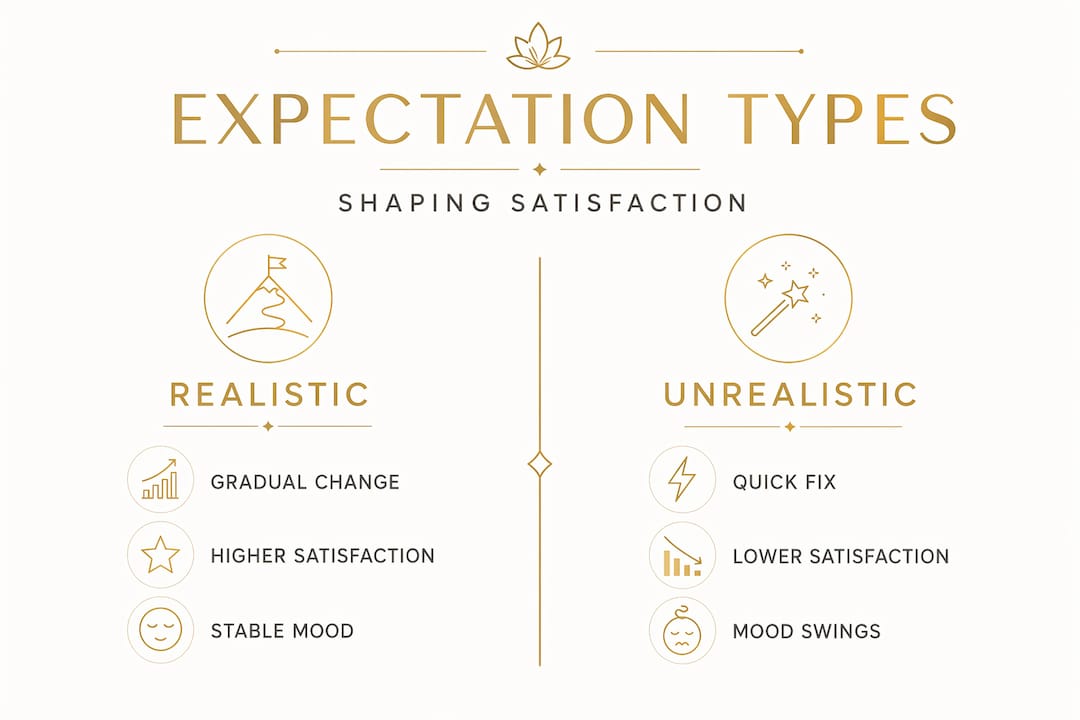
| Expectation type | Likely emotional outcome | Satisfaction risk |
|---|---|---|
| Realistic, gradual improvement | Calm, supported, pleased | Low |
| Vague or undefined | Uncertain, anxious post-treatment | Moderate |
| Dramatic or overnight change | Disappointed, critical of results | High |
| Informed and tiered | Confident, engaged, patient | Very low |
Why transparent expectation-setting matters
Even when a provider delivers technically excellent results, satisfaction can fall short if the client arrived with a different picture in mind. This gap is not about skill. It is about communication. Patient education in aesthetics is the bridge between what is possible and what feels meaningful to you.
A prospective multicenter study found that satisfaction links to preoperative information quality and psychological factors related to how patients evaluate their own appearance. In plain terms: how well you are counseled before treatment meaningfully shifts how satisfied you feel after it. This holds true across surgical and non-surgical settings.
Transparent expectation-setting involves more than a quick overview of the procedure. It means walking through what the result will look like at one week, one month, and three months. It means discussing what the treatment cannot address, not just what it can. It means planning consultations that are unhurried and genuinely educational, not a sales conversation.
Clinic guidance from experienced non-surgical providers confirms that transparent expectation-setting around realism, gradual results, and timelines is the primary mechanism for achieving natural outcomes and reducing disappointment. The goal is not to lower your excitement. It is to channel it toward what is genuinely achievable.
Steps for transparent expectation-setting before any non-surgical treatment:
- Ask your provider to describe the result in specific, observable terms
- Request a realistic timeline for when you will see changes
- Ask what the treatment cannot address, not just what it can
- Discuss how many sessions may be needed for your specific goal
- Confirm what normal side effects look like and how long they last
- Ask whether your goals align with your current skin health and anatomy
Setting clear goals before your appointment gives your provider the information they need to be honest with you. Vague goals make honest counseling harder for everyone.
Pro Tip: Ask your provider directly: “What is one thing I might be hoping for that this treatment cannot deliver?” A confident, trustworthy provider will answer that question clearly and without hesitation.
Comparison of realistic vs. unrealistic expectation scenarios:
| Scenario | Expectation | Outcome | Satisfaction |
|---|---|---|---|
| First-time filler client | Subtle volume restoration | Gradual, natural improvement | High |
| Client expecting “erased” lines | Complete elimination of deep lines | Softening, not removal | Low |
| Informed skincare client | Gradual texture improvement over sessions | Visible improvement at 6 weeks | High |
| Client comparing to filtered photos | Match a heavily edited image | Natural, believable result | Low |
Edge-case nuances: Expectations, satisfaction, and natural results
The most overlooked reality in aesthetics is this: you can have a technically perfect treatment and still feel let down. This is not rare. It is one of the most common patterns seen in real-world clinical settings.
Research from a multicenter surgical cohort confirms that unfulfilled expectations lower satisfaction even when technical delivery is adequate. The variables that drive this are psychological and informational, not clinical. Satisfaction, in these cases, is tied to whether the client felt heard, informed, and prepared, not just whether the procedure went well.

Perfectionistic expectations are a particular risk. When someone enters treatment hoping for a flawless, overnight transformation, no result will feel adequate. The standard they are measuring against is not a real person’s face. It is a filtered image, a memory of youth, or an idealized version of themselves that no treatment can reliably reproduce. This is where the subtle enhancements for lasting confidence approach becomes genuinely protective. Gradual, believable changes build confidence over time. Dramatic changes often create new anxieties.
Common mismatches between expectation and outcome:
- Expecting one session to resolve a concern that developed over years
- Believing injectables will replicate the look of a surgical procedure
- Assuming results will be permanent after a single treatment
- Expecting zero downtime and zero visible change during recovery
- Comparing your result to someone else’s face rather than your own baseline
The average satisfaction rate in real-world aesthetic cohorts sits around 69%, and that number is strongly shaped by these invisible variables. Not by technique. Not by product quality. By whether the client’s internal picture of success matched what was actually possible.
This is also why avoiding quick fixes is not just a safety recommendation. It is a satisfaction strategy. Quick fixes invite unrealistic timelines and dramatic expectations. Measured, planned treatment respects both your anatomy and your psychology.
Practical steps: Setting realistic expectations for natural enhancements
Moving from theory to practice, here is what thoughtful expectation management actually looks like before, during, and after a non-surgical treatment.
Clinic guidance consistently recommends gradual interventions over multiple sessions with transparent communication about what is achievable. The goal is not to erase every line or turn back the clock dramatically. It is to enhance your natural features in a way that looks believable and feels supported.
Pre-treatment checklist for realistic expectations:
- Identify one to three specific, observable goals
- Research what the treatment typically achieves, not what filters suggest
- Bring reference photos that reflect realistic, natural results
- Ask about the full treatment plan, not just the first session
- Confirm your provider’s approach to conservative, gradual enhancement
- Understand the recovery window and what it will look like day by day
Numbered steps for the expectation-setting process:
- Start with a thorough consultation, not a rushed intake
- Share your goals and ask your provider to reflect them back in realistic terms
- Review before-and-after examples from real clients with similar anatomy
- Discuss the timeline for results, including when you will see peak effect
- Agree on a follow-up appointment to assess and adjust
- Document your starting point with photos so progress is measurable
For clients exploring at-home supplementary care, choosing microcurrent facial devices thoughtfully can support your in-clinic results, but the same expectation principles apply. Understand what the device can and cannot do before you invest.
Pro Tip: Ask your provider for a personalized roadmap that includes expected timelines, likely outcomes at each stage, and how often you will need sessions to maintain results. A written plan gives you something concrete to return to when you are evaluating your progress.
Conservative treatments for natural results are not about doing less for the sake of it. They are about doing the right amount, at the right pace, with the right information. That combination produces results that feel genuinely yours.
Our take: Why expectation management is the real secret to natural results
Here is what most aesthetic conversations miss: the gap between a good result and a satisfying one is almost never about technique. It is about the psychological anchor the client brought into the room.
We have seen this consistently. A client leaves with beautifully placed filler, subtle and natural, and feels disappointed because she expected to look like she did at 28. Another client has a nearly identical result and feels genuinely renewed because she understood she was supporting her face, not rewinding it. Same treatment. Same skill. Completely different experiences. The difference was the expectation each person carried in.
This is why we believe expectation management is not a soft add-on to aesthetic care. It is the foundation of it. The role of medical providers in this process is not just to deliver a technically sound treatment. It is to help you arrive at a realistic, grounded picture of what success looks like for your face, your timeline, and your goals.
Confidence and self-evaluation genuinely improve when expectations are aligned with achievable, gradual results. Not because the change is dramatic, but because it is believable. You recognize yourself. You look rested, not altered. That recognition is what builds lasting satisfaction.
The uncomfortable truth is that some clients are not ready for treatment. Not because their concern is not valid, but because their expectation is not yet calibrated to what is safely and naturally achievable. The most responsible thing a provider can do in that moment is slow down, educate, and revisit.
Pro Tip: Revisit your goals at every stage of the process. What you hoped for at the start may shift as you see gradual changes. Ongoing, honest feedback from your provider is more valuable than a single before-and-after comparison.
Ready to experience natural results? Start with expert guidance in Raleigh
Understanding the science of expectations is the first step. Acting on it with the right support is what makes the difference.
At The Aesthetics Lounge and Spa Raleigh, every appointment begins with a calm, unhurried conversation about your goals, your anatomy, and what is genuinely achievable for you. We do not start with products. We start with a plan. Explore our full range of aesthetic treatments in Raleigh designed for gradual, natural enhancement, and learn more about the top non-surgical treatments we offer for clients who want results that still look like themselves. When you are ready to take the first step, we are here to guide it thoughtfully, with transparent information and planning for fewer side effects built into every stage of your care.
Frequently asked questions
How can I make sure my expectations are realistic before a non-surgical aesthetic treatment?
Discuss your goals openly with your provider and ask for detailed information about achievable results, timelines, and potential side effects. Transparent expectation-setting is the most reliable way to reduce disappointment and achieve natural outcomes.
What is the most common reason for disappointment after a cosmetic procedure?
Most dissatisfaction comes from mismatched or poorly managed expectations, not technical errors. Research confirms that satisfaction ties to counseling quality and the psychological variables each client brings to the experience.
Can my mood or confidence actually change based on what I expect from a treatment?
Yes, and the effect is measurable. Studies show that expectations causally shift emotion and subjective experience even when the treatment itself contains no active ingredient.
What should I ask during my consultation to avoid unrealistic expectations?
Request a step-by-step roadmap covering what is achievable, how gradual the results will be, potential side effects, and what the treatment cannot address. Gradual interventions and transparency about realistic outcomes are the standard at reputable clinics.