
TL;DR:
- Most visible skin aging results from photoaging caused by UV exposure rather than genetics.
- Proactive skin care, including daily SPF and non-invasive treatments, can significantly slow aging signs.
- Combining professional treatments with consistent topical routines yields the best, natural long-term results.
Most visible signs of skin aging are not written in your DNA. They develop gradually, quietly, over years of cumulative sun exposure, overlooked skincare habits, and a reactive mindset that only kicks in once lines and pigmentation have already settled in. The good news? Photoaging accounts for 80-90% of visible facial aging signs, which means the majority of what you see in the mirror is addressable, not inevitable. Modern non-invasive treatments, paired with intentional daily care, give you real tools to support your skin health over the long term and preserve results that feel genuinely like you.
Table of Contents
- The science behind skin aging and photoaging
- Benefits of supporting skin health for natural results
- Non-invasive treatments that support skin health
- Topical skincare and professional treatments: A winning combination
- Our perspective: Why prevention beats panic and what most miss about skin health
- Ready to support your skin health for natural, lasting beauty?
- Frequently asked questions
Key Takeaways
| Point | Details |
|---|---|
| Prevention is powerful | Starting skin health support early can prevent up to 80% of visible aging signs. |
| Modern treatments are safe | Non-invasive options like microneedling and chemical peels fit all skin types with minimal risks and high satisfaction rates. |
| Combination approach wins | Blending professional treatments with proven topicals leads to optimal, naturally youthful results. |
| Start now for lifelong benefits | The earlier consistent care begins, the greater the return on investment for healthy, radiant skin. |
The science behind skin aging and photoaging
Many people assume aging is predetermined, a slow countdown set at birth. But the science tells a more empowering story. Skin aging actually happens through two distinct processes, and understanding both changes how you approach your care.
Intrinsic aging is the internal, time-driven process. Collagen production naturally slows by about 1% per year after your mid-20s, and cellular turnover follows a similar gradual decline. Skin becomes thinner, drier, and less elastic over time. This is real, but it is modest compared to what accumulates from the outside world.
Extrinsic aging, most notably photoaging, is where the larger share of visible change originates. UV radiation drives up to 80% of facial aging, triggering the breakdown of collagen and elastin fibers, generating free radicals, and causing the uneven pigmentation many clients in their 30s and 40s first notice and want to address.
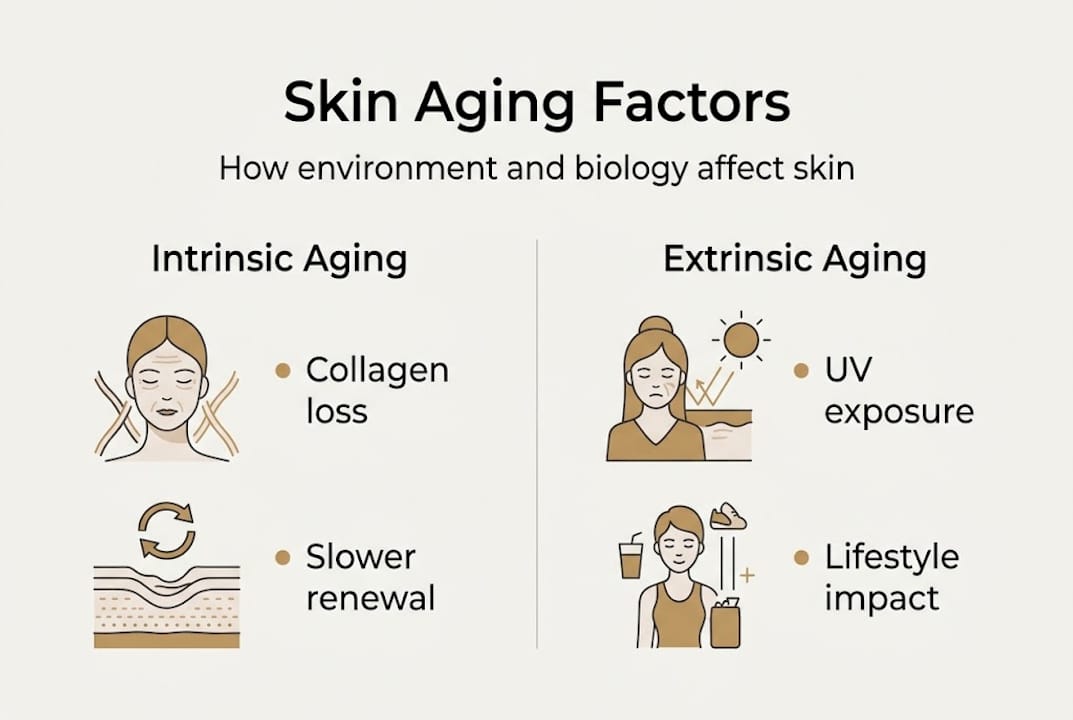
Here is a quick look at how photoaging tends to progress:
| Age range | Common visible changes |
|---|---|
| Late 20s | Subtle texture changes, early fine lines |
| 30s | Pigmentation spots, loss of firmness begins |
| 40s | Deeper lines, skin laxity, uneven tone |
| 50s+ | Volume loss, pronounced wrinkles, dullness |
The main signs of photoaging to watch for include:
- Fine lines and deeper wrinkles, particularly around the eyes and mouth
- Uneven skin tone and brown spots (solar lentigines)
- Rough or thickened skin texture
- Loss of natural radiance and overall skin firmness
As one widely cited summary of skin biology notes: “Chronic UV exposure degrades dermal architecture faster than any intrinsic biological process, making photoprotection the single highest-leverage intervention available.”
This is why early support matters so much. Waiting until signs are pronounced means working against compounded, layered damage rather than maintaining a healthier baseline from the start. Our facial aging prevention guide walks through this in more practical detail for anyone wanting a clear starting point.
Benefits of supporting skin health for natural results
With the science clear, what specific benefits can you expect from caring for your skin proactively? The honest answer is: more than most people realize, and far earlier than most people start.
Preventing photoaging and supporting collagen slows visible signs of aging in a measurable, meaningful way. The difference between someone who started SPF and consistent care at 28 versus someone who began addressing concerns at 45 is striking, and it is not primarily about genetics.

Here is a straightforward comparison between reactive and proactive approaches:
| Approach | Focus | Typical outcomes | Cost over time |
|---|---|---|---|
| Reactive | Correcting visible damage after the fact | More treatments needed, harder to reverse | Higher, more intensive |
| Proactive | Preventing and maintaining skin health | Sustained natural results, fewer interventions | Lower, more efficient |
The functional and aesthetic benefits of consistent proactive care include:
- Strengthened skin barrier that retains moisture and resists environmental stressors
- Minimized pigmentation through SPF protection and targeted topical ingredients
- Increased resilience as collagen production is supported rather than simply replaced
- Reduced wrinkle depth over time compared to skin that has gone unprotected
- More even, luminous tone that reads as naturally rested rather than treated
For practical guidance on building good habits, these natural facial rejuvenation tips offer a grounded, realistic starting framework. And if you are curious about what the actual facial rejuvenation process looks like from a clinical perspective, that is worth reading before your first consultation.
Pro Tip: The ROI on daily SPF 30 or higher, used consistently, rivals nearly every in-clinic treatment available. It is the least glamorous step and the most impactful one.
Non-invasive treatments that support skin health
Once you understand the benefits, the next natural question is: what safe, evidence-based options are available in Raleigh today? The landscape has shifted significantly, and the best current treatments support skin health rather than simply masking it.
Non-invasive treatments like chemical peels, microneedling, radiofrequency, and EMFACE stimulate collagen and elastin production, address surface damage, and improve overall skin quality with minimal downtime. Here is a brief breakdown of each:
- Chemical peels: Remove damaged outer skin layers, improve texture and pigmentation, and accelerate cellular renewal
- Microneedling: Creates controlled micro-injuries that trigger the skin’s natural repair response, boosting collagen production deep in the dermis. Learn more about how microneedling works before deciding if it is right for your skin.
- Radiofrequency (RF): Delivers heat energy to deeper skin layers to firm and tighten without affecting the surface
- EMFACE: A newer modality that simultaneously targets muscle tone and skin texture, addressing both structure and surface
A useful point of reference: device safety benchmarks across these treatment categories consistently show low adverse event rates, making them appropriate for a wide range of skin types including sensitive and diverse complexions.
For those weighing their options, a skin rejuvenation treatments comparison is a useful tool for understanding which modality addresses your specific concerns most directly. An overview of top non-surgical treatments can also help orient your thinking before a consultation.
Pro Tip: Combining treatments, such as a chemical peel series with periodic RF sessions, is often more effective than relying on a single modality. A medically guided plan lets you layer approaches that build on each other rather than compete.
Topical skincare and professional treatments: A winning combination
With so many choices on the market, it is important to understand how at-home and professional approaches can work together for your best results. Neither alone gets you as far as both together.
Proven topicals form the daily foundation. The ones with the strongest clinical track records include:
- Retinoids: Vitamin A derivatives that increase cell turnover and stimulate collagen. Retinoids can reduce wrinkles by 20 to 30% with consistent use, making them one of the most validated ingredients in skincare.
- Antioxidants (Vitamin C, niacinamide): Neutralize free radical damage from UV and pollution, protecting existing collagen
- Broad-spectrum SPF: Non-negotiable daily step, regardless of season or skin tone
- Peptides and growth factors: Support collagen synthesis and barrier function over time
But topicals have limits. They cannot reach the deeper dermal layers where collagen is produced and where structural change actually happens. Professional treatments close that gap. They stimulate at the tissue level, addressing laxity, deeper lines, and loss of firmness in ways that no serum or cream can match.
The distinction matters. Think of your daily skincare as maintenance between sessions, and professional treatments as the deeper work that sets a new structural baseline. As your medical-led skincare guide explains, the most effective regimens are built with both in mind from the start.
“A well-designed regimen pairs at-home consistency with periodic professional intervention, delivering results that are sustained, layered, and believable.”
When you are ready to structure this kind of approach, working through guided skincare steps with a provider ensures you are not doubling up on products or missing key steps.
Our perspective: Why prevention beats panic and what most miss about skin health
There is a pattern we see often. Someone comes in at 45 or 50, frustrated by changes that have accumulated over years, wanting to know what can be done quickly. The care is entirely possible, and we approach it with the same measured precision we bring to everything. But the conversation we wish we had started earlier is always the one about prevention.
Culturally, we are wired for crisis management. You notice a problem, then you address it. That instinct makes sense in many contexts. Skin health is one place where it quietly costs you more, in time, in investment, and in the degree of change possible.
Early prevention delivers better outcomes than corrective treatments applied after significant damage has occurred. The structural advantage of skin that has been consistently supported is real and measurable. It is not about perfection or starting at 22. It is about deciding, at whatever age you are now, to stop waiting for a reason to start.
The other thing most people miss: a proactive plan does not have to be complicated. A conversation with a medically led spa provider about where your skin is today and what would serve it best over the next three to five years is a more valuable investment than any single treatment purchased in urgency.
Ready to support your skin health for natural, lasting beauty?
Taking care of your skin does not have to feel overwhelming or clinical. It should feel clear, supported, and tailored to you.
At The Aesthetics Lounge and Spa Raleigh, we offer a full range of aesthetic treatments in Raleigh designed around your skin’s actual structure and long-term health. Every plan starts with an honest conversation, not a product list. Whether you are curious about what medical-led skincare looks like in practice or want to see aesthetic treatment examples before deciding, we are here to guide you without pressure. Book a consultation and let’s build something that works for your skin, your timeline, and your goals.
Frequently asked questions
How does supporting skin health slow visible aging?
Supporting skin health addresses the two primary drivers of visible change: UV damage and collagen loss. Since photoaging drives 80-90% of facial aging signs like wrinkles and pigmentation, consistent protective and restorative care slows that process in a direct and meaningful way.
Are non-invasive skin treatments safe for all skin types?
Yes. Most non-invasive treatments are proven safe across skin types with low adverse event rates, including for sensitive skin and diverse complexions when administered by experienced, medically trained providers.
What is the best age to start supporting skin health?
Your 20s offer the greatest prevention advantage, but improvements are achievable at any age with the right combination of consistent daily care and appropriately timed professional treatments.
Is topical skincare alone enough to stay youthful?
Topical care builds an important daily foundation, but combining topicals with energy-based devices and non-invasive treatments leads to far greater improvements in elasticity, firmness, and wrinkle reduction over time.