
TL;DR:
- Subtle, medically guided aesthetic enhancements improve confidence by aligning appearance with internal self-perception.
- Authentic results supporting self-identity foster lasting psychological wellbeing through autonomy, competence, and relatedness.
- Gradual, natural-looking treatments preserve self-authenticity, ensuring confidence is integrated and sustainable.
Aesthetics are often dismissed as vanity, a luxury concern reserved for those with too much time and too little depth. That framing misses something important. For adults navigating demanding careers, shifting self-images, and the quiet pressures of daily life in Raleigh, the way you feel about your appearance connects directly to how you move through the world. This guide examines the evidence behind that connection, explains the psychology driving it, and shows how medically guided, subtle enhancements can support genuine, lasting confidence without changing who you are.
Table of Contents
- How aesthetics really influence confidence
- Beyond vanity: The psychological needs behind confidence
- Subtle enhancements: Striking the balance between natural and confident
- Choosing the right aesthetic enhancement for you
- A fresh take: Why real confidence is about subtlety and self-authenticity
- Next steps: Experience subtle confidence with medical aesthetics in Raleigh
- Frequently asked questions
Key Takeaways
| Point | Details |
|---|---|
| Aesthetics boost real confidence | Scientific studies show appearance improvements can raise self-esteem in authentic ways. |
| Psychology matters more than trends | Sustainable confidence comes from meeting deeper psychological needs, not just chasing current looks. |
| Subtlety delivers best results | Medically guided, natural enhancements create lasting confidence without obvious changes. |
| Personalization is essential | The most effective treatments align with your unique facial features, goals, and lifestyle. |
How aesthetics really influence confidence
Let’s begin by clarifying what the science actually says about how aesthetics interact with confidence.
The idea that caring about your appearance is purely superficial does not hold up under scrutiny. A growing body of research confirms that appearance satisfaction is meaningfully linked to psychological wellbeing and self-esteem across a wide range of adult populations. A 2026 self-esteem study published in Frontiers in Psychology found that better appearance correlates with psychological wellbeing and self-esteem in adult samples, with measurable effects even in aesthetic-adjacent contexts like dental aesthetics and psychosocial impact measures.
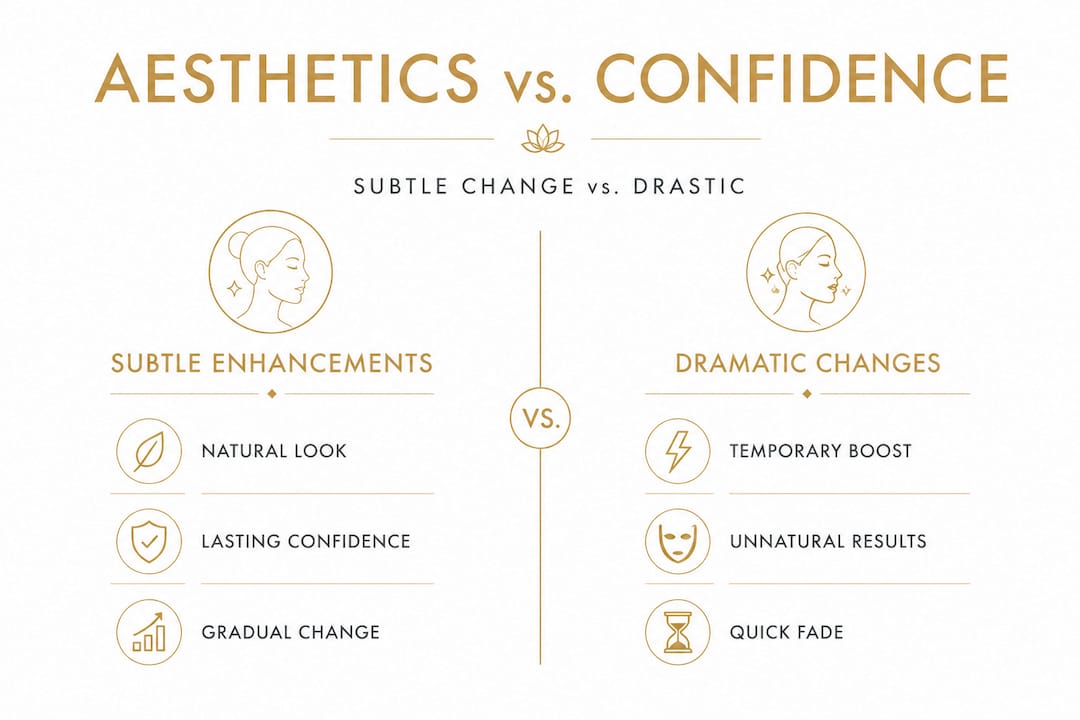
This is not a trivial finding. It suggests that how we look, and more precisely, how we feel about how we look, carries real psychological weight. The effect is not limited to people in their twenties, either. Adults across a broad age range achieve meaningful improvements in self-esteem when their appearance more closely aligns with their internal sense of themselves.
What this means practically:
- Subtle improvements in skin quality, facial symmetry, or volume restoration can shift how you experience your own reflection
- The confidence effect tends to carry into social and professional settings, not just quiet moments at home
- The key factor is not dramatic transformation but a sense of alignment between how you look and how you feel inside
When you are considering choosing aesthetic treatments, the evidence points toward a clear principle: results that feel believable to you tend to produce more lasting confidence than results designed to impress others.
| Approach | Confidence effect | Sustainability |
|---|---|---|
| Dramatic, trend-driven changes | Short-term novelty, possible regret | Often requires correction |
| Subtle, anatomy-based enhancements | Authentic alignment, lasting improvement | Builds over time naturally |
| No intervention despite concern | Ongoing self-consciousness | Unresolved, sometimes worsening |
The case for lasting confidence with subtle enhancements is not built on anecdote. It is built on a growing library of validated psychological research, and that matters when you are making decisions about your face and your wellbeing.
Beyond vanity: The psychological needs behind confidence
Now that we’ve established the evidence, let’s explore why aesthetics are more meaningful than simply looking good.
Psychology offers a framework called Self-Determination Theory, or SDT, which identifies three core psychological needs that drive authentic wellbeing: autonomy (feeling in control of your choices), competence (feeling capable and effective), and relatedness (feeling genuinely connected to others). When any of these needs is threatened or undermined, wellbeing suffers. Research shows that aesthetic improvements, when approached thoughtfully, can support all three.
A study in Frontiers in Psychology (2025) confirmed that aesthetic confidence can be understood through these psychological needs and wellbeing pathways. In plain terms, the confidence you gain from a carefully selected treatment is not cosmetic. It is woven into your sense of self.
“Confidence effects are not purely cosmetic; Self-Determination Theory pathways and perceived self-authenticity can mediate wellbeing changes.” — Frontiers in Psychology, 2025
Consider what this looks like in practice. When you choose a treatment that addresses something you have privately noticed for years, you are exercising autonomy. When that treatment produces a result that feels skillfully done and natural, your sense of competence in your own choices grows. And when you move through social situations feeling more at ease in your appearance, relatedness deepens because you are not spending mental energy on self-consciousness.
Three ways aesthetic improvements support psychological wellbeing:
- Autonomy: Making a deliberate, informed choice about your appearance reinforces your sense of agency and self-direction
- Competence: Seeing a result that genuinely improves how you feel validates your judgment and your investment
- Relatedness: Reduced self-consciousness allows fuller, more present engagement with the people around you
None of this requires a dramatic transformation. In fact, the research suggests that dramatic changes can undermine self-authenticity, which is the feeling that you still recognize yourself and still feel like you. When aesthetic results read as overdone, they often erode the very confidence they were meant to build.
The path toward lasting results from gradual treatments is, in many ways, the psychological path. Small, well-placed, medically guided changes that preserve your identity while quietly supporting it tend to produce the most durable wellbeing gains.
Pro Tip: Before any consultation, spend a moment identifying which specific aspect of your appearance creates the most self-consciousness. That focused reflection helps your provider make choices that address real need rather than chasing a generalized ideal.
Subtle enhancements: Striking the balance between natural and confident
But what does it look like when these psychological insights are put into practical use through actual treatments?
Minimally invasive treatments like dermal fillers, neuromodulators (such as Botox or Dysport), and microneedling have become some of the most studied tools in aesthetic medicine, and the evidence for their confidence-boosting effects is specific and meaningful. A filler confidence study published in Springer Nature (2025) found that for minimally invasive filler treatments, clinical studies report measurable improvements in aesthetics-related quality of life, self-esteem, and perceived attractiveness.

That combination, quality of life, self-esteem, and perceived attractiveness together, represents a meaningful outcome. It is not just that people look better in photos. They feel better navigating their daily lives.
What distinguishes a confidence-building result from one that misses the mark? Here are four key principles:
-
Start conservatively. A treatment plan that begins with less and adds carefully over time consistently outperforms aggressive initial approaches. You can always build; reversing is harder and sometimes impossible.
-
Respect facial anatomy. Treatments that work with your bone structure, muscle movement, and natural fat distribution produce results that make people say “you look well” rather than “what did you do?” For more on this, explore facial anatomy for natural results.
-
Address function, not just appearance. The most satisfying results often target something functional, like hollow tear troughs that make you look perpetually tired, or brow descent that gives an unintentionally stern expression. Fixing these feels corrective, not cosmetic.
-
Pace your treatments. Confidence built gradually feels more integrated and authentic than confidence triggered by a single dramatic session. Space matters.
| Treatment approach | Typical outcome | Best suited for |
|---|---|---|
| Overdone filler volume | Unnatural fullness, altered identity | Trend-chasers (not recommended) |
| Conservative, anatomy-based filler | Subtle restoration, natural contour | Adults wanting authentic enhancement |
| Microneedling for texture | Improved skin quality, minimal social downtime | Anyone seeking skin health improvement |
| Medically guided neuromodulators | Softened expression lines, preserved movement | Adults noticing fatigue or stress in their face |
For practical guidance on what this looks like treatment by treatment, the examples of subtle treatments resource walks through specific options with clear visual context.
Pro Tip: Ask your provider to show you an amount that is 20% less than what they initially suggest. Then decide together. That one step alone dramatically reduces the risk of looking overdone and keeps you in control of your outcome.
Choosing the right aesthetic enhancement for you
Let’s translate the research and real-world options into concrete steps for selecting enhancements that fit you best.
The most common mistake adults make when exploring aesthetic treatments is approaching the decision through external pressure rather than internal clarity. Trends, social media, and well-meaning friends can all pull you toward treatments that are not actually designed for your face, your lifestyle, or your goals. The SDT research is clear: wellbeing and confidence mechanisms are rooted in autonomy and self-authenticity, not compliance with external ideals.
Here is a practical framework for making choices that are genuinely right for you:
-
Reflect on the specific, not the general. Instead of thinking “I want to look younger,” identify one or two specific concerns that create daily self-consciousness. That precision helps your provider target with accuracy rather than guessing.
-
Research the provider, not just the treatment. A medically guided provider will assess your facial anatomy, ask about your lifestyle, and discuss realistic expectations before recommending anything. If a consultation feels rushed or pressure-driven, that is important information.
-
Understand the difference between trending and timeless. Treatments aligned with your natural facial structure tend to age gracefully. Treatments chasing a current aesthetic trend often create problems as that trend shifts. The guidance on why choose conservative treatments explains this distinction clearly.
-
Ask about pacing. A well-designed treatment plan builds results over multiple sessions rather than attempting to achieve everything at once. Pacing respects your anatomy and allows natural integration.
-
Evaluate results against your own baseline, not someone else’s. The question is not “do I look like the before and after?” but “do I still look like me, just more rested and supported?”
The guide to natural-looking enhancements offers a structured approach to this personalization process, connecting facial structure to treatment selection in practical terms.
Pro Tip: Bring a photo of yourself from five to seven years ago to your consultation. Not to reverse time, but to help your provider understand your natural facial proportions and give them a baseline to work with rather than a cultural ideal.
A fresh take: Why real confidence is about subtlety and self-authenticity
The mainstream aesthetic conversation tends to reward the dramatic. Before and after images that show stark transformation get engagement. Procedures that produce immediate, obvious results feel like proof of value. But that framing gets the psychology exactly backwards.
The evidence is consistent and somewhat counterintuitive: the confidence gains from aesthetic treatments are most durable when the results preserve self-authenticity. When treatments make you feel like a more supported, more rested version of yourself, the psychological integration is seamless. You carry the result naturally because it genuinely feels like you. When treatments push past that threshold into obvious transformation, the result can feel external. Something done to you rather than something that reflects you.
We see this play out in practice. Clients who come in asking for “a lot” often leave their first conservative treatment surprised by how satisfied they are with something subtle. The mirror shows a version of their face that feels right, not foreign. That experience, looking at your reflection and feeling recognition rather than surprise, is where genuine confidence lives. The conservative treatments for natural results approach is built precisely around that experience.
The mainstream culture around aesthetics has been slowly correcting toward this understanding, but it takes time. Adults in Raleigh, many of them navigating professional and personal demands that require them to feel genuinely grounded in who they are, tend to understand this instinctively. They are not looking to look like someone else. They want to look like themselves, at their best, without the tired or stressed overlay that life sometimes adds to a face.
That is not vanity. That is self-care with psychological depth, supported by medical precision. The SDT research validates what many adults already sense: that autonomy and self-authenticity are the real engines of aesthetic confidence, and subtlety is the most reliable way to protect them.
Next steps: Experience subtle confidence with medical aesthetics in Raleigh
Ready to translate knowledge into results? Here’s how to get started in Raleigh.
At The Aesthetics Lounge and Spa Raleigh on Six Forks Road, every consultation begins with listening. We want to understand what specifically concerns you, what feels important to preserve, and what a successful outcome looks like in your daily life. That foundation shapes a treatment plan built around your facial anatomy and your goals, not a trend or a template.
Whether you are exploring non-surgical treatments for natural results for the first time or refining an existing plan, our medically led team applies the same measured, anatomy-first approach. For those considering injectables specifically, our injectable best practices guide explains our protocol in detail. You can also browse all treatment options in Raleigh to begin identifying what aligns with your goals. The path forward is calm, clear, and entirely at your pace.
Frequently asked questions
How soon can I expect to feel more confident after a subtle aesthetic treatment?
Many adults report a confidence boost within weeks after minimally invasive treatments, though individual results vary based on the specific procedure and personal response. Clinical studies confirm improvements in quality of life and self-esteem following minimally invasive filler treatments.
Are aesthetic improvements only about looking younger?
No. Research shows that confidence benefits come from authenticity and aligning treatments to your specific goals, not simply reversing the signs of age. The most meaningful outcomes often involve feeling more like yourself, not someone younger.
Does research support natural-looking aesthetic treatments for adults?
Yes. Multiple studies confirm that minimally invasive, medically guided treatments can noticeably boost confidence and self-esteem in adults. A 2026 study found that appearance and psychological wellbeing correlate meaningfully in adult samples across a range of aesthetic contexts.
What’s the best way to ensure my results look subtle, not overdone?
Choose a medically guided provider who personalizes your treatment plan to your facial anatomy, lifestyle, and specific concerns rather than applying a standardized or trend-based protocol.
Recommended
- Natural Aesthetics: Subtle Enhancements, Lasting Confidence
- Conservative aesthetics: The path to natural, subtle results
- Why precision matters in aesthetics: safer, natural results
- Communicate your aesthetic goals clearly for natural results
- Włosy doczepiane a samopoczucie: Jak wpływają na naszą pewność siebie | Blog Clipinwlosy.pl
- Lip Enhancement | Rao Dermatology