
TL;DR:
- Precision in aesthetics tailors treatment to individual facial anatomy, ensuring natural, lasting results.
- It significantly reduces serious complications like vascular occlusion, necrosis, and blindness.
- Advanced assessment tools and techniques are essential for personalized, safe aesthetic treatments.
When it comes to non-surgical aesthetic treatments, a common assumption is that more product or a stronger approach automatically delivers better outcomes. It doesn’t. What separates a result that looks quietly natural from one that reads as overdone is rarely the volume of filler used or the number of sessions booked. It’s precision. Skilled technique, anatomical knowledge, and individualized planning are the real drivers of safety and subtlety. This article breaks down exactly what precision means in aesthetics, how it protects you from serious complications, and why it’s the foundation of results that genuinely last.
Table of Contents
- Precision in aesthetics: more than a buzzword
- How precision prevents complications and enhances safety
- Personalized skin assessment: foundation of precision in aesthetics
- Precision for unique faces: edge cases and advanced tools
- Why precision is the true art of natural aesthetics
- Experience precision-driven aesthetics in Raleigh, NC
- Frequently asked questions
Key Takeaways
| Point | Details |
|---|---|
| Precision prevents risks | Accurate technique lowers complications like vascular occlusion and uneven results. |
| Technology enables personalization | Tools like AI and 3D imaging let providers craft treatments unique to your skin. |
| Natural results require expertise | True aesthetics depends on both advanced science and skilled artistry for outcomes that look real. |
| Everyone benefits from customization | Precision becomes vital for those with thinner skin, prior treatments, or unique features. |
Precision in aesthetics: more than a buzzword
Precision in aesthetics is not about being careful in a general sense. It means tailoring technique, injection depth, and product dosing to your specific facial anatomy, not a template. Two people requesting the same treatment may need entirely different approaches based on skin thickness, tissue quality, and bone structure. Understanding facial anatomy basics is foundational to why this matters so deeply.
When precision is absent, even small errors carry serious consequences. Overcorrecting volume in the wrong layer creates irregularities that are visible under movement. Misplacing product near vascular structures can cause ischemia risks with fillers, where blood supply is compromised. In the most severe cases, this leads to tissue necrosis or, in certain locations, vision loss. These are not rare horror stories. They are documented, preventable outcomes tied directly to imprecise technique.
Certain areas of the face carry heightened risk and require specialized skill:
- Glabella (the space between the brows): highest documented risk for blindness due to proximity to ophthalmic arteries
- Nasolabial folds: a frequent site for necrosis due to regional vascular anatomy
- Periocular zone: thin skin and delicate vessels demand careful depth control
- Temporal region: dense vascularity with limited room for error
- Lip borders: precise layering is essential to avoid unnatural fullness
One of the most persistent misconceptions in aesthetics is that more product equals more improvement. It rarely does. Volume beyond what the anatomy can support creates distortion, not enhancement. Precision in non-surgical treatments prevents vascular occlusions and necrosis by mapping these danger zones before treatment begins.
“The goal of precision is not perfection. It is respect for the face in front of you, treating what is there, not what you imagine should be there.”
Pro Tip: When consulting with a provider, notice whether they discuss your anatomy specifically. If the conversation stays generic, centered only on what you want rather than what your face can safely support, that’s worth paying attention to.
How precision prevents complications and enhances safety
Understanding what precision means is only the first step. Seeing how it actively protects you shifts this from theory to practice. The primary complications tied to imprecise injectable technique include vascular occlusion, skin necrosis, blindness, and volume irregularities. Each one is serious. Each one is largely avoidable.
Volume irregularities are the most common early complication, managed through skilled anatomy knowledge and layered placement. But the higher-stakes risks demand more attention. Nasolabial fold accounts for 32.4% of necrosis cases, while the glabella carries the highest documented risk for blindness due to its direct vascular connection to retinal circulation.
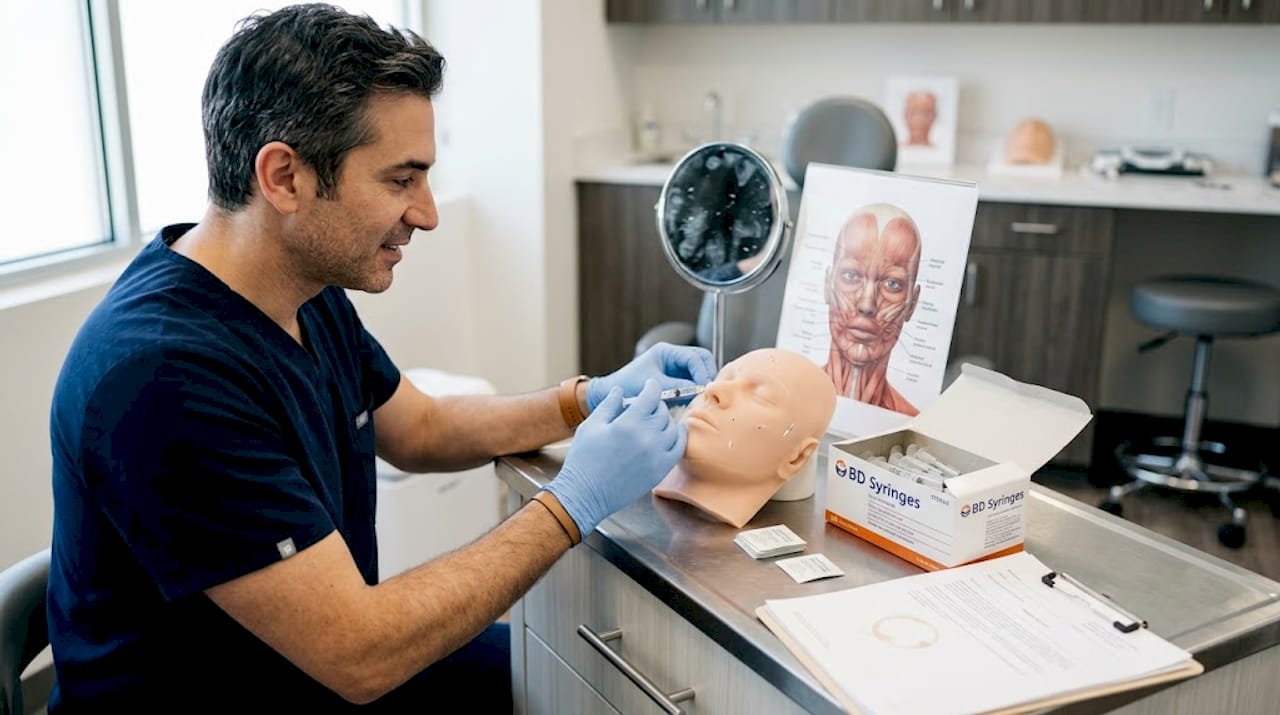
| Complication | Primary cause | Precision-based prevention |
|---|---|---|
| Vascular occlusion | Intravascular injection | Aspiration, slow delivery, danger zone mapping |
| Skin necrosis | Tissue ischemia from compression | Correct depth, low volume per pass |
| Blindness | Retrograde embolism | Avoiding high-risk zones, blunt cannulas |
| Volume irregularity | Improper product layering | Anatomical assessment, incremental dosing |
A safety-first approach follows a clear sequence:
- Pre-treatment facial mapping: Identify individual vascular anatomy and flag high-risk zones before any product is drawn.
- Product and tool selection: Match filler viscosity and cannula versus needle choice to the treatment area and tissue depth.
- Incremental, low-volume injection: Place small amounts at a time, assessing tissue response between passes.
- Immediate complication monitoring: Watch for blanching or mottled skin, which signals compromised blood flow, and act within minutes if needed.
- Post-treatment review: Confirm symmetry and absence of early ischemia signs before the client leaves.
The timing of intervention matters enormously. Early ischemia intervention by a skilled practitioner reverses approximately 80% of cases. That window is narrow. This is why the role of anatomy in safe treatments and having a provider trained to recognize and respond to complications is non-negotiable.
Pro Tip: Before any injectable appointment, ask your provider specifically about their training in complication recognition and reversal. A confident, clear answer is a strong signal of genuine expertise. You can also explore reducing side effects in aesthetics for a broader look at how planning shapes outcomes.
Personalized skin assessment: foundation of precision in aesthetics
Once you understand the risks that precision prevents, the next question is how providers actually build that precision into every appointment. The answer starts well before any needle is involved. It starts with assessment.
Modern aesthetic care uses objective tools to evaluate your skin far beyond what the eye alone can detect. Skin biotyping, barrier integrity analysis, and standardized measurement frameworks give providers a structured baseline. The Skin Quality Index standardizes 15 terms across four dimensions, including texture, tone, firmness, and radiance, creating a shared language for what good skin health actually means.
Standardized protocols and AI imaging enable personalized treatments by evaluating biotypes and barrier integrity objectively. This removes the guesswork. When a provider knows your collagen density, hydration level, and how your skin responds to pressure, the treatment plan reflects your biology, not a generalized protocol.
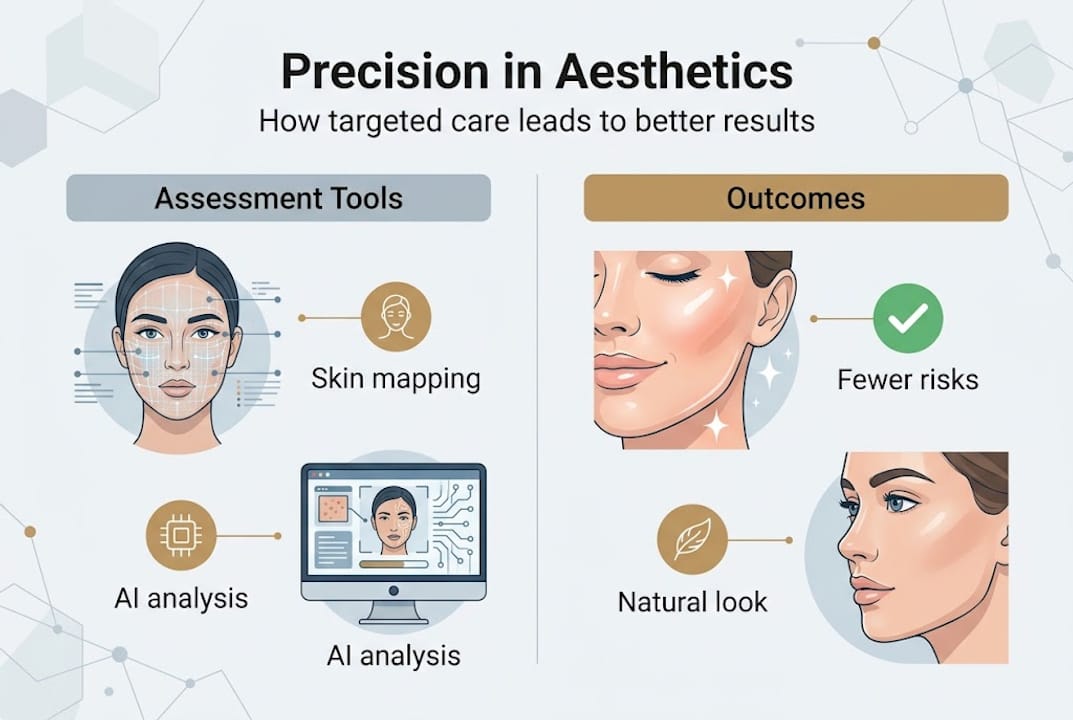
| Assessment method | What it measures | Key advantage |
|---|---|---|
| Traditional visual exam | Surface texture, tone, visible lines | Fast, accessible |
| AI skin analysis | Pore size, pigmentation, barrier function | Objective, data-driven |
| 3D imaging | Volume, symmetry, structural depth | Precision planning over time |
| Barrier integrity testing | Hydration, TEWL, sensitivity markers | Guides product compatibility |
3D and photonic imaging adds another layer by mapping facial volume and structural asymmetry so that treatment plans can be built with spatial accuracy. This is especially useful for tracking subtle changes over multiple sessions, confirming that progress is measured and intentional.
The most impactful assessment tools and what they capture:
- AI skin cameras: texture irregularities, subsurface pigmentation, pore distribution
- 3D volumetric imaging: structural asymmetry, depth of folds, volume deficit mapping
- Transepidermal water loss (TEWL) meters: barrier health and sensitivity risk
- Elasticity probes: collagen and elastin integrity to guide product viscosity selection
You can explore advances in aesthetics technology to understand how these tools are integrated into personalized care planning. The point is simple: objective data makes the subjective goal of natural results more achievable.
Precision for unique faces: edge cases and advanced tools
Standardized assessment tools set a strong foundation, but some faces and situations call for an even more individualized approach. This is where precision becomes non-negotiable rather than just advisable.
Thinner skin around the eyes and lips is structurally different from mid-face tissue. It holds product differently, shows irregularities more readily, and responds to inflammation more visibly. Prior treatments add another layer of complexity because scar tissue, residual product, or changed tissue planes alter how new injections behave. These are not rare scenarios. They are the everyday reality of real clients with real histories.
Ultrasound guidance reduces hyaluronidase dose for occlusion by 10x, making it one of the most significant tools available for high-complexity cases. By visualizing tissue in real time, providers can confirm product placement, identify prior filler deposits, and navigate safely around vessels that standard surface mapping cannot detect. AI for advanced personalization further refines this by predicting how different skin types respond to specific treatments before the first session begins.
Signs that your situation calls for advanced assessment:
- Previous filler treatments in the same area, especially if results were uneven or unexpected
- Visible scarring from prior procedures, injury, or surgery near the planned treatment zone
- Known sensitivities or history of inflammatory responses to injectables
- Revision goals, where an existing result needs correction rather than a fresh start
- Structural asymmetry that requires careful, graduated correction to avoid overcorrection
For clients with facial feature variations that fall outside average anatomical norms, a bespoke approach is not a luxury. It is the standard of care. Precision scales up with complexity.
Pro Tip: If you have had prior treatments elsewhere, or if your anatomy includes features your provider hasn’t commented on, ask directly whether imaging-guided therapy would be appropriate for your case. A provider committed to precision will welcome the question.
Why precision is the true art of natural aesthetics
Here is something worth saying plainly: the most impressive aesthetic results are the ones nobody notices. Not because nothing changed, but because the change fits so seamlessly that it reads as you, only more rested, more supported, more yourself.
Precision is what makes that possible. It is not just a safety protocol. It is the difference between enhancement and alteration, between a result that belongs to your face and one that doesn’t. The trend toward heavier volume and maximalist aesthetics misses something important: real beauty is quiet. It doesn’t announce itself.
What we see in Raleigh clients is consistent. People don’t come in wanting to look different. They come in wanting to look better, and those are not the same request. The goal is confidence, not change for its own sake.
Precision requires both a trained eye and a steady hand, but more than either of those, it requires restraint. The discipline to stop when a result is right, rather than continuing because more product remains in the syringe, is a skill. It’s the mark of someone who understands that the face in front of them is not a canvas to fill but a structure to support. That perspective is what drives medically-led spa benefits and why it produces outcomes that hold up over time.
Experience precision-driven aesthetics in Raleigh, NC
If this way of thinking about aesthetic care resonates with you, the next step is finding a team that puts it into practice, every appointment, every time.
At The Aesthetics Lounge and Spa Raleigh, precision is built into every consultation. Your appointment begins with a thorough assessment of your skin and facial structure, not a menu of options. Treatment plans are individualized using advanced tools, and every decision is explained before anything moves forward. Explore our Raleigh aesthetic treatments or take a closer look at our injectables to understand what’s possible. You can also review how we approach planning for fewer side effects as part of every client’s care strategy.
Frequently asked questions
What are facial danger zones and why are they important?
Facial danger zones are specific anatomical areas where blood vessels sit close to the surface, making them higher-risk sites for complications like vascular occlusion or blindness. The glabella carries the highest blindness risk, while the nasolabial fold accounts for 32.4% of documented necrosis cases. Providers trained in these zones use precision techniques to treat safely.
How does technology improve precision in aesthetics?
AI and 3D imaging create an objective picture of your skin’s structure, hydration, and volume so providers can build a treatment plan tailored to your biology rather than a generalized estimate. AI accuracy reaches 85 to 95% in aesthetic skin analysis, and the Skin Quality Index standardizes 15 assessment terms to ensure consistent evaluation across appointments.
Can precision reduce the risk of complications with injectables?
Yes. Precise placement, appropriate product selection, and danger zone mapping significantly lower the likelihood of necrosis, vascular occlusion, and unnatural results. Precision in non-surgical treatments prevents vascular occlusions by keeping injections within safe anatomical boundaries.
What should I look for in a provider to ensure precision?
Look for providers who conduct a thorough skin and structural assessment before recommending any treatment, discuss your specific anatomy rather than offering a standard menu, and can clearly explain their approach to complication recognition and reversal.
Is precision equally important for every skin type or age?
Precision matters for everyone, but it becomes especially critical for clients with thinner skin, prior treatments, or anatomical features outside average norms. Thinner periocular and lip skin, along with prior filler history, alter tissue behavior and require even more careful depth control and product selection.