TL;DR:
- Conservative aesthetic treatments focus on subtle, precision-based enhancements for natural-looking results.
- They prioritize safety, reversibility, and long-term skin health over dramatic changes.
- Most clients prefer these methods for authentic confidence and graceful aging.
The fear of walking out of a provider’s office looking like a different person is real, and it stops many people from ever exploring aesthetic care. That hesitation makes sense. You have seen results that look stiff, overfilled, or simply off, and the last thing you want is to trade one concern for another. Here is what most people do not realize: looking refreshed does not require dramatic intervention. Conservative aesthetic treatments are built around restraint, anatomy, and precision. They work with your face, not against it, and the results are quiet enough that people notice you look well, not worked on.
Table of Contents
- What does ‘conservative’ mean in aesthetic treatments?
- Why subtlety matters: Natural aesthetics and psychological benefits
- Key benefits: Safety, reversibility, and long-term skin health
- Who benefits most? Personalization by age, anatomy, and lifestyle
- Pitfalls and prevention: Avoiding overcorrection and ‘filler fatigue’
- Our take: Why Raleigh adults should prioritize conservative enhancements
- Take the next step: Discover conservative aesthetic treatments in Raleigh
- Frequently asked questions
Key Takeaways
| Point | Details |
|---|---|
| Subtlety preserves natural beauty | Conservative treatments align with facial anatomy for authentic, understated results. |
| Lower risks and reversibility | Non-surgical conservative options have fewer side effects and can be adjusted or reversed. |
| Personalized plans matter | Best outcomes come from treatments tailored to age, lifestyle, and specific facial features. |
| Prevents overfilled appearances | A strategic, conservative approach avoids perception drift and artificial results. |
What does ‘conservative’ mean in aesthetic treatments?
To understand the benefits, it helps to be clear about what conservative actually means in this context. It is not about doing less for the sake of doing less. It is about doing exactly what is needed, where it is needed, guided by your facial anatomy and your goals.
Conservative aesthetic treatments use subtle, anatomy-led enhancements to achieve natural results. That means restoring proportion, softening shadows, and supporting structure without overfilling or distorting. The tools include neuromodulators like Botox, dermal fillers, and energy-based devices like radiofrequency or laser. What separates conservative care from aggressive approaches is not the tool itself but the dose, placement, and intent.
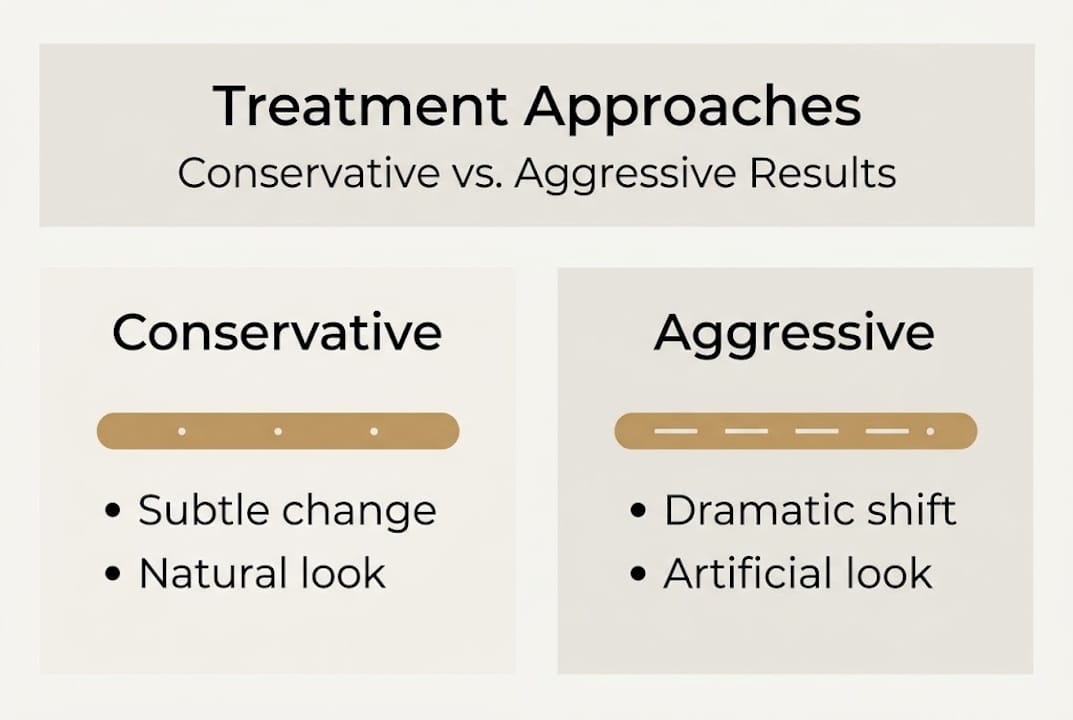
Conservative vs. aggressive approaches at a glance:
| Feature | Conservative approach | Aggressive approach |
|---|---|---|
| Volume added | Minimal, targeted | High, broad |
| Facial movement | Preserved | Often restricted |
| Recovery time | Minimal | Moderate to significant |
| Risk of overcorrection | Low | Higher |
| Reversibility | Easier | More complex |
Areas commonly addressed with conservative methods include the chin, jawline, nasolabial folds, and periorbital zone (the area around the eyes). Each of these responds well to small, precise adjustments. The goal is balance, not transformation.
By contrast, aggressive treatments can cause unnatural distortion due to overcorrection. When too much product is placed too quickly, the face loses its natural contour and movement. That is the look most people are trying to avoid.
Key principles of conservative care:
- Treat one area at a time and assess before adding more
- Prioritize symmetry and proportion over volume
- Use the lowest effective dose of any injectable
- Revisit and adjust rather than front-load
Pro Tip: If you are new to injectables, slow-paced treatments allow you to see how your face responds before committing to more. Starting small is not timid. It is smart.
Why subtlety matters: Natural aesthetics and psychological benefits
With this foundation in place, it is worth exploring why subtle results are increasingly valued, and not just for their visual appeal.
There is growing evidence that natural-looking enhancements produce stronger psychological outcomes than dramatic ones. Natural aesthetics improve psychological satisfaction and long-term self-confidence, particularly when results align with a person’s existing features rather than replacing them.
“The goal is not to look like someone else. It is to look like the best, most rested version of yourself.”
This matters because aesthetic satisfaction is not just about the mirror. It is about how you feel in a conversation, in a photo, at work. When results look believable, you carry them differently. There is no self-consciousness about whether someone can tell. You simply feel more like yourself, with a little more support.
Conservative dosing also has long-term skin health benefits that are easy to overlook. Certain fillers stimulate collagen production over time, which means the skin itself improves, not just its surface appearance. Neuromodulators used at low doses preserve natural expression while reducing the repetitive muscle movement that deepens lines.
The benefits of being subtle extend to sustainability as well. Overfilling creates a cycle: as filler stretches tissue, more product is needed to maintain the look. Conservative plans avoid that cycle entirely.
Why patients prefer natural results:
- Results integrate with existing features rather than replacing them
- Confidence feels authentic, not performance-based
- Skin quality improves alongside appearance
- No need for frequent, escalating corrections
- Results age gracefully rather than becoming more obvious over time
Key benefits: Safety, reversibility, and long-term skin health
Psychological comfort is not the only upside. The practical case for conservative care is just as strong, especially when you weigh safety and longevity.
Non-surgical conservative methods improve hydration, elasticity, and collagen with lower risk than surgical or aggressive non-surgical options. That means less downtime, fewer complications, and a treatment experience that fits into a real schedule.

Reversibility is another major advantage. Most hyaluronic acid fillers can be dissolved with an enzyme called hyaluronidase if you want to adjust or undo results. Neuromodulators wear off naturally over three to six months. This is not permanent commitment. It is a conversation you can continue to shape.
How conservative and aggressive approaches compare on key outcomes:
| Outcome | Conservative | Aggressive |
|---|---|---|
| Downtime | Hours to 1 day | Days to weeks |
| Complication rate | Low | Moderate to high |
| Reversibility | High | Low to moderate |
| Collagen support | Yes (with some fillers) | Variable |
| Long-term tissue health | Preserved | Risk of stretching |
Steps to evaluate any treatment plan for safety:
- Ask your provider what the minimum effective dose is for your concern
- Request a phased plan rather than a single large session
- Confirm which products are reversible and how
- Ask how your provider defines a successful outcome before treatment begins
Exploring non-surgical options with a medically guided team ensures that each step is intentional. Energy devices, for example, can improve skin texture and firmness without any product at all, making them a strong complement to fillers and hydration treatments.
Pro Tip: Before any appointment, ask your provider directly: “What would you not do to my face today, and why?” A confident, conservative provider will have a clear answer.
Who benefits most? Personalization by age, anatomy, and lifestyle
Who typically opts for these subtle approaches, and what can they expect?
Conservative treatments work well for adults across a wide age range, roughly 25 to 70, though the goals and methods shift with each decade. In your 30s and 40s, the focus is often prevention. Low-dose neuromodulators soften early lines before they become fixed, and light filler support maintains structure without adding volume that looks out of place.
Preventive subtle enhancements in the 30s and 40s delay aging and are particularly preferred for periorbital areas by men aged 30 to 65. The periorbital zone, which includes crow’s feet and tear troughs, is often the first area men address, and conservative treatment there produces results that read as rested rather than treated.
It is worth noting that over-elevation reduces perceived attractiveness and trustworthiness, which is why conservative periorbital treatments are strongly advised over aggressive brow-lifting approaches.
Who is a strong candidate for conservative care:
- Adults in their 30s seeking early prevention
- Patients in their 50s and 60s wanting to restore structure without surgery
- Men focused on periorbital refreshment
- Anyone with high sun exposure or a history of smoking, where skin integrity needs careful management
- Clients who want gradual, authentic change rather than a single dramatic result
Personalized aesthetics treatment plans account for your anatomy, lifestyle, and timeline. There is no universal protocol. What works for one person’s jawline may not suit another’s, even if they are the same age.
Pitfalls and prevention: Avoiding overcorrection and ‘filler fatigue’
Even with all these benefits, it is worth knowing what can go wrong without a measured approach.
One of the most common risks is perception drift. Over time, a person becomes accustomed to a slightly altered appearance and begins to request more product to maintain what now feels normal to them. Aggressive treatments can result in distorted features like “pillow face” or “duck lips” precisely because of this gradual escalation, not a single bad decision.
Filler fatigue is a related concern. When filler accumulates in tissue over multiple sessions without adequate time for the body to process it, the face can look heavy, uneven, or puffy. Filler fatigue and overfill often require reversal, and early intervention helps prevent escalation to more invasive correction.
“Less is more. Start small and reevaluate often.”
How a conservative plan prevents escalation:
- Begin with the lowest dose that addresses the concern
- Wait at least two weeks before assessing results
- Schedule a follow-up review before any additional treatment
- Document changes with photos to maintain objectivity
- Allow a provider to advise against more treatment when the result is already strong
The value of pace and moderation cannot be overstated. A provider who encourages you to wait, to assess, to hold off, is protecting your outcome, not limiting it.
Our take: Why Raleigh adults should prioritize conservative enhancements
Here is something we see consistently: the clients who are most satisfied with their results are not the ones who asked for the most. They are the ones who trusted a measured plan and gave it time.
In Raleigh’s professional and social environment, subtlety carries real weight. An overdone look does not signal confidence. It signals effort, and not the kind most people want noticed. The trendy, heavily filled aesthetic that circulates on social media rarely translates well in real life, and it almost never ages gracefully.
A provider’s willingness to say “not yet” or “you do not need that” is one of the clearest signs of genuine expertise. It takes more skill to hold back than to add. We believe that medically guided workflows produce the best long-term outcomes because they evolve with you, rather than locking you into a look that made sense at one moment in time.
Conservative care is not the cautious option. It is the confident one.
Take the next step: Discover conservative aesthetic treatments in Raleigh
Natural results do not happen by accident. They come from a knowledgeable provider, a thoughtful plan, and the patience to let good work speak quietly.
At The Aesthetics Lounge and Spa Raleigh, every consultation starts with listening and planning before any treatment is discussed. If you are ready to explore what a conservative, medically guided approach could look like for you, browse our full range of aesthetics treatments or learn more about what sets medically led spas apart. You can also explore examples of natural results to see what refined, believable enhancement actually looks like. When you are ready, we are here.
Frequently asked questions
What is the main difference between conservative and aggressive aesthetic treatments?
Conservative enhancements restore proportion without overfilling, while aggressive methods aim for dramatic change and carry a higher risk of overcorrection. The distinction lies in dose, intent, and respect for your natural facial structure.
Are conservative treatments safer than surgery?
Yes. Non-surgical conservative methods carry lower risks, require less downtime, and are reversible in most cases, making them a practical and lower-commitment option compared to surgical procedures.
How do I avoid an ‘overdone’ look with fillers or Botox?
Choose a provider who follows anatomy-based approaches and prioritizes subtle, phased improvements. The right provider will encourage you to wait and assess before adding more.
Can subtle treatments really make a visible difference?
Absolutely. Conservative methods restore balance and structure in a way that reads as naturally refreshed. The difference is real; it simply does not announce itself.