
TL;DR:
- Modern facial mapping is a precise, data-driven clinical process that enhances natural aesthetic outcomes.
- It uses advanced imaging and structured frameworks to assess facial anatomy, ensuring personalized treatment plans.
- Individualized mapping improves safety, results, and patient satisfaction by grounding decisions in objective data.
Facial mapping has a reputation problem. Many people still associate it with vague wellness trends or ancient traditions that have little to do with modern medicine. The reality is quite different. Today, facial mapping is a clinically grounded, data-driven process that forms the foundation of safe, natural-looking aesthetic care. It blends anatomical precision with artistic judgment, and when done well, the results are quietly transformative. You still look like yourself. Just more rested, more supported, more like the version of you that feels right.
Table of Contents
- What is facial mapping? The science behind the trend
- Key facial mapping frameworks: ART CODES, 10-7 analysis, and more
- How facial mapping is used in non-surgical aesthetic treatments
- What to expect from a facial mapping assessment in Raleigh, NC
- Why individualized facial mapping is the future of natural aesthetics
- Discover advanced facial mapping in Raleigh, NC
- Frequently asked questions
Key Takeaways
| Point | Details |
|---|---|
| Facial mapping is science-based | Modern facial mapping uses data-driven tools and frameworks for reliable, natural, and safe results. |
| Personalization delivers best outcomes | Individual mapping ensures enhancements look natural and align with your facial structure. |
| Technology boosts accuracy | Advanced systems like VISIA and AI skin analysis provide precise, consistent measurements for planning treatments. |
| Consult specialists for success | Getting mapped and treated by trained professionals raises satisfaction and reduces risks. |
What is facial mapping? The science behind the trend
Modern facial mapping is not a trend. It is a structured clinical method for evaluating your face before any treatment begins. It considers facial structure, skin health, symmetry, volume distribution, and how your face moves. The goal is to understand what is actually happening beneath the surface before making any decisions about what to address and how.
This is where it separates itself from older, less precise approaches. Traditional beauty analysis often relied on subjective observation, general categories, or surface-level assessments. Modern facial mapping uses calibrated imaging technology, standardized frameworks, and clinical data to make assessments that are accurate and repeatable.
One of the most significant tools in this space is VISIA complexion analysis, a multispectral imaging system that captures detailed data on skin texture, pores, pigmentation, UV damage, and more. The precision here is not incidental. VISIA repeat variation under 2% means that measurements are highly consistent across sessions, and AI-assisted skin age analysis achieves accuracy rates between 85 and 95%. That level of reliability changes how treatment planning works entirely.
Here is what a modern facial mapping assessment typically evaluates:
- Facial symmetry and proportions, including the golden ratio and how your features relate to one another
- Volume distribution, identifying areas of loss or excess that affect how light falls on your face
- Skin quality markers, such as texture, hydration, pigmentation, and structural integrity
- Dynamic movement, meaning how your face changes when you smile, speak, or express emotion
- Bone structure and soft tissue relationships, which determine how treatments will interact with your anatomy
| Assessment method | Technology used | What it measures |
|---|---|---|
| VISIA complexion analysis | Multispectral imaging | Skin texture, UV damage, pores, pigmentation |
| 3D stereophotogrammetry | High-resolution 3D camera | Volume, symmetry, contour changes over time |
| AI skin analysis | Machine learning algorithms | Estimated skin age, condition scoring |
| Clinical visual assessment | Trained provider observation | Movement, expression, structural balance |
“The most natural-looking outcomes come not from treating what you see, but from understanding what you cannot see with the naked eye. Precision begins before the first treatment.”
3D stereophotogrammetry, another advanced imaging method, achieves an intraclass correlation coefficient above 0.95, which in clinical terms means near-perfect reliability. These are not soft estimates. They are measurable, reproducible findings that make personalized treatment planning genuinely possible.
Key facial mapping frameworks: ART CODES, 10-7 analysis, and more
Now that we understand the basics, it is important to explore the structures and systems that shape facial mapping in aesthetic medicine. Practitioners do not simply look at your face and make intuitive calls. They apply structured frameworks that have been refined through clinical research and real-world application.
Two of the most widely used systems today are the ART CODES framework and the 10-7 analysis method. Understanding what these involve helps you appreciate why a well-planned consultation looks and feels different from a rushed one.
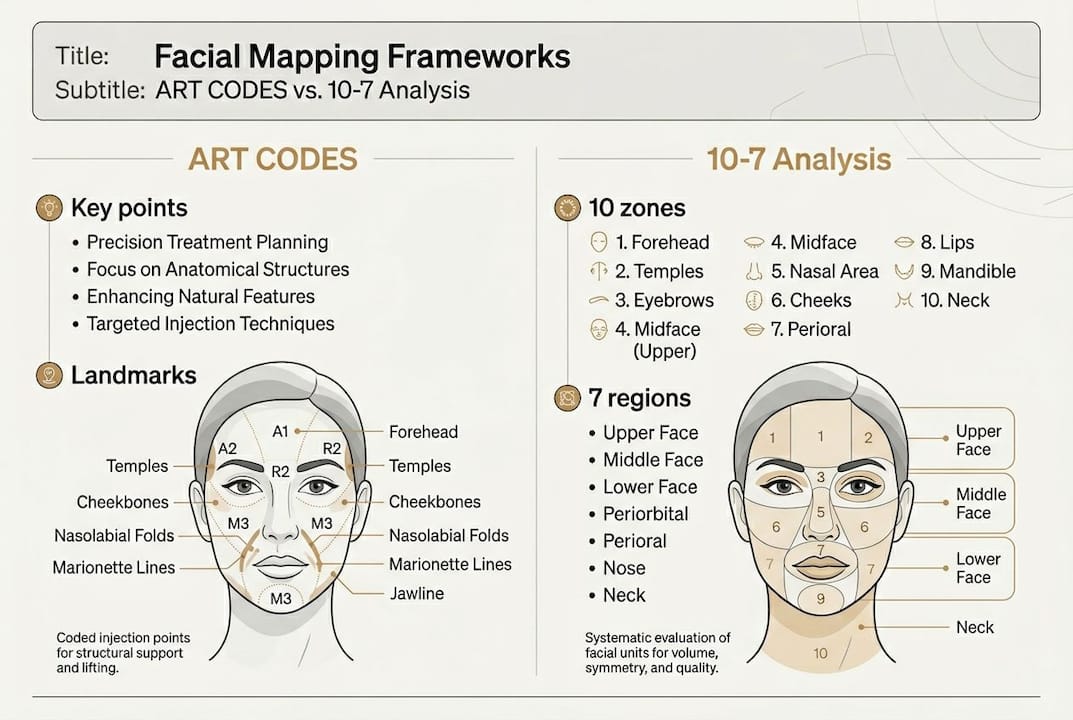
The ART CODES framework organizes the face into points, lines, and planes. It evaluates specific anatomical landmarks and how they relate to one another in three dimensions. This approach supports a holistic view of facial balance rather than treating isolated features in isolation. When a provider uses this framework, they are considering how a change in one area will affect the visual harmony of the whole face.
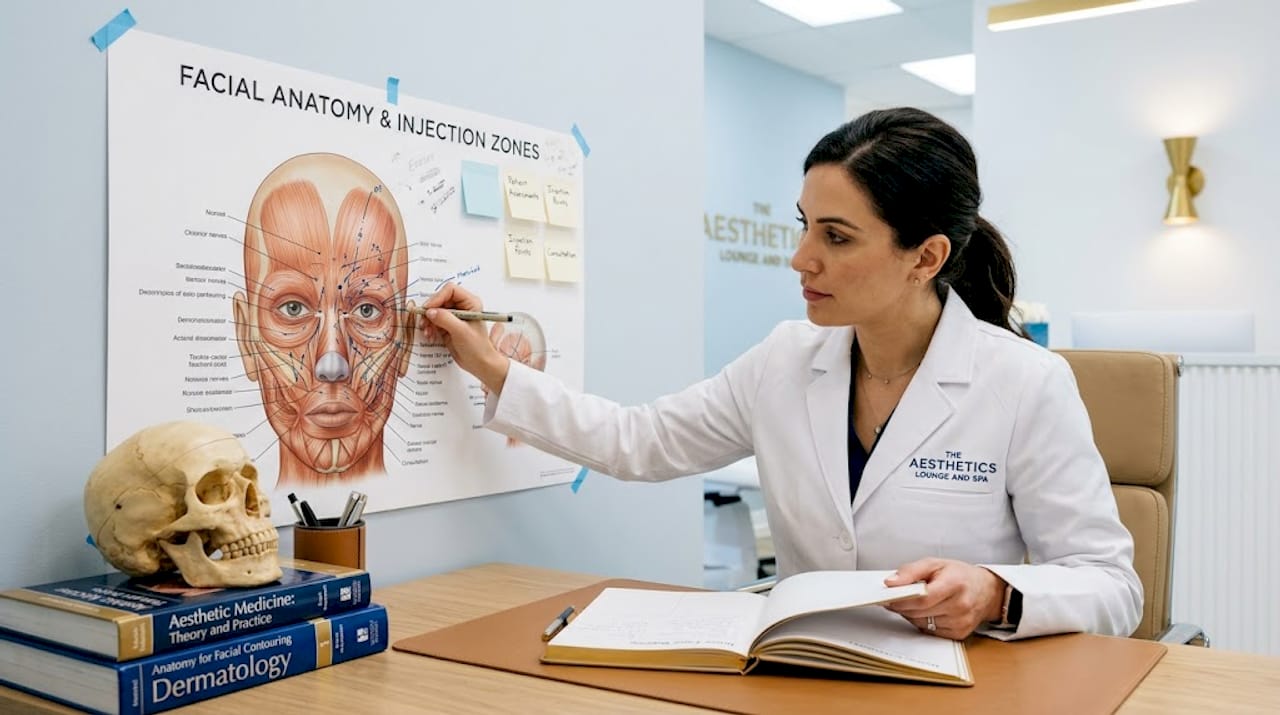
The 10-7 analysis method divides the face into 10 frontal and 7 lateral regions, giving practitioners a systematic way to evaluate the face from multiple angles. This is particularly useful for planning procedures that address volume loss, skin laxity, or structural asymmetry. Each region is assessed independently and in relation to adjacent zones, which prevents the kind of piecemeal thinking that leads to unnatural outcomes.
Dynamic assessment adds another layer of sophistication. Some practitioners use what researchers call “smiling cadaver” studies to understand how fat compartments shift with facial movement. This matters because a face at rest and a face in motion are genuinely different structures. Treatments that only account for static anatomy can look stiff or unnatural when a person laughs or speaks.
Here is how these frameworks compare in practical application:
| Framework | Primary focus | Best used for | Key advantage |
|---|---|---|---|
| ART CODES | Points, lines, planes | Overall facial balance | Holistic, 3D perspective |
| 10-7 analysis | Regional zone mapping | Lifting, volume planning | Systematic, angle-specific |
| Dynamic assessment | Movement and fat compartments | Expression-related concerns | Accounts for motion |
| Golden ratio analysis | Proportional relationships | Symmetry correction | Mathematically grounded |
Understanding facial structure basics is the starting point for applying any of these frameworks meaningfully. And because each person’s anatomy is genuinely different, a provider trained in facial anatomy in aesthetics will use these frameworks as guides, not rigid scripts.
Pro Tip: Ask your provider which framework they use during your consultation. A practitioner who can explain their approach clearly is one who has invested in the depth of training that produces natural, lasting results.
It is also worth noting what these frameworks are not. Ancient Chinese facial reading, which maps organs to facial zones, is a separate tradition with no role in modern aesthetic medicine. Contemporary facial mapping is anatomical and evidence-based, not interpretive.
A detailed step-by-step facial assessment brings all of these frameworks together into a coherent consultation process that informs every treatment decision.
How facial mapping is used in non-surgical aesthetic treatments
Armed with an understanding of frameworks, let us see how practitioners put facial mapping into action for non-surgical enhancement. The connection between mapping and treatment is direct. What you learn in the assessment phase shapes every decision that follows, from which product to use to exactly where and how much to place it.
Injectables become more precise. When a provider maps your facial anatomy before administering neuromodulators or dermal fillers, they know where your blood vessels and nerves run. This is not a minor detail. Vascular occlusion, a rare but serious complication from filler, is significantly less likely when the injector has a clear, individualized picture of your anatomy. Mapping does not just improve aesthetics. It improves safety.
Results look natural, not constructed. One of the most common concerns people bring to consultations is the fear of looking “done.” That outcome is almost always the result of treating features in isolation without considering the whole face. Facial mapping prevents this by anchoring every decision in the context of your overall facial structure. The goal is enhancement that reads as rested, not altered.
Key ways facial mapping improves non-surgical outcomes:
- Volume placement is guided by where natural fat compartments have shifted, not just where hollowness is visible
- Neuromodulator dosing is calibrated to your specific muscle mass and movement patterns
- Skin treatments are selected based on imaging data, not general skin type categories
- Treatment sequencing is planned so that each step supports the next, rather than addressing concerns randomly
- Maintenance intervals are personalized to how your skin and structure respond over time
The clinical evidence supports this approach. A proof-of-concept study of 130 patients found that 95% of patients and 98% of practitioners rated midface rejuvenation outcomes as improved when treatments were guided by structured facial mapping. Those are not marginal gains. They reflect a meaningful difference in how people experience their results.
Understanding the facial rejuvenation benefits of a mapped approach helps clarify why this method consistently outperforms generalized treatment protocols. For practical guidance on maintaining those results, rejuvenation tips and a clear understanding of the rejuvenation process are valuable companions to your initial consultation.
Pro Tip: If a provider moves straight to treatment recommendations without first assessing your facial structure, that is a signal to slow down. A thorough mapping session is not overhead. It is the work that makes everything else more effective.
What to expect from a facial mapping assessment in Raleigh, NC
Understanding the value of mapping in treatments, you might wonder what is actually involved in a real-world assessment. Here is what to expect when you arrive for a facial mapping consultation at a medically led practice.
1. Advanced imaging comes first. Before any conversation about treatment, your skin and facial structure are documented using clinical imaging tools. This might include VISIA complexion analysis, 3D photography, or both. These images become your baseline. They capture details that are invisible to the naked eye and provide an objective record of your starting point.
2. The data is reviewed together. Your provider walks you through what the imaging reveals. This is not a sales presentation. It is an educational conversation. You see your skin’s UV damage, texture patterns, and structural asymmetries in detail. Many clients find this part genuinely eye-opening. The AI skin age accuracy of 85 to 95% means the analysis reflects your actual skin biology, not a generalized estimate.
3. Lifestyle and health context is gathered. Skin and structure do not exist in isolation. Your provider will ask about sun exposure habits, skincare routine, stress levels, sleep quality, hydration, and any previous treatments. This context shapes how your face has aged and how it will respond to treatment.
4. A treatment plan is built collaboratively. Based on imaging data, clinical observation, and your personal goals, a treatment strategy is proposed. This is not a menu of services. It is a sequenced plan that considers what to address first, what to defer, and what to monitor over time.
5. You leave with clarity, not pressure. A well-run consultation ends with you understanding your options, the reasoning behind each recommendation, and the expected timeline. Decisions are yours to make, at your pace.
Reviewing the facial assessment steps in detail before your appointment helps you arrive prepared and confident. For a broader view of what is available, exploring aesthetics and skincare resources gives you a clear picture of the full range of support available.
Why individualized facial mapping is the future of natural aesthetics
Here is an honest observation from years of working in this field. The most common regrets in aesthetic medicine do not come from people who did too little. They come from people who were treated without a plan.
Generic approaches, where a provider looks at a concern and addresses it directly without contextualizing it within the whole face, produce results that can feel off even when they are technically correct. A perfectly placed filler in the wrong location relative to your overall structure creates imbalance. A neuromodulator dose calibrated to a population average, rather than your specific muscle mass, produces results that look borrowed from someone else’s face.
Individualized facial mapping solves this. When every decision is anchored in your specific anatomy, your skin’s actual condition, and your natural movement patterns, the results do not announce themselves. They simply make you look like a more rested, more supported version of yourself. That is the standard worth holding.
The most skilled practitioners we know do not separate artistry from clinical data. They use data to inform artistry. The imaging tells them what is objectively present. The frameworks give them a language for understanding relationships between facial zones. And their clinical judgment translates all of that into a treatment approach that fits you specifically.
Thinking carefully about choosing treatments naturally is not about being conservative for its own sake. It is about being accurate. The future of aesthetics is not more product or more procedures. It is better information, applied with more precision, in service of outcomes that genuinely last.
Discover advanced facial mapping in Raleigh, NC
If this article has clarified what facial mapping actually involves, the natural next question is where to experience it done well.
At The Aesthetics Lounge and Spa Raleigh on Six Forks Road, every consultation begins with a structured facial assessment before any treatment is discussed. Our medically led team uses advanced imaging, established anatomical frameworks, and a genuinely unhurried approach to build a plan that fits your face and your goals. Explore our full range of aesthetic treatments in Raleigh or learn more about top non-surgical aesthetic treatments that deliver natural results. You can also read about the medically led spa benefits that set this kind of practice apart. When you are ready, we are here to plan carefully and treat with precision.
Frequently asked questions
Is facial mapping the same as traditional Chinese facial reading?
No. Modern facial mapping in aesthetics is based on anatomy and clinical science. Ancient Chinese organ mapping is a separate tradition and plays no role in contemporary aesthetic medicine.
How accurate are facial mapping methods?
Clinical imaging systems like VISIA show less than 2% repeat variation, and AI-assisted skin analysis achieves accuracy between 85 and 95%, making modern mapping highly reliable.
Can facial mapping help prevent unnatural results?
Yes. Individualized mapping ensures that every treatment decision is grounded in your specific anatomy. A 130-patient proof-of-concept study showed 95% of patients rated their mapped midface rejuvenation outcomes as improved.
Is facial mapping safe for all skin types and ages?
When performed by qualified professionals, facial mapping is non-invasive, safe, and adaptable to all skin types and age groups. It is an assessment process, not a treatment itself.
How long does a facial mapping consultation take?
A thorough facial mapping session typically lasts between 30 and 60 minutes, depending on the depth of imaging analysis and how much time is spent on collaborative treatment planning.