TL;DR:
- Clear, specific communication of goals enhances aesthetic results and patient satisfaction.
- Use visuals and medical terminology to accurately express desired outcomes.
- Building a collaborative partnership with your provider ensures more natural, personalized results.
Miscommunication is one of the most common reasons aesthetic results fall short of expectations. You leave the appointment looking different, not better. That gap between what you envisioned and what you received rarely comes from a lack of skill. It comes from a conversation that wasn’t specific enough. Whether you’re considering injectables, facial harmonization, or clinical skincare, the clarity you bring to your consultation shapes everything that follows. This guide walks you through how to define your goals, prepare your language, participate actively in your consult, and handle the moments when things get complicated.
Table of Contents
- Identify and prioritize your aesthetic goals
- Gather visuals and language: How to express your vision
- Maximize your consultation: Dialog strategies for best results
- Troubleshooting: Navigating challenges and special cases
- A fresh take: Why genuine partnership is your best tool
- Take the next step: Expert, medically guided results in Raleigh
- Frequently asked questions
Key Takeaways
| Point | Details |
|---|---|
| Define your vision | Clarify and prioritize specific goals before your consultation for best results. |
| Use precise language | Medical terms and realistic visuals help avoid misunderstandings and improve outcomes. |
| Actively participate | Take an active role in your consultation by asking questions and stating your motivations. |
| Prepare for challenges | Be ready for emotional nuances or feedback and respond with openness and clarity. |
| Partner with your provider | True satisfaction comes from a collaborative approach with your aesthetics professional. |
Identify and prioritize your aesthetic goals
Before you say a single word to a provider, you need to know what you actually want. That sounds obvious, but most people walk into consultations with a vague sense of wanting to look “better” or “more rested.” That’s a starting point, not a goal.
Start by asking yourself what natural, refreshed not frozen means to you specifically. Does it mean softening forehead lines while keeping full expression? Evening out skin tone without looking treated? Restoring a little volume to the midface without changing your profile? The more precise your answer, the more useful your consultation becomes.
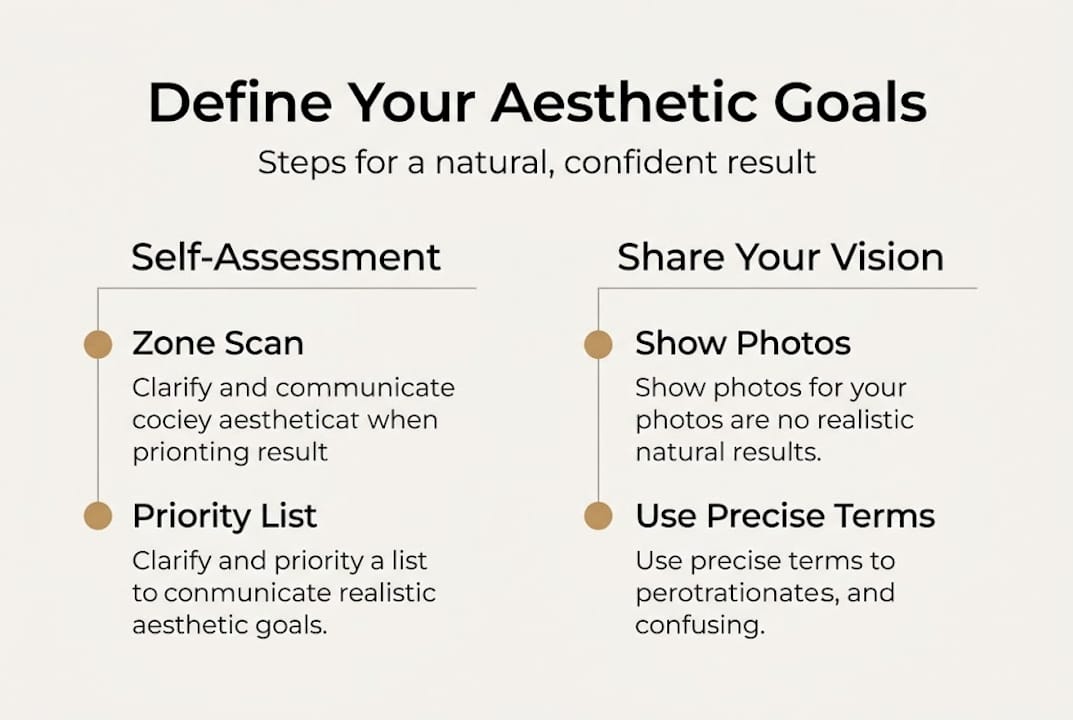
Self-assessing facial areas before your appointment gives you a structured way to notice what bothers you and what you want to preserve. Spend time in natural light, not filtered photos. Look at your face from multiple angles. Notice which areas draw your attention and which ones you’d rather leave untouched.
Here’s a simple way to map your priorities:
| Area of concern | Desired outcome | Priority level |
|---|---|---|
| Forehead lines | Softer, not frozen | High |
| Under-eye area | Less shadowed, more rested | Medium |
| Skin tone | More even, less dull | High |
| Lip volume | Subtle definition only | Low |
| Jawline | Slight lift, natural contour | Medium |
Common priorities clients bring to their first consult include:
- Preserving natural facial movement and expression
- Achieving even skin tone without looking “done”
- Smoothing texture while keeping skin looking like skin
- Subtle volume restoration without obvious filler
- Refreshed appearance that colleagues won’t be able to pinpoint
Self-assessment and zone prioritization support subtle, harmonious results by helping providers understand your face as a whole, not just isolated concerns.
Pro Tip: Focus on one or two areas per treatment cycle. Addressing too many zones at once increases the risk of results that feel unbalanced or overdone. Restraint, especially early on, is what keeps outcomes looking believable.
Thoughtful self-assessment also saves time in the room. When you arrive knowing your priorities, your provider can spend less time drawing out basic information and more time building a plan that fits your face.
Gather visuals and language: How to express your vision
Once you know your priorities, the next step is preparing the tools and language to communicate them clearly. Visuals and vocabulary are your two most practical assets.
When it comes to reference images, the goal is clarity, not aspiration. Follow these steps:
- Choose photos of people with similar facial structure, skin tone, and age range to your own.
- Select images that show a result you’d be happy with, not a face you wish you had.
- Use multiple images to show a range, not just one ideal outcome.
- Include examples of what you don’t want, not just what you do.
- Bring photos of yourself at a younger age if volume restoration is a goal.
“Visuals can help clarify intent, but unrealistic references harm communication and can set the stage for disappointment. Celebrity photos, in particular, often reflect lighting, makeup, angles, and editing, not actual treatment outcomes.”
Language matters just as much as images. Using medical terms signals that you’ve thought carefully about your goals and helps your provider respond with equal precision. Here’s a quick reference:
| Colloquial phrase | Preferred medical term | Why it helps |
|---|---|---|
| “Lip filler” | “Hyaluronic acid lip augmentation” | Specifies product type and intent |
| “Botox for wrinkles” | “Neuromodulator for dynamic lines” | Clarifies mechanism and target |
| “Face lift in a syringe” | “Volumetric facial restoration” | Sets realistic expectations |
| “Get rid of my lines” | “Soften static rhytids” | Indicates subtlety, not erasure |
Education dominates aesthetic consultations, which can sometimes limit how much space you have to share your own perspective. Knowing the right language helps you hold your ground and stay part of the conversation.
When choosing treatment language, focus on outcomes rather than procedures. Say “I want to look rested without looking altered” rather than “I want filler everywhere.” That framing invites a collaborative response.
For a deeper look at industry terms explained, having that vocabulary ready before your appointment makes the entire consult more productive.
Pro Tip: Practice saying terms like “facial harmonization,” “neuromodulator,” and “soft tissue augmentation” out loud before your appointment. Familiarity with these words makes you a more confident participant in the conversation.
Maximize your consultation: Dialog strategies for best results
Now that you’re equipped to express your vision, here’s how to make the most of the time you have with your provider.
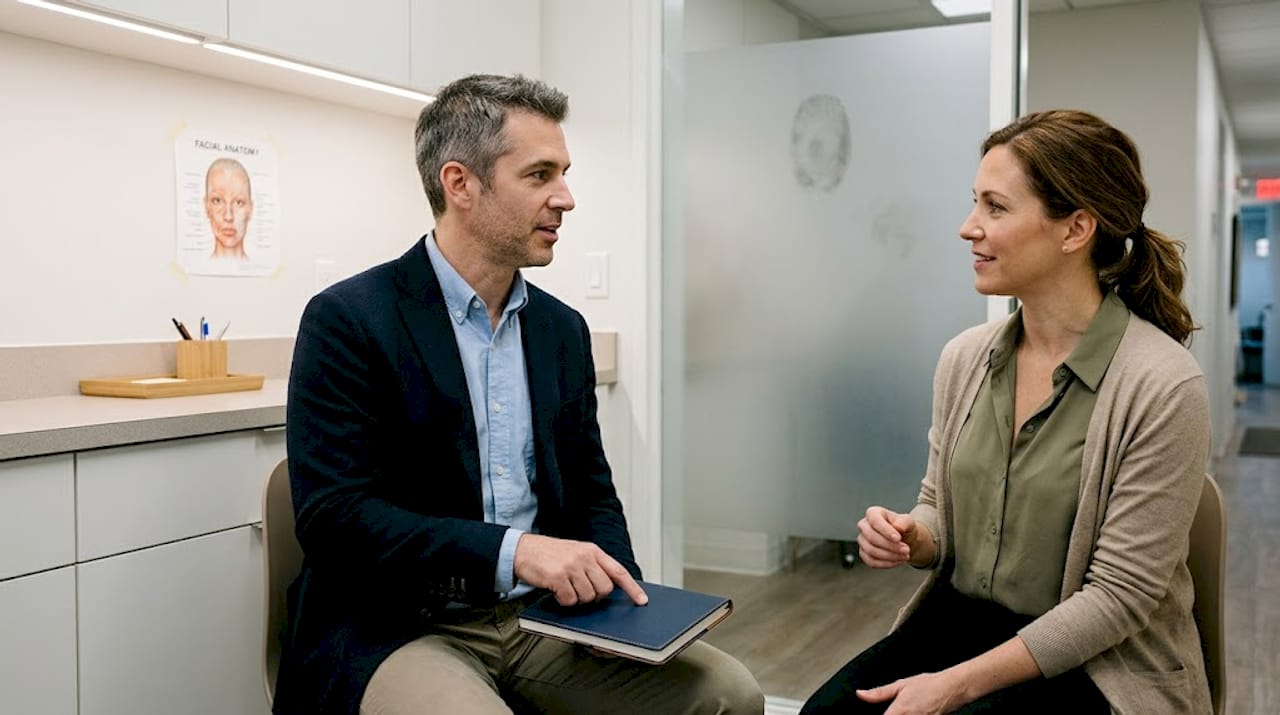
Communication quality explains nearly 29% of satisfaction variance in aesthetic outcomes. That’s a significant portion of your result that has nothing to do with technique. It’s entirely about the conversation.
Use these strategies during your consult:
- Open with your emotional goal, not just the physical one. “I want to feel more confident in meetings” gives your provider context that “fix my forehead” does not.
- State what you want to preserve. “I love my natural expression and I don’t want to lose it” is just as important as describing what you’d like to change.
- Ask your provider to explain their recommendation in plain terms before agreeing.
- Request to see before-and-after photos of patients with similar features and goals.
- Ask directly: “What result would you consider a success for someone like me?”
- If something feels unclear, say so. “Can you summarize what we’ve agreed on?” is a completely appropriate question.
Clear communication directly correlates with higher patient satisfaction, and the best way to achieve it is to stay active in the conversation rather than deferring entirely to your provider’s judgment.
Sharing your emotional motivations also matters more than most people realize. Confidence, ease, feeling like yourself again, these are legitimate clinical inputs. Providers who understand why you’re seeking treatment can calibrate their approach more precisely.
For more on how patient education tips support better outcomes, preparation before the appointment consistently leads to more satisfying results. And when choosing natural injectables, knowing your goals in advance helps your provider recommend the right product at the right amount.
Pro Tip: Before leaving the consultation, ask your provider to walk you through the planned treatment one more time. Hearing it summarized confirms you’re both aligned and gives you a final chance to adjust.
Troubleshooting: Navigating challenges and special cases
Even with careful preparation, real conversations are complex. Be ready for these situations.
Common obstacles that can complicate communication include:
- A provider who seems hesitant about your goals or redirects without explanation
- Feeling emotionally attached to an outcome that may not be anatomically achievable
- Difficulty finding words for what you want, especially if you’re new to aesthetic care
- Cultural or personal values around beauty that your provider may not immediately understand
- Anxiety or self-consciousness that makes it hard to speak clearly in the moment
Unrealistic expectations can reduce satisfaction, and providers may decline requests that fall outside what’s safely achievable for your anatomy. This isn’t a rejection. It’s a sign of clinical integrity. If your provider pushes back on a goal, ask them to explain what’s possible instead and what the outcome would look like.
Emotional attachment to a specific result can also work against you. If you’re seeking treatment to resolve a deeper confidence issue, the physical outcome alone may not deliver the satisfaction you’re expecting.
“When technical skill isn’t enough for emotional satisfaction, the gap is almost always traced back to misaligned expectations, not poor execution. Providers who address special considerations in aesthetics including racial and cultural aesthetic priorities, tend to build stronger, longer-term trust with their clients.”
Cultural background also shapes aesthetic priorities in meaningful ways. What reads as “natural” in one context may feel overdone in another. If your cultural values around beauty are relevant to your goals, share them. A good provider will incorporate that perspective into their plan.
If you feel misunderstood at any point, return to your top priority. State it simply. Ask your provider to reflect it back. Understanding your facial structure basics together creates a shared reference point that makes the rest of the conversation easier.
A fresh take: Why genuine partnership is your best tool
Most aesthetic content focuses on what to ask for. We think the more important question is how to build a relationship where asking feels natural.
Technical skill is essential. But technical success alone is insufficient when emotional alignment is missing. The results that clients love most aren’t always the most technically impressive. They’re the ones where the person feels genuinely heard and the outcome reflects who they actually are.
True collaboration means your provider understands not just what you want changed, but what you want protected. It means you feel comfortable saying “that’s not quite right” without fear of being dismissed. That kind of partnership doesn’t happen automatically. It’s built through honest, two-way conversation from the very first appointment.
When you approach your consultation as a co-planning session rather than a transaction, the entire experience shifts. The artistry and the science align. The result looks like you, just more supported. That’s the standard worth holding.
For more on how injectable results and partnership work together, the relationship between patient and provider is where outcomes are truly made.
Take the next step: Expert, medically guided results in Raleigh
You’ve done the preparation. You know your priorities, your language, and your strategies. The next step is finding a provider whose approach matches the care you’ve put into this process.
At The Aesthetics Lounge and Spa Raleigh, every consultation is built around your goals, your anatomy, and your comfort. We offer a full range of aesthetic treatments in Raleigh guided by medical expertise and a genuine commitment to results that look like you. Explore the medically led spa benefits that set this approach apart, and review our facial structure basics guide to arrive even more prepared. Book your consultation on Six Forks Road and experience care that’s calm, precise, and entirely focused on you.
Frequently asked questions
What language should I use to express my goals in a consult?
Use specific medical terms like “neuromodulator” or “soft tissue augmentation” rather than informal phrases. Medical language in consults reduces confusion and signals that you’ve thoughtfully considered your goals.
How do I know if my expectations are realistic?
Share your goals openly and stay receptive to clinical feedback about what your anatomy can support. Providers may decline requests that fall outside what’s safely achievable, and that guidance is worth taking seriously.
Can visuals really help my provider understand my wishes?
Yes, when chosen carefully. Use photos of people with similar features and realistic outcomes. Unrealistic references harm communication and can lead to misaligned expectations before treatment even begins.
What should I do if I feel misunderstood during my consultation?
Restate your top priority clearly, use medical terminology, and ask your clinician to summarize their understanding. Clear communication boosts satisfaction and trust, and it’s always appropriate to pause and realign before moving forward.