
TL;DR:
- Medically guided facial assessments ensure natural, personalized results by evaluating anatomy, skin, and goals.
- These assessments reduce risks of asymmetry, over-treatment, and mismatched expectations through structured analysis and technology.
- Regular, comprehensive evaluations help tailor ongoing treatments to preserve natural appearance and account for individual facial aging patterns.
You want to look like yourself, only more rested. That quiet confidence, not a dramatic change. But without proper medical guidance, even well-intentioned treatments can miss the mark, leaving results that feel off or unrecognizable. A medically guided facial assessment considers your anatomy, skin health, lifestyle, and personal ideals before any treatment is ever discussed. It is the foundation that separates subtle, believable results from ones that raise questions. This article walks through every step of that process, from your first intake form to your personalized plan, so you know exactly what to expect and why each stage matters.
Table of Contents
- Why a medically guided facial assessment matters
- What to expect: Preparation and initial evaluation
- The clinical and instrumental facial assessment: Step-by-step
- Interpreting results and creating your personalized plan
- Why panfacial, patient-centered assessment beats one-size-fits-all
- Connect with medically led facial assessment experts in Raleigh
- Frequently asked questions
Key Takeaways
| Point | Details |
|---|---|
| Medical guidance matters | A structured facial assessment by an expert ensures safer, more natural results tailored to you. |
| Detailed steps ensure personalization | Each step, from intake to tech-assisted measurements, leads to a uniquely designed plan. |
| Holistic, panfacial approach | Assessing the entire face prevents unnatural outcomes and respects your unique beauty. |
| Benchmarks track subtle progress | Valid tools and scales help objectively monitor your improvement over time. |
Why a medically guided facial assessment matters
Skipping a structured assessment is one of the most common reasons people end up with results they did not want. Without a thorough evaluation, a provider is essentially guessing. They may address one concern while overlooking how it connects to the rest of your face. Volume placed in the wrong area, or the wrong amount, can shift proportions in ways that feel subtle but read as unnatural to everyone around you.
A structured facial assessment changes that. It creates a clear picture of your anatomy before any decisions are made. Here is what a proper assessment helps avoid:
- Asymmetry that worsens rather than improves when one side is treated without accounting for natural differences
- Mismatched expectations when a client and provider are not aligned on goals before treatment begins
- Over-treatment when a single concern is addressed without understanding how it relates to the full face
- Skin reactions when medical history, allergies, or prior procedures are not reviewed in advance
Modern assessment frameworks have also evolved to respect the full range of human faces. Older checklists leaned heavily on Western beauty ideals, which do not reflect the diversity of real clients. Newer tools, like the Galderma FASTM scale, are built to avoid that bias and focus on personalized, culturally aware results. The same research notes that assessments must account for dynamic versus static views, asymmetry, and ethnic variation, because no two faces age or move the same way.
“The goal is never perfection. It is precision, applied to your face, your proportions, and your goals.”
Validated assessment scales show up to 80% assessor agreement, meaning that when structured tools are used consistently, providers reach the same conclusions reliably. That kind of consistency matters when the outcome needs to look natural and last over time.
Real beauty is personal. Assessment frameworks are guides, not templates. They help a skilled provider see clearly, ask the right questions, and build a plan that respects who you already are.
What to expect: Preparation and initial evaluation
Before any hands-on evaluation begins, there is groundwork to cover. The intake stage is where your provider builds the full picture of your health, skin, and goals. It sounds administrative, but it is genuinely clinical. What you share here shapes every recommendation that follows.
A thorough medical history in facial assessments includes more than just allergies. Your provider will review your lifestyle habits, sun exposure history, current medications, and any prior aesthetic procedures. The intake protocol also covers your Fitzpatrick phototype (how your skin responds to sun), your skin biotype (oily, dry, combination, or sensitive), and any known sensitivities.
Here is what to bring and prepare:
- A complete list of current medications and supplements
- Notes on any past aesthetic treatments, including fillers, toxins, or laser procedures
- Your typical skincare routine, including products and how long you have used them
- Any known allergies, including topical or injectable reactions
- Photos if you have them, especially before and after any prior treatments
| Intake area | Information collected | Tool or method used |
|---|---|---|
| Skin type | Fitzpatrick phototype, biotype | Visual review, questionnaire |
| Medical history | Medications, allergies, conditions | Intake form |
| Prior procedures | Fillers, toxins, lasers, peels | Client interview |
| Skin condition | Hydration, texture, pigmentation | Derma Unit, Wood’s lamp |
| Lifestyle factors | Sun exposure, smoking, diet, stress | Questionnaire |
The medically guided workflow at this stage is deliberate. Nothing is rushed. Your provider is building context, not just collecting forms.
Pro Tip: Be honest about your home care habits, even if they are inconsistent. Your provider is not judging your routine. They are using it to make better recommendations for you.
Once you are prepared for your appointment, the next step is the hands-on assessment itself, where expertise and technology work together.
The clinical and instrumental facial assessment: Step-by-step
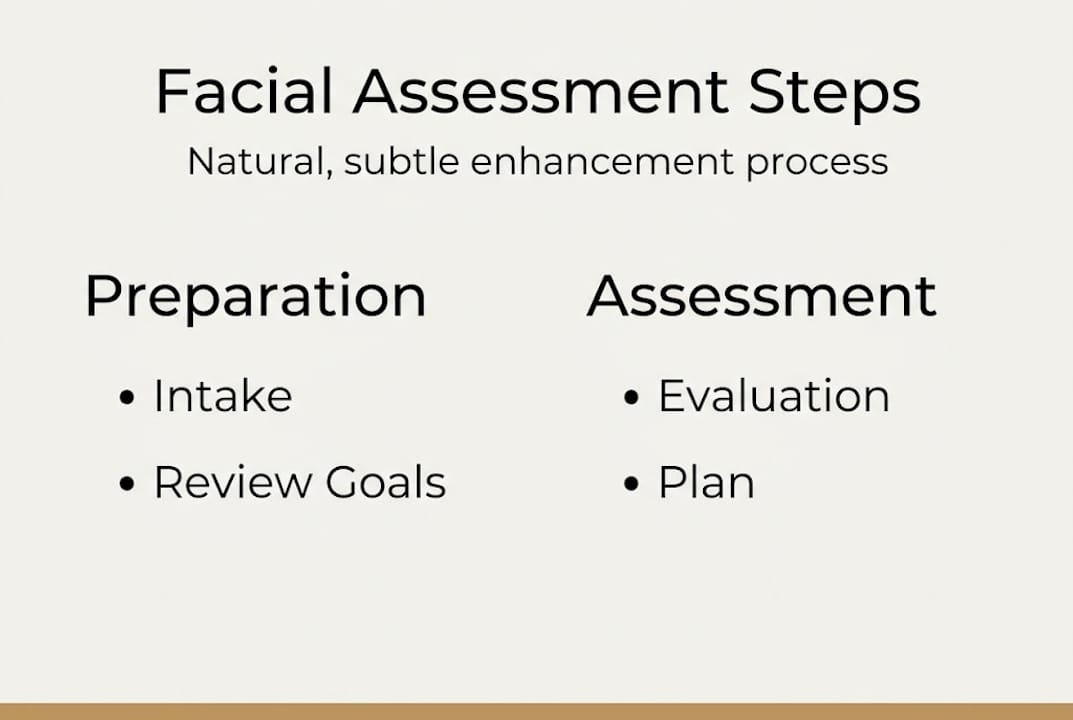
This is where the evaluation becomes active. Your provider moves through a structured sequence, examining your face from multiple angles and using both clinical skill and technology to gather precise data. Here is how that process typically unfolds:
- General inspection at rest and in motion, reviewing skin quality, tone, texture, and overall facial balance
- Palpation to assess tissue quality, fat pad distribution, and bone structure beneath the surface
- Phototype and photodamage review to identify sun damage, pigmentation patterns, and skin aging markers
- Instrumental measurements using tools that measure hydration levels, sebum production, and skin pH for objective data
- Dynamic and asymmetry review where you are asked to smile, raise your brows, and move naturally so the provider sees how your face behaves in motion
- Panfacial evaluation that considers the entire face together, not just the area of concern
The VISIA complexion imaging system is one tool that supports this stage, capturing UV damage, pore patterns, and texture data that the naked eye can miss. Technology like this supplements clinical judgment. It does not replace it.
| Modern scale frameworks | Traditional checklists |
|---|---|
| Patient-centered, culturally aware | Often Western-centric |
| Dynamic and static evaluation | Primarily static review |
| Five-domain panfacial structure | Single-concern focus |
| Validated for diverse populations | Limited diversity data |
The Galderma FASTM scale offers a five-domain framework that is patient-centered and culturally aware, a meaningful improvement over older approaches. Photonumeric scales are also highly reliable for non-surgical assessment, giving providers a consistent reference point across appointments.
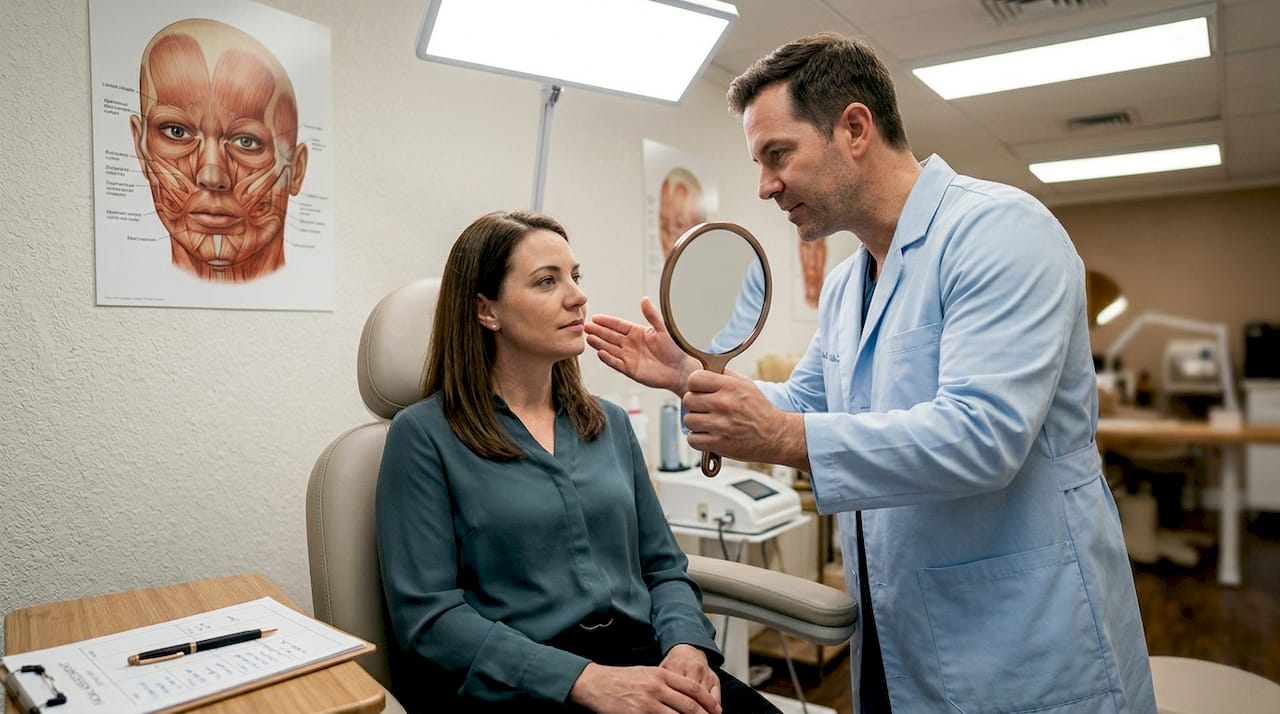
Pro Tip: Ask your provider to walk you through what they see in real time using a mirror. Understanding your own anatomy makes it easier to align on priorities and feel confident in the plan.
With the hands-on and technology-assisted assessment complete, the next step is interpreting those findings and building your customized plan.
Interpreting results and creating your personalized plan
Once the assessment is done, your provider translates findings into a clear, stepwise set of recommendations. This is where the data becomes direction. Each finding maps to a specific area of focus, and the plan is built around what your face actually needs, not a general protocol.
| Assessment finding | Recommended focus |
|---|---|
| Dehydrated skin with fine surface lines | Hydration-focused skincare, possible biostimulator |
| Mid-face volume deficit | Conservative filler placement, structural support |
| Uneven skin tone, UV damage | Laser or light-based treatment, medical-grade SPF |
| Brow heaviness with upper lid fullness | Toxin placement for lift, not just wrinkle reduction |
| Early jowling with jawline softening | Lower face contouring, collagen stimulation |
The facial rejuvenation process is never a single appointment. It is iterative. Your plan may start with skin health before any injectables are introduced, because a well-supported skin foundation makes every other treatment perform better.
Tracking subtle changes matters too. Here is how providers and clients monitor progress over time:
- Standardized before and after photography taken at the same angle and lighting
- Validated scoring scales re-applied at follow-up appointments
- Instrumental re-measurement of hydration and skin quality metrics
- Client self-assessment using structured prompts, not just mirror impressions
“Facial age models let you track what matters, not just your calendar age.”
Multiethnic facial age models predict facial age independent of ethnicity or phototype, giving providers a reliable benchmark that is not skewed by background. That means your progress is measured on terms that are fair and specific to you. Exploring the full range of treatment types available helps you understand how each option fits into a longer strategy rather than a one-time fix.
Why panfacial, patient-centered assessment beats one-size-fits-all
Here is something worth saying plainly: every face has asymmetry. Every face ages according to its own pattern, shaped by genetics, lifestyle, bone structure, and ethnicity. A provider who treats a concern in isolation, without understanding how it connects to the rest of the face, is working with incomplete information.
One-size-fits-all templates exist because they are efficient. But efficiency is not the goal when the outcome needs to look like you. Holistic assessment respects the individuality of your face, including how your features relate to each other, how your skin has aged, and what subtle shifts will create the most natural improvement.
Technology is a valuable tool in this process. But it is a tool. The interpretation, the communication, and the final judgment still belong to a skilled, experienced provider. Panfacial anatomy insights reinforce why treating the face as a connected system, not a collection of isolated concerns, leads to results that hold up over time.
“Natural results come from treating the face as a whole, not chasing perfection in isolation.”
Pro Tip: Ask your provider not just what they recommend, but why. A confident, medically grounded provider will always have a clear anatomical reason for every suggestion.
Connect with medically led facial assessment experts in Raleigh
You have just walked through the full arc of a medically guided facial assessment, from intake to personalized plan. Now the question is: who is guiding yours?
At The Aesthetics Lounge and Spa Raleigh, every assessment is led by medical expertise, paced thoughtfully, and built around your anatomy and goals. We do not follow templates. We follow your face. Whether you are exploring Raleigh aesthetics treatments for the first time or refining an existing plan, our team is here to make the process feel clear and calm. Learn more about the benefits of a medically led spa and what sets this approach apart, or revisit the full facial rejuvenation process to see how each step connects. Book your assessment and start with a plan that is truly yours.
Frequently asked questions
How long does a full facial assessment take?
A full, medically guided facial assessment usually takes 30 to 60 minutes, depending on your medical history and goals. The assessment process includes history review, clinical examination, and instrumental testing, all of which take time to do well.
Is the process painful or invasive?
Modern assessments are non-invasive and typically painless, focusing on external evaluation and gentle imaging tools. Non-surgical assessments use inspection, palpation, and imaging without any needles or discomfort.
Will the assessment consider my cultural or personal beauty ideals?
Yes, newer frameworks like the Galderma FASTM scale specifically account for a range of cultural and personal ideals, moving well beyond older Western-centric standards.
How often should I have a facial assessment?
Annual reassessments are best for most adults, or after major life or health changes, to keep results natural and current. Facial age benchmarks offer reliable, repeatable tracking so your plan evolves as your face does.