
TL;DR:
- Movement-friendly fillers are softer, more elastic products designed for natural facial movement.
- Proper placement techniques and anatomical understanding are essential for natural, expressive results.
- Matching filler type and technique to facial regions ensures support without restricting movement.
You’ve seen it before. Someone smiles and something looks slightly off. Not dramatic, not frozen exactly, but stiff. Like their face and their filler aren’t quite moving together. That disconnect is one of the most common concerns we hear from clients who are curious about injectables but cautious about looking overdone. The good news is that the field has evolved significantly. Movement-friendly filler techniques now make it possible to add subtle volume and support without sacrificing the expressiveness that makes your face distinctly yours. This article walks you through what that means, why it matters, and how to make informed choices.
Table of Contents
- Why traditional fillers can look unnatural in motion
- What makes a filler movement-friendly?
- How movement-friendly fillers are placed for natural results
- Choosing the right option for expressive areas
- Our take: The real secret to natural-looking, lasting results
- Next steps: Explore movement-friendly treatments in Raleigh
- Frequently asked questions
Key Takeaways
| Point | Details |
|---|---|
| Natural movement matters | Movement-friendly fillers are designed to shift and flex with your expressions for subtle, believable results. |
| Technique is crucial | Proper layering and placement are key for maximizing the benefits and longevity of movement-friendly fillers. |
| Choose the right filler | Not all fillers are created equal—select a product and approach matched to expressive areas and your unique goals. |
| Medical guidance helps | Expert consultation ensures your results look natural in motion and respect your facial structure. |
Why traditional fillers can look unnatural in motion
Most dermal fillers are made from hyaluronic acid, a substance your body already produces naturally. HA fillers work by attracting water molecules and adding volume beneath the skin. They were originally designed to restore static volume loss, things like hollowed cheeks or thinning lips at rest. And for those goals, they work well.
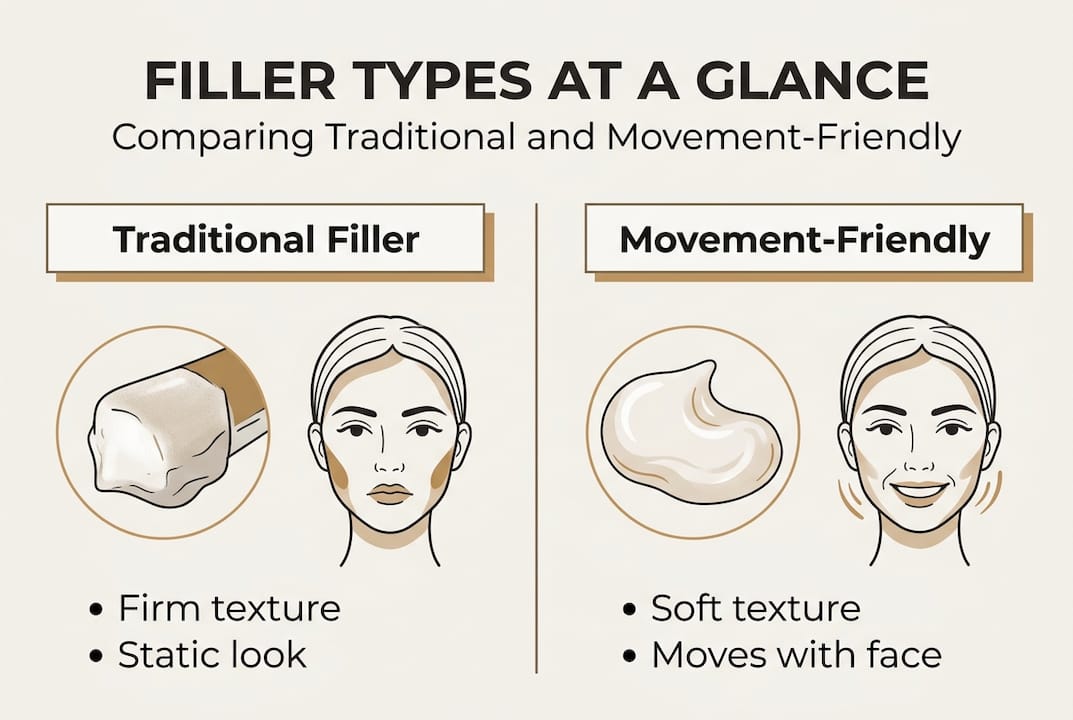
The challenge arises in motion. Traditional HA fillers like Juvederm are formulated with firmer gels that hold their shape well for static volume but can feel or appear stiffer when your face is actively moving. When you smile, laugh, or speak, your face moves in complex, layered ways. If a filler doesn’t flex with that movement, it can create a subtle but noticeable resistance.
“The goal of any filler treatment should be to support the face as it moves, not to hold it in place.”
Some of the areas most affected by this include:
- Smile lines (nasolabial folds): Filler placed too superficially or in too firm a product can bunch or look uneven when smiling.
- Lips: Overly firm product in the lip body can restrict natural movement during speech and expression.
- Cheeks in motion: Volume placed without accounting for how the cheek lifts and shifts during a smile can look displaced or heavy.
- Perioral area: The skin around the mouth is highly dynamic and unforgiving of stiff product.
Growing patient demand is also reshaping what providers prioritize. More people seeking injectables for natural results are asking specifically about how their face will look in conversation, not just in a still photo. That shift in expectation is driving more nuanced approaches to both product selection and technique. You can also explore subtle enhancement examples to understand what thoughtful, expressive results actually look like in practice.
The result is a growing category of approaches collectively called movement-friendly filler, which we’ll break down next.
What makes a filler movement-friendly?
Not every filler is built the same. Movement-friendly filler refers to products and techniques specifically chosen for their ability to integrate with tissue and remain flexible during facial expression. It’s less a brand name and more a philosophy of matching product properties to the demands of dynamic facial areas.
Several characteristics define a movement-friendly approach:
- Lower viscosity: Softer, more fluid gels integrate more naturally with surrounding tissue and flex rather than resist.
- High elasticity: Products with good elastic recoil return to their shape after movement without creating visible distortion.
- Tissue integration: Fillers that blend well with native tissue feel and move more like your own anatomy.
- Appropriate placement depth: Even the right product performs poorly if placed at the wrong depth.
Product choice and placement technique work together. As multilayering injection research shows, injecting into superficial dynamic fat layers using fanning, linear threading, or cannula techniques respects the distinction between deep static compartments and superficial dynamic ones. That distinction is what allows the face to move freely while still benefiting from added support.
| Filler property | Traditional HA | Movement-friendly HA |
|---|---|---|
| Viscosity | Higher (firmer) | Lower (softer) |
| Elasticity | Moderate | High |
| Best use | Static volume, structure | Dynamic areas, expression |
| Tissue integration | Good at depth | Excellent in superficial layers |
Common products used in movement-friendly approaches include softer HA formulations like Juvederm Volbella, Restylane Silk, and Belotero Balance. These are not the firmest products in their respective lines. They are chosen specifically because their physical properties support flexibility.
Pro Tip: Ask your provider which specific product they plan to use and why. A thoughtful answer about viscosity, elasticity, and placement depth signals that they are treating your face as a dynamic system, not a static canvas.
Understanding filler types compared side by side can help you have a more informed conversation before your appointment. You can also learn more about injectables in aesthetics to understand how these products fit into a broader treatment strategy.
How movement-friendly fillers are placed for natural results
Product selection is only half the equation. How filler is placed determines whether it supports natural movement or works against it. Advanced injection technique is what separates a result that reads as rested from one that reads as treated.
Three primary techniques are commonly used in movement-friendly approaches:
- Linear threading: The needle or cannula is inserted and filler is deposited in a line as it is withdrawn, creating smooth, even distribution along a natural contour.
- Fanning: Multiple threads are placed from a single entry point, spreading product across a wider area with minimal trauma and even coverage.
- Cannula technique: A blunt-tipped cannula reduces the risk of vascular injury and allows smooth, controlled placement in superficial layers where dynamic movement occurs.
Layering is equally important. Multilayering technique respects the difference between deep static compartments, which provide structural support, and superficial dynamic compartments, which move with expression. Placing product at multiple depths allows the face to retain both lift and mobility.
Anatomical knowledge is non-negotiable here. Providers who understand how fat pads shift during a smile, how the orbicularis muscle moves around the mouth, and how the cheek elevates during expression can plan placement that works with those patterns rather than against them.

| Technique | Best for | Key benefit |
|---|---|---|
| Linear threading | Lips, fine lines | Smooth, even distribution |
| Fanning | Cheeks, temples | Wide coverage, minimal entry points |
| Cannula | Perioral, under-eye | Safety, smooth superficial placement |
Pro Tip: Ask whether your provider uses cannulas for dynamic areas. Cannulas allow more precise, atraumatic placement in the superficial layers where movement-friendly results happen.
Exploring Raleigh dermal fillers with a medically led team ensures these techniques are applied with appropriate anatomical understanding. And if you’re still weighing your options, guidance on choosing injectables naturally can help you feel confident before committing.
Choosing the right option for expressive areas
Not every area of the face has the same movement demands. Matching your filler choice to the specific region and your personal goals is where personalized planning becomes essential.
Facial regions that benefit most from movement-friendly approaches include:
- Around the mouth: Perioral lines and lip borders require soft, flexible product that won’t restrict speech or create visible stiffness.
- Cheeks: The midface moves significantly during smiling. Product placed here needs to lift without displacing or looking heavy in motion.
- Under the eyes: The tear trough area is delicate and visible during expression. Softer, well-integrated product avoids the Tyndall effect and looks natural in all lighting.
- Crow’s feet and eye area: These regions require minimal product with high tissue integration.
When comparing your options, it helps to understand the broader category of fillers available. Biostimulatory options like Radiesse and Sculptra stimulate your own collagen production over time, offering longevity. However, as liquid lift research notes, these options provide less immediate dynamic flexibility compared to soft HA fillers, and diluted techniques, while reducing the risk of lumps, tend to have a shorter duration.
Key factors to weigh when planning your treatment:
- Longevity vs. flexibility: Firmer, longer-lasting products may suit structural areas. Softer products suit expressive zones.
- Your treatment goals: Subtle refresh or more noticeable volume restoration will guide product and volume decisions.
- Budget and maintenance: Softer fillers in dynamic areas may need refreshing sooner, typically every 6 to 12 months.
- Safety profile: Cannula techniques and anatomically informed placement reduce risk in vascular areas.
Medical guidance is not optional in this process. A provider who reviews your facial anatomy, your movement patterns, and your long-term goals before recommending a product is the kind of partner you want. Explore Xeomin and filler solutions to understand how neuromodulators can complement filler for a balanced, expressive result. You can also browse the full injectables archive to see what thoughtful planning looks like in practice.
Our take: The real secret to natural-looking, lasting results
Here is something that often gets lost in conversations about filler brands and product lines: movement-friendly results are not primarily about which product you choose. They are about how well your provider understands your face as a living, moving structure.
The most common cause of overdone or stiff-looking filler is not over-filling alone. It is ignoring natural motion patterns. A provider who places product without accounting for how your cheek shifts when you smile, or how your lips move when you speak, will produce results that look fine in a mirror but feel wrong in conversation.
True artistry here is anatomical. It requires studying the face in motion, not just at rest. The best outcomes we see come from providers who treat the face like a dynamic canvas, layering product thoughtfully across depths, choosing flexibility over volume when the area demands it, and pacing treatment over time rather than loading product in a single session.
One-size-fits-all approaches simply do not work for expressive faces. Seek out natural aesthetic examples and ask your provider how they plan for movement specifically. That question alone will tell you a great deal about their approach.
Next steps: Explore movement-friendly treatments in Raleigh
If this article has clarified what movement-friendly filler actually means, the next step is experiencing that approach in person. At The Aesthetics Lounge and Spa Raleigh, every injectable consultation begins with a conversation about your anatomy, your goals, and how your face moves. We plan before we treat.
Our team on Six Forks Road specializes in medically led, conservative Raleigh aesthetics treatments designed to support your face over time, not transform it overnight. Whether you are exploring fillers for the first time or reassessing a previous experience, we offer clear guidance and unhurried appointments. Learn how to choose treatments naturally or go deeper into what dermal fillers can realistically offer. We are here when you are ready.
Frequently asked questions
What is a movement-friendly filler in cosmetic treatments?
Movement-friendly fillers are soft, flexible products placed in superficial dynamic layers using techniques like cannula or fanning, so they integrate with tissue and flex naturally during facial expression rather than creating visible resistance.
Are movement-friendly fillers suitable for all areas of the face?
They are best suited for dynamic regions like the mouth, cheeks, and under-eye area. Firmer areas needing structural support, such as the jawline or chin, may benefit from denser HA formulations that hold shape more reliably at rest.
How long do movement-friendly fillers typically last?
Most last 6 to 12 months depending on product softness, placement depth, and your metabolism. Diluted techniques that reduce lumpiness in dynamic areas tend toward the shorter end of that range.
What is the difference between traditional and movement-friendly fillers?
Traditional HA fillers use firmer gels optimized for static volume and structural lift, while movement-friendly fillers use softer, more elastic formulations placed in superficial dynamic layers to maintain flexibility during expression.